If someone forwarded you this email you can subscribe. View in web browser.

A faster, cleaner openDemocracy is on the way.

Over the next few weeks, you’ll notice some exciting changes to our website and the newsletters landing in your inbox.

As a reader-funded newsroom, we are always looking for ways to improve how we deliver our journalism to you. We are upgrading our platforms to give you a faster, cleaner reading experience that makes it easier to read, share, and support the investigations that matter.

While we make the switch, things might look a little different, but our commitment to fearless, independent reporting remains exactly the same.

If you spot a glitch or have any questions during the transition, our inbox is always open: supporters@opendemocracy.net

Hi ,

Agents linked to the Kremlin ‘paid’ for fake news – by fake authors – to be published by Argentine press. Why? To influence Argentinia's election. 

These agents were a part of a propaganda network known as ‘the Company’. They spent much of 2024 working to undermine Milei’s government and further divide Argentina’s already polarised society.

Read more below.

- openDemocracy

 
EDITOR'S PICKS
 
1
Gurr-boss: Inside ex-Amazon exec’s appointment to UK competition watchdog

Yes, new CMA chair Doug Gurr has downplayed links to Big Tech. But that’s not why experts are worried Read more... 

2
‘Labour-specialist’ lobbying firm with close ties to No10 revs up business

Having helped get the party elected, Anacta Strategies now helps its clients get what they want from Starmer's Labour government Read more... 

3
PODCAST | The AI Panopticon: How Big Tech and the State are Watching You

"My ultimate vision... was to achieve by means of AI and technology, what Jeremy Bentham tried to do with his panopticon." — UK Home Secretary Shabana Mahmood.

When the state openly admits it wants its eyes on you at all times, how do citizens fight back? Spotify | Apple


FEATURED STORY

Fake authors, fake stories: Inside the Russian campaign to influence Argentina's election

Diana Cariboni

Russian agents linked to the Kremlin spent much of 2024 working on secretive operations to infiltrate Argentina’s media to discredit the country’s new far-right libertarian president, Javier Milei, according to leaked documents seen by openDemocracy.

In the run-up to his election victory in December 2023, Milei began seeking favour with Joe Biden’s administration in the US. While the pair were unlikely to see eye to eye on Milei’s domestic politics – he famously appeared on stage brandishing the chainsaw he was going to use to “destroy the state from within” – Milei adopted US-friendly geopolitical positions, including support for Ukraine, even inviting Ukraine’s President Volodymyr Zelensky to his inauguration and hosting him in the presidential palace.

This support appears to have ruffled feathers in Moscow. A propaganda network backed by Russian foreign intelligence and internally known as ‘the Company’ began working to undermine Milei’s government and further divide Argentina’s already polarised society, according to a tranche of Russian-language documents obtained by The Continent, an African news outlet, and shared with a consortium of investigative newsrooms including openDemocracy, Dossier Center, iStories, All Eyes on Wagner, and Forbidden Stories.

The documents offer exclusive and unprecedented details of the operations and activities that the Kremlin’s agents at ‘the Company’ carried out in more than 30 countries across South America and Africa between February and November 2024.

 
SUPPORT OUR INVESTIGATIONS INTO THE MILITARY INDUSTRIAL COMPLEX
 
When I saw that the UK government had seconded an official to work with Rothschild & Co on defence policy, all paid for by you and me, I knew this was something I had to look into. The revolving door between government, private finance and lobbying firms needs to be exposed if we are to understand how money and power work in our politics. Nowhere is this more urgent than on questions of defence and national security, at a time when the government is investing more and more of taxpayers’ money on rearming Britain.
 
You can help keep me on this beat, as I dig into the contracts and cosy relationships between Labour, defence, and big finance. Will you donate to support my work today?
Please donate now
 

These include commissioning surveys and polls and assembling briefings on subjects as varied as Argentina’s military-industrial complex, oil resources in the Antarctic, profiles of political leaders, political parties and worker unions and “expert interviews” with “politicians, opposition political scientists and economists”.

The Company even made plans to support opposition candidates in Argentina’s 2025 mid-term legislative elections.

Its most intensive campaign, though, involved creating “a network for the distribution of media content in Argentine mass media and the local segment of social networks”.

openDemocracy has identified at least 250 pieces of content – news, analyses and opinion pieces – that the Russians claimed to have placed in more than 20 online Argentinian news outlets from June to October 2024.

While the Company budgeted more than $280,300 for this content, we have been unable to verify whether the payments were made, and if so, whether they were made to the media, journalists or third parties. The comparatively large figures for Argentina’s cash-strapped media suggest that the Russian agents may have inflated the amount of money required to their superiors in St Petersburg.

The documents also provide clear links between the ‘The Company’, the Russian Foreign Intelligence SVR, and the Wagner group of the late oligarch and mercenary Yevgeny Prigozhin, as laid out in a previous openDemocracy investigation, which revealed how the Kremlin-backed ‘Company’s’ agents tried to prop up former President Luis Arce’s faltering government in Bolivia.

The Company’s existence in Argentina was first publicly confirmed in a speech by Milei’s spokesperson in October 2025. Its operations, the spokesperson said, included disseminating content in social media, influencing local civil organisations, foundations, and NGOs, conducting focus groups with Argentine citizens, and gathering political information to be used in favour of Russian interests.

“This is the declassified portion of the information,” the spokesperson said, “Of course, there's a whole lot of classified information, which is a state secret.”

Now, for the first time, openDemocracy and its investigative partners are able to shed more light on the Russian operations.

Fake fees

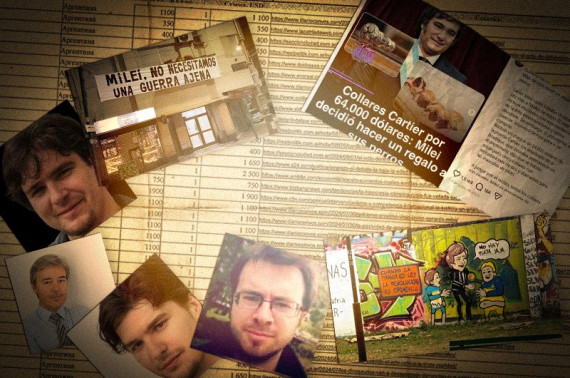
In October 2024, an author called Manuel Godsin published a story about universities protesting Milei’s budget cuts for the Realpolitik news site. It was a topic relevant to his interests; the biography at the end of the piece says Godsin has a PhD from the University of Bergen and is a member of a Centre for Political and Strategic Studies.

What the editors at Realpolitik failed to notice, though, is that Godsin doesn’t exist.

His face belongs to a Russian man named Mikhail Malyarov, as was revealed by Africa Confidential last year and corroborated by an investigation by Code for Africa published last month, which found that Godsin is a “fictitious identity”, created to “whitewash Russian narratives in the mainstream media” using content generated by ChatGPT.

openDemocracy found that Godsin’s article is one of 20 published by Realpolitik that appears in the Russian files. Our analysis of the documents reveals the Russians reported paying $11,000, or $550 a piece, to host the articles on Realpolitik. The site’s director, Santiago Sautel, told openDemocracy he had not received any payments for carrying these articles, and that he didn’t know any of the authors of the 20 pieces.

“We publish opinion pieces all the time,” Sautel said. “We do not know the origin of these particular ones. We can confirm, however, that they were not the result of any underhanded manoeuvre hatched behind closed doors at a diplomatic mission. And if any of these pieces were orchestrated in the shadows to serve a specific agenda, we are unaware of it.”
 
Is MAGA a religion? Why has protest been criminalised in England and Wales? Who is profiting from anti-immigration sentiment? And how can we engage with young men who’ve fallen down the alt-right pipeline? 
 
These are just a few of the questions that we’ve put to leading thinkers, frontline activists, and global experts on our new podcast, In Solidarity, over the past six months.
 
In Solidarity is a podcast for people who understand that politics doesn’t just happen in the halls of power. Every show, we tackle a new theme to uncover how authoritarianism spreads, who is benefiting from fear, and how solidarity is evolving into resistance movements around the world.
 
To ensure you never miss an episode of In Solidarity, subscribe to get an email notification whenever a new one is released. 
Subscribe to episode notifications
 

Realpolitik was far from the only Argentine digital outlet fooled by the agents – we have confirmed that more than 20 outlets with differing audiences, resources and political outlooks published their articles. For the most part, this content was not unlike the day-to-day coverage of news and critical commentary about the state of the economy and the increased diplomatic tensions with progressive governments in the region.

Yet our analysis of the articles and the Company’s corresponding documents reveals they were unusual in two key ways. First, many of the pieces contained references favourable to Russia and critical of the US, as well as distortions, exaggerations and fake news.

Secondly, they were extortionate – if the Russian documents are to be believed. The Company reported spending between $350 and $3,100 on each article, figures that were shocking to Argentinian media representatives we spoke with; journalists in the country typically earn less than $700 a month. Our analysis indicates the payments must have been inflated in the documents, which were written for the agents’ superiors.

openDemocracy, Forbidden Stories and Filtraleaks, which partnered for this investigation, contacted all the media outlets mentioned in the documents and interviewed editors, directors or journalists from 15 of them. Many asked not to be identified.

Two sources told us that they had been paid for publishing some of the articles, but that the payments were far lower than those recorded in the documents. Both were approached by the same intermediary, who gave them different, yet similar, accounts of the origin of the articles and the money: a group of Argentine businesspeople concerned at the state of national industry, or angry at Milei’s cuts to public works budgets.

openDemocracy’s analysis of the leaked documents indicates the Russian agents attempted to exaggerate the scope of their operations in other ways, too, with some of the articles’ URLs listed twice in their spreadsheets.

All of the Argentine journalists we spoke to denied any involvement with the Company or any associated Russian influence campaigns. Most said the articles they’d published had been provided for free by a third party, described as a “news agency”, “consultant” or “intermediary”, but could not name the agency in question. Several admitted that the articles were published without much editorial oversight, and said they did not know the authors of the pieces.

Our interviews with the media representatives reveal the Russian disinformation operation in Argentina exploited an increasingly common global practice: PR agencies offer free or paid content to resource-strapped newsrooms to gain client visibility. Although media standards require that such arrangements be disclosed, this often does not happen. Our conversations with editors and journalists in Argentina indicate this may have been the case.

openDemocracy made contact with one such intermediary, who said he provided editing services for some of the articles mentioned in the documents and was paid the market rate. The intermediary expressed surprise that these articles were part of a Russian influence operation. He noted that editing was a legitimate profession.

“It is possible, but uncommon, for a journalist to publish content without their editor's knowledge; but if it is true that this network paid to place more than 250 articles, it is very unlikely that no editor any outlet did not know about this,” Martín Becerra, media expert and researcher of the National Scientific and Technical Research Council (CONICET) told openDemocracy.

“The increasing precariousness of the media, the excessive relaxation of editorial oversight create an environment conducive to disinformation campaigns and manipulative operations of all kinds and stripes,” he added.

In their press conference in October 2025, the Argentinian authorities identified two Russian citizens, Lev Konstantinovich Andriashvili and his wife Irina Yakovenko, as key members of the disinformation campaign...

You can read the rest of this investigation here.


COMMENTS

Sign in 💬

Our award-winning journalists can now respond directly to your comments underneath the articles on our site!

Just sign in or register underneath any of our articles to start leaving your thoughts and questions today.

Sign in and join the conversation

MORE FROM OPENDEMOCRACY

Weekly Newsletter
The Dark Arts
Bluesky Facebook X / Twitter Mastodon Instagram YouTube


openDemocracy, 18 Ashwin Street London, E8 3DL United Kingdom

Unsubscribe