Schäuble himself, as described by journalist Gunter Hofmann, who has observed West German politics for Die Zeit since the 1970s, was only dissuaded from his German-nationalist path by Lamers in the first place – Europe was in motion, history was becoming reality. The question now was how history and the present could be brought into a constructive relationship. The question was also – and this reflects how what happened in Europe mirrored what happened in Germany – how the old and the new could be combined in such a way that the old would also change, that something new would emerge. To put it concretely: If the West were to transform, was there a chance that this moment could be seized as a productive turning point to create something new together? Or, as the Bulgarian political scientist Ivan Krastev put it: How could “imitation poisoning” be avoided?
Schäuble and Lamers’ initiative was retrospective in its approach, but viewed from today’s perspective, it was also forward-looking. Their aim, for instance, was to strengthen the “Union’s capacity for action in foreign and security policy” after the end of the Cold War – implicitly, Schäuble and Lamers called for a joint European army, which is still lacking today and whose formation French President Emmanuel Macron, for example, sought to advance repeatedly in 2018 and thereafter. Schäuble and Lamers also proposed “transforming NATO into a balanced alliance between the US and Canada and Europe as a capable unit” – instead, Europe remains dependent on both the US and NATO, which in turn threatens to become a fragile entity in times of political radicalisation in the US.
Chancellor Helmut Kohl, who saw Schäuble as a rival for power, remained opposed to the initiative; Germany, in general, has remained effectively passive in the decades since: both Angela Merkel and Olaf Scholz lacked the drive that was present on various sides in the 1990s. It was significant that no decision was reached at the time, nor was any initiative launched at the European level. Thus, Europe’s inability to act in the military sphere dragged on through the decades, from the lack of engagement in the wars in the former Yugoslavia, through the absence of a European initiative in Syria in the years since 2011, to Russia’s invasion of Ukraine in 2022, to which Europe had no response of its own.
Even a full-scale crisis like the European debt crisis or the war in Ukraine has not led to a rethinking of the fundamental principles of the European order. One of the concerns in the 1990s was that the EU’s eastward expansion could primarily lead to an increase in German power, which was one of the reasons for the rejection of the Schäuble-Lamers paper. Ultimately, however, this is exactly what happened, as became evident in the aftermath of the 2008 economic and financial crisis. Germany dominated politics during the European debt crisis; the media, in Germany as in other European countries, became more nationalistic, and so did politics. A process of disengagement accelerated, leading to a situation where it is unclear today whether the EU is more of a vehicle for progress or an instrument of reaction. Even far-right parties can now be in favour of Europe – provided it is a white, Christian, homogeneous Europe, a bastion of civilisation against a world full of barbarians.
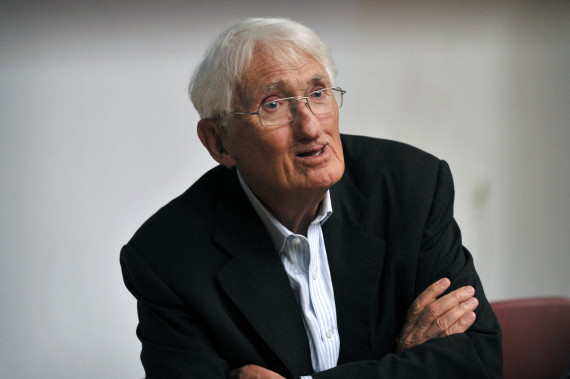
A particularly clear voice in these debates was the philosopher Jürgen Habermas, who, for Germany, used the term “constitutional patriotism” – coined by Dolf Sternberger – to define a postnational identity; he played the role of a progressive oracle whose positions remained fairly consistent over the years and, viewed from today’s perspective, are characterised by a steadfast rationality. Habermas intervened repeatedly in the debate on Europe and Core Europe, especially toward the end of the decade, with a series of texts, initially taking a decidedly opposing stance to the federal alliance envisioned by Schäuble and Lamers. Habermas sought, as he put it, an “alternative to the artificial cheerfulness” of a neoliberal politics that is “winding itself down,” he wrote in 1998 in The Postnational Constellation and the Future of Democracy – the aim, he argued, was “to find forms suitable for the democratic process even beyond the nation-state.”
What he actually said: Europe needs a constitution; it needs a European constitutional patriotism and must transform itself into a European nation-state – a European nation-state as an emancipatory necessity, for only within this framework can the crucial social, economic, and security policy issues be resolved; only it is capable of acting effectively. Yet, according to Habermas, there was a lack of will and imagination: “Because the idea that a society can democratically influence itself has so far only been credibly implemented within a national framework, the post-national constellation evokes that restrained alarmism of enlightened helplessness that we observe in our political arenas.”
Perhaps nothing describes the years since 1989 in Europe better than this phrase: enlightened helplessness. It seemed, Habermas argues, that the nation’s cohesive power had dissolved into history. For him, it was thus clear in which direction European unification had to be driven – and between deepening and expanding the Union, democratic momentum faltered.
In his writings from the late 1990s, such as The European Nation-State Under the Pressure of Globalisation, Jürgen Habermas outlined the disempowerment of nation-states in this new era with great precision and advocated for a decisive step toward post-nationality – that is, an understanding of how new forms of legitimacy and identity can be created. He saw in the European Union the possibility of the “first form of a post-national democracy” – but for this to happen, he argued, the Union must “shift from its current foundation of international treaties to a charter in the manner of a constitution.” In other words: Without a European constitution, there is no European identity, no European capacity for action, no European politics. Thus, the fundamental elements that constitute a democracy are still missing from the construction of Europe today.
Habermas formulated very precisely how a European democracy could emerge: The process of legitimisation must “be supported by a European party system, which can only take shape to the extent that existing political parties first debate the future of Europe in their national arenas and thereby articulate cross-border interests. This discussion, in turn, must resonate within a Europe-wide political public sphere, which in turn presupposes a European civil society comprising interest groups, non-governmental organisations, civic movements, and so on. However, transnational mass media can only establish such a multilingual communicative context if, as is already the case today in smaller nations, national education systems provide a common (foreign) language foundation. Ultimately, there will be no normative driving forces to simultaneously set these various processes in motion from the scattered national centres without overlapping projects for a common political culture.”
So where is the European public sphere? Where is European civil society? Where are the European media that could create a European public sphere? Where is a “shared practice of opinion-forming and decision-making that draws its nourishment from the roots of a European civil society,” as Jürgen Habermas put it? Is there a European people? And if not, how is a European democracy supposed to function? The crucial political questions on the path to genuine European unification were posed in the 1990s – and left unanswered.
In later writings, Jürgen Habermas shifted his focus slightly and, much like Schäuble and Lamers, saw the need for a “core Europe” that should take the lead in a “symbolically powerful foreign and security policy.” Together with Jacques Derrida, Habermas advocated for a “rebirth of Europe” in a 2003 newspaper article – inspired by the experiences of Europe’s military weakness during the Balkan wars and the global protests against the US invasion of Iraq. Habermas, too, now saw that Germany and France should drive this European project forward, in what he called a “locomotive consensus”.
But this consensus was lacking here, just as it was on major economic and social policy issues – economic union was not followed by social union, which has led to massive social imbalance and understandable dissatisfaction. “Many people simply ask themselves: What’s in it for me?” Habermas summed it up in the late 1990s as follows: The social policy damage caused by a race to deregulate among national “locations” under the “seemingly apolitical supervision of a central bank” can only be avoided “if the common European monetary policy is supplemented by a common tax, social, and economic policy that is strong enough to prevent national unilateral actions with negative spillover effects.”
But national unilateral actions are exactly what we have today. That was the case during the EU debt crisis, it is the case today in migration and asylum policy, and it is the case in security and military policy. There is no discernible path toward realising a Union as Jürgen Habermas envisioned it in the 1990s. Nor are there any strong ideas in sight, no political visions, no intellectual initiatives, as there were at least in the 1990s. Europe is a form without content. The 1990s were an exciting, promising, yet lost decade for Europe; the decades since have been lost as well.