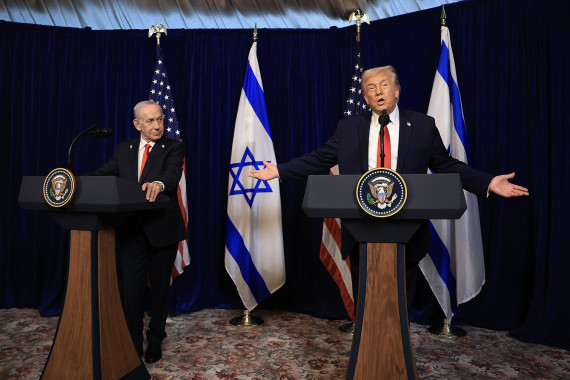
The war has spread rapidly across the region over the past three weeks, and Netanyahu this week suggested a need for ground troops in Iran. Yet despite Israel’s central role in the Iran War and its deadly actions in Lebanon and the Occupied West Bank, Western media attention is heavily focused on Trump.
This may in part be down to the US president’s personal attention-seeking, but it is a mistake. Netanyahu started this war, and the Israeli attack on Iran’s South Pars Gas Field earlier this week will most likely prolong it.
As I wrote last week, Netanyahu is highly unlikely to entertain any deal with Tehran short of total Iranian surrender. Israel must achieve regime termination and full control of Iran, extending to the detailed long-term oversight of its post-war military capabilities, especially on nuclear weapons development. Anything less would allow any post-war surviving power base to prioritise the development of a crude nuclear capability.
That means any chance of an early end to the war will depend on the US and Trump’s position, where an element of political uncertainty is emerging.
For a start, there is now a deep reluctance among the US’s Western allies to become more involved in the war. Trump’s evident disapproval will cut little ice with leaders horrified at the unfolding global economic disorder, particularly with older politicians still harbouring distant memories of the 1973/74 oil price crisis. In the UK, it has already been forecast that the war will lead to a £330 increase in typical annual household energy bills, according to a new calculation from energy consultancy Cornwall Insight.
Two further developments this week are relevant and help to undermine Trump’s position.
The first is that the US and Iran were reportedly engaged in negotiations to avoid an escalation to the conflict when Netanyahu precipitated the war. A participant in the talks was Britain’s national security adviser, Jonathan Powell, who was said to be surprised at the extent of the Iranian offer and felt a deal was in sight.
The Guardian reported: “Two days after the talks ended, and after a date had been agreed for a further round of technical talks in Vienna, the US and Israel launched the attack on Iran.”
The other development is the sudden resignation of Joe Kent – formerly seen as a Trump loyalist – from his post as director of the US National Terrorism Centre. Writing on X this week, Kent said he could not “in good conscience support the ongoing war in Iran” because Iran posed “no imminent threat to our nation.”
Trump’s core domestic support base – around 30% of voters – is still holding reasonably firm, especially among MAGA Republicans, but his popularity is slipping among the general public. His net approval on a three-week moving average has hovered around -16 to -18 over the past six months, down from 2 this time last year.