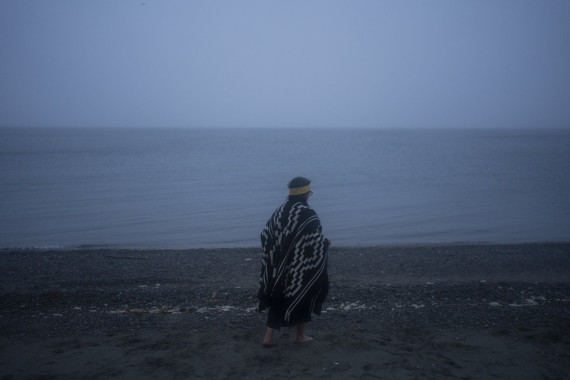
Caro and her community, Grupos Familiares Nómades del Mar, live in the Kawésqar National Park. At 2.8 million hectares, the park is the second-largest protected area in Chile – but this doesn’t protect it from the salmon industry. Salmoneras are allowed within national parks, despite widespread scientific evidence on the environmental damage they cause. For this reason, Caro’s community and two others are applying for the creation of a 300,000-hectare Indigenous Peoples’ Coastal Marine Area (ECMPO).
ECMPOs were established by Law 20249 – known as Lafkenche law, after the Mapuche communities who inhabit coastal areas in southern-central Chile – in 2008. They are a powerful tool to help Indigenous communities protect specific maritime and coastal areas, and their traditional practices, fishing and sacred sites, from all forms of exploitation, including that linked to the salmon industry.
The first ECMPO was approved in 2015, and geographer Alvaro Montaña, from the nonprofit Center for the Study and Protection of Natural Heritage, told openDemocracy that 42 have been approved over the past ten years.
Once the government approves an application for an ECMPO, the community has the right to establish a management plan for the area together with the Chilean state’s maritime authorities. No new maritime concessions can be granted to businesses, effectively banning the creation of new salmon farms in the area, though pre-existing concessions and exploitation activities are not affected.
Despite being internationally celebrated as a pioneering piece of legislation for Indigenous rights, the Lafkenche law is under fierce attack and at risk of being watered down.
Last month, a Senate committee backed an amendment to the legislation, which will now be voted on by the floor. If passed, it will limit the areas for an ECMPO, make it mandatory to include a management plan in the initial application – a requirement that will force the communities to invest extensive work, time, and possibly funds into their applications – and curtail communities’ rights in favour of businesses and other productive activities.
The amendment comes after representatives of the salmon industry have accused Indigenous communities of misusing the law, claiming their applications for ECMPOs represent ‘land grabs’ as they span large areas that can still be used for Indigenous fishing and gathering practices, as well as for ancestral navigation.
For Indigenous peoples, though, these spaces are sacred and must be protected. “Take the case of the cave, for example,” said Caro. “It is an important archaeological site. We are fighting against all this. It is not just pollution: it is cultural interference, the destruction of memory that salmon companies are carrying out.”
But criticisms of the law are not just being levelled by the salmon industry – they go right to the top of Chilean politics. Speaking at last year’s Salmon Summit, the country’s new president, José Antonio Kast, called the legislation a “tool for political blackmail” and advocated for its amendment.
Kast’s comments came a month after another former Chilean president, Eduardo Frei, who was in power from 1994 to 2000, condemned the law. “We have to kill the Lafkenche law because it is killing the salmon industry,” said Frei, who is now the country’s ambassador extraordinary for Asia-Pacific.
“I believe many of these criticisms stem from misinformation,” said Christian Paredes Letelier, an environmental lawyer from Observatorio Ciudadano, an NGO which promotes human rights. “But also from discrimination and racism toward Indigenous communities.” Montaña of the Center for the Study and Protection of Natural Heritage also believes many of the attacks stem from “racial hatred”.
Paredes continued: “The communities that brought about the law always emphasise that it is not a tool against the salmon industry, but a tool to protect the ancestral traditions of the indigenous peoples, which also include protecting the sea, although that is not the direct goal of the law.”
A Freedom of Information request to Sernapesca, the Chilean state agency for fisheries, by human rights NGO Observatorio Ciudadano, reveals there have been no complaints or reports of alleged violations or abuses of the Lafkenche law since it was enacted.
Paredes stressed the legislation “does not grant communities ownership of the sea, it grants them its administration. A very different thing.”
For Montaña, the main problem with the law is not its impact on the salmon industry, but that its “timelines for the process are not being followed”. The legislation states an ECMPO should be approved within two-and-a-half years of an application being lodged, but the process is taking seven-and-a-half years due to the high number of applications and a lack of public funds. “But this is an administrative problem that could be resolved,” Montaña added. “The law works.”
An assembly of Lafkenche communities rejected the proposed amendment and called on the government to protect their rights...
You can read the rest of this feature here.