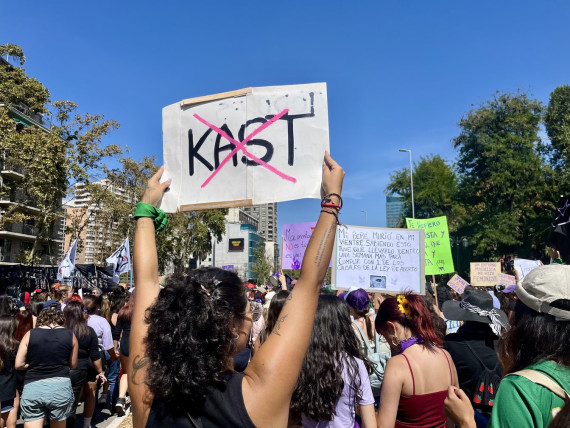
Last year’s election was Kast’s third attempt at running for president. He campaigned on a forcefully anti-migrant policy and pledged to tackle violent crime – gaining 58.1% of the second-round vote, while left-wing opponent Jeannette Jara managed 41.3%. Kast promised order, even proposing an “emergency government” to tackle insecurity, which Chileans perceive to have increased by 90% in the past decade and which many associate with the rise in undocumented migration, largely from Venezuela. Chile is now one of the most fearful countries in the world, but the fearmongering doesn’t match reality. Homicide rates have doubled in the past 10 years, but Chile is still one of Latin America’s safest countries.
“All this narrative about insecurity and anti-feminism is everywhere. We can see it in the United States with Trump. We see it in Argentina with [president Javier] Milei. It’s a global strategy from the far right,” Sotomayor said.
Kast also opposes same-sex marriage and abortion. In January he announced Judith Marín, an evangelical Christian and staunch opponent of abortion, as his women and equalities minister. Yet the majority of the women on the streets this Sunday wore green bandanas calling for the legalisation of abortion, which is legal in only three limited circumstances: in the case of pregnancy by rape, when the embryo or fetus is unviable, or when a pregnant person’s life is at risk. These criteria were introduced in a 2017 law change by Michele Bachelet’s government, which overturned a law criminalising all abortion, which was introduced by Pinochet in 1989, the final year of his rule.
One protester, Miriam Piturra, 30, told me that in December her pregnancy ended in foetal death, but she wasn’t allowed to have an abortion immediately due to the legal requirement of two doctors confirming the diagnosis. “I had to carry my dead baby in my womb for another week in order to meet the legal conditions required under the abortion law,” she said. Carrying a dead foetus is not just traumatic; it significantly endangers pregnant people by risking maternal sepsis, a life-threatening, rapid-onset response to infection.
“Today I fight because I don’t want anyone else to have to go through that – knowing their baby has died, knowing they have lost their pregnancy, and still not having the right to remove it from their body,” Piturra said. She, like many on the Sunday march, are afraid of what’s to come under the next government.
“Kast has already shown that he wants to take away our rights. In my case, I didn’t want to end a pregnancy because I didn’t want a baby. But if my baby died, I also have the right to take care of my physical and mental health. And that is something they don’t consider,” she said.
While the future is in question for many, activists are determined to keep fighting. Just last week, on 3 March, the health commission of the Chamber of Deputies approved a draft bill to legalise abortion up to 14 weeks, which was introduced by the progressive Gabriel Boric’s government in May 2025, moving it to the next legislative process. While Kast’s government is likely to want to scrap the bill, its future depends on whether there are enough progressive legislators willing to support it.
“We advance grain by grain, little by little,” said Siomara Molina of the Asamblea Permanente por la Legalización del Aborto (Standing Assembly for Abortion Legalisation). “This week we had an advance in institutional terms regarding abortion, but the level of public support has been steadily growing for the last 30 years, and it hasn’t stopped. It keeps rising. Feminist organisations have undoubtedly done the work, we are the ones who have persistently kept this debate on the table”.
“However, the far-right has been very clear. They consider abortion to be murder and women who have abortions to be murderers. That is the framework they operate from – not a framework of rights. So we do not know exactly what they will do,” Molina continued.
She was marching alongside other Asamblea members who are calling for people to sign a petition in support of the abortion bill. For her, the most important message of this year’s M8 “is not necessarily directed at the government. It is a message to ourselves, to the women of this country and to social movements, that says: we are here, we remain strong, and we are not hiding.”
She holds onto hope. It’s a hope strengthened by the presence of the women and queer people of all ages who filled streets across Chile on Sunday. “That sense of solidarity among women and social movements is extremely important at this moment,” Molina added.