If someone forwarded you this email you can subscribe. View in web browser.

Hi ,

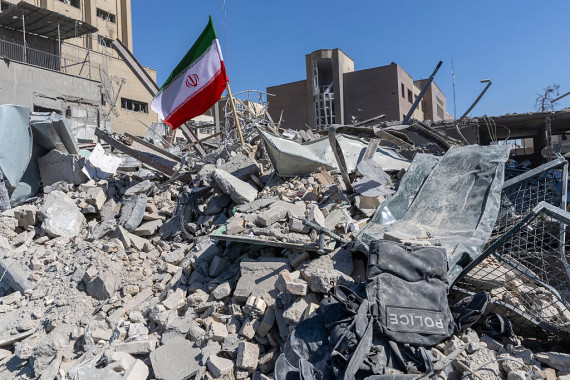
The effects of the US-Israel war on Iran are spreading across the world – what will be the long-term impact?

“The only coordinated mechanism that most policy makers across the global South are indulging in right now is prayer.”

That's what analyst and columnist Mihir Sharma said to our editor-in-chief, Aman Sethi, in a recent interview.

Read more below.

- openDemocracy

 
EDITOR'S PICKS
 
1
Top civil servant boomeranged between government and Tony Blair Institute

Exclusive: Tech firms such as TBI are embedding staff in government, sparking fears AI policy is being ‘outsourced’ Read more... 

2
For Trump and Netanyahu, the Iran war is a problem of their own making

The US president’s claim that the war is ‘very complete’ was little more than wishful thinking Read more... 

3
PODCAST | Iran, Oil, Inflation, Unrest: The Global Fallout of the US-Israeli War on Iran

As the US-Israeli war on Iran continues to escalate, there is much that we do not know. Listen to the audio version of our interview with Mihir Sharma here. Spotify | Apple


FEATURED STORY

Oil, Inflation, Unrest: The Global Fallout of the US-Israeli War on Iran

Aman Sethi

As the US-Israeli war on Iran continues to escalate, the effects of the conflict are spiralling outwards across a world already whiplashed by cross-border violence, global tariffs, and the unravelling of regional alliances.

There is much that we do not know: How will spiking energy prices affect developing economies in Asia and Africa? What are the long term impacts of the destabilisation of the Gulf, a region that has long served as a magnet for labour and capital from around the world? What does the conflict in Iran reveal about the latest chapter in the relationship between international finance capital and nation states?

To talk through these questions, I interviewed analyst and columnist Mihir Sharma. Sharma is a principal research fellow at IPPR, and has been a Bloomberg Opinion columnist on global economics and politics for over a decade.

Aman Sethi: I'm groping in the dark for what signals to pay attention to in this current conflict in the Gulf. One obvious vector of course is oil prices, but what are the other trends, signals, vectors, call them what you will, should we pay attention to when considering the global fallout of the war in Iran and now the rest of the middle east?

 
SUPPORT OUR INVESTIGATIONS INTO THE MILITARY INDUSTRIAL COMPLEX
 
When I saw that the UK government had seconded an official to work with Rothschild & Co on defence policy, all paid for by you and me, I knew this was something I had to look into. The revolving door between government, private finance and lobbying firms needs to be exposed if we are to understand how money and power work in our politics. Nowhere is this more urgent than on questions of defence and national security, at a time when the government is investing more and more of taxpayers’ money on rearming Britain.
 
You can help keep me on this beat, as I dig into the contracts and cosy relationships between Labour, defence, and big finance. Will you donate to support my work today?
Please donate now
 

Mihir Sharma: One of the other things that a lot of people are paying attention to, probably for good reason, is currencies, right? That is because over time a lot of countries that have to buy oil have to pay for it in dollars. And the longer this lasts the higher the price of oil goes, the more dollars they have to spend, the lower the value of their currencies, and they start getting squeezed a bit.

So a lot of people are watching currencies, foreign exchange reserves across Asia, parts of Africa, just to figure out what's the big implications for these economies going forward. Of course, we should probably also be looking at the movement of people, which hasn't really happened yet.

Nobody has launched giant operations to get their nationals out of the gulf the way that they did in previous Gulf Wars, but that's likely to be something that we should watch. It's a much more visceral indicator that something has gone very wrong.

When you say one of the things that people are looking at is currencies could you give us an example on how this particular mechanism that you're describing would play out in a country in say Africa or Asia?

Let's look at India. The currency, the rupee, has just hit an all time high across 90 rupees to the dollar. What that means is that the amount of stuff that we can buy from outside if you are an Indian, has decreased significantly. So you are just poorer.

It just happens the moment your currency declines against the dollar, becomes weaker against the dollar, goes from 80 rupees to the dollar to 95 rupees to the dollar. You just can buy a lot less stuff from outside. You can buy fewer iPhones, you can buy less oil, fewer foreign cars, anything at all. Everything costs more, and so suddenly you're a lot poorer.

But there's another way in which this begins to matter, which is that in many countries, the government helps their citizens, by saying, ‘Guys, we are going to basically control the price of fuel a little and ensure that these big ups and downs in how much gasoline or petrol costs that the pump is not going to affect you that much.”

But naturally that promise, those subsidies don't come free. They're coming out of taxes, they're coming out of the government budget. And in times of crisis like this, when oil crosses $90 a barrel, a hundred dollars a barrel, the money that those governments have begins to run out very fast. And then you have the kind of crisis that calls in the IMF. That means that you can't buy food. That creates an enormous sequence of destabilizing events.

Every single time that India has had to endure oil over $100, it's led to enormous chaos. In the 1970s after the OPEC oil crash, we had a period of essentially authoritarian rule and enormous amounts of political unrest in the late eighties and early nineties when Iraq invaded Kuwait. India went bankrupt and essentially had to go to the IMF and eventually launched an entire giant package of structured reform.

More recently, about 15 years ago, when oil was again above a hundred, there were these fake anti-corruption things that happened all over the country that led to the rise of the right in India led by Prime Minister Modi, who has now ensconced himself on power on the back of a period of very high oil prices and very high inflation that discredited his opposition.

And you see that kind of internal dynamic happening across the world, wherever you have this period of high oil prices.

So you have a crisis in the gulf — the mechanism is that it leads to a spike in oil prices which leads to a currency crisis which leads to political unrest and a kind of churn in developing economies around the world. Would that be correct?

 
Is MAGA a religion? Why has protest been criminalised in England and Wales? Who is profiting from anti-immigration sentiment? And how can we engage with young men who’ve fallen down the alt-right pipeline? 
 
These are just a few of the questions that we’ve put to leading thinkers, frontline activists, and global experts on our new podcast, In Solidarity, over the past six months.
 
In Solidarity is a podcast for people who understand that politics doesn’t just happen in the halls of power. Every show, we tackle a new theme to uncover how authoritarianism spreads, who is benefiting from fear, and how solidarity is evolving into resistance movements around the world.
 
To ensure you never miss an episode of In Solidarity, subscribe to get an email notification whenever a new one is released. 
Subscribe to episode notifications
 

I mean, it's even simpler than that. If you can't get oil, you have to pay more for it. The more you pay for oil, the less cash you have to give to your people, the angrier they get, and they're more likely to throw you out right on the street, complain about the price of bread, et cetera.

The second kind of signal that you talked about is the movement of people. I'm thinking about how the near collapse 15 years ago of the Syrian regime resulted in this refugee crisis which transformed politics in Europe for a generation. Are we at risk of seeing something similar like that playing out again?

I very much hope that we don't have a repeat of that. Not just obviously because of the impacts on populist politics in the West, but also because that would mean that there are boots on the ground in some of these places and there is the kind of devastation and breakdown of law and order of state control that accompanies invasions, and civil wars, such as we had in Syria.

Although obviously the bombing is leading to devastation [in Iran]. We don't know if it hasn't reached the level that would lead to a vast movement of people from a country like Iran out to the broader world.

Now, two things could happen. We could see a spread in this kind of disruption in the area that would cause movements of people from other countries with lower state capacity than Iran, which does have enormous state capacity.

But also what you are seeing at a different level is perhaps a movement to the elites one way or the other. Elites who, perhaps, looked at some places in the Gulf as a refuge in a haven for quite a while, and it is possible that that is no longer the case. So you'll see movement at a different level of people.

How serious do you think that is? I can understand that a week or a month of bombings in the Middle East could shake this idea of Dubai as a safe haven or the UAE is a safe haven, or Qatar as a safe haven. But do you think that risk is overblown? That in six months from now, air defenses are back. The Gulf continues to do business. Rising oil prices mean that the Gulf has even more money than it had previously, and so actually it's like the go-go days all over again.

I think that all of those things will be true, there will be more money. That business as usual will continue once this has died down. Except it'll be a little bit deceptive as compared to the past.

Abu Dhabi and Dubai are different: One does have oil wealth, which is Abu Dhabi, and one essentially doesn't, which is the Emirate of Dubai. And Dubai exists purely as a product of what it has to sell to people who move there. And what it has to sell is this notion that it is a place beyond the contestations of politics.

It is a place beyond the troubles of taxation and politics and geopolitics and regional turbulence and rioting on the street. And, you know, it's all the comforts of home, whatever home you may be from. So you'll have the same brands that you have in Kensington, and the same household staff that you have in Defence Colony in New Delhi, but completely detached from actual reality. And that's the promise. That is the appeal that Dubai has.

I think that that promise has been punctured a little. It is in that sense a very interesting conflict. Have we seen conflicts like these before where a country under attack cannot get back at its aggressor and so essentially decides to wreak devastation in the neighborhood?

I mean, not in this very obvious way, but you could argue that the Russian Federation does that. It's angry at, I don't know, the UK, the US, at history, but what it clobbers is Georgia and Ukraine. North Korea will be angry at the US but we'll threaten Japan.

So this is what the weak do. Um, even if they're pissed off, they, you know, they, they always, um, they may be pissed off at the. It's true in politics as well. You're pissed off at the elite, but you bash up your neighbor...

You can read the rest of this interview here, or listen wherever you get your podcasts.
 

COMMENTS

Sign in 💬

Our award-winning journalists can now respond directly to your comments underneath the articles on our site!

Just sign in or register underneath any of our articles to start leaving your thoughts and questions today.

Sign in and join the conversation

MORE FROM OPENDEMOCRACY

Weekly Newsletter
The Dark Arts
Bluesky Facebook X / Twitter Mastodon Instagram YouTube


openDemocracy, 18 Ashwin Street London, E8 3DL United Kingdom

Unsubscribe