If someone forwarded you this email you can subscribe. View in web browser.

Hi ,

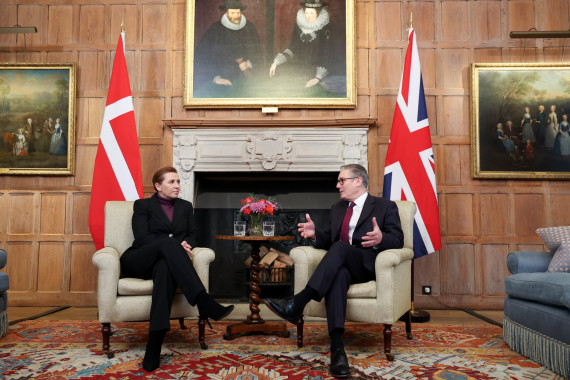
The UK and Danish prime ministers, Keir Starmer and Mette Frederiksen, have called for states to follow Denmark's immigration model. But what does that mean?

And considering the UK population is more than ten times the size of Denmark's, can this model meet the UK's needs?

Read more below.

- openDemocracy

 
EDITOR'S PICKS
 
1
As missiles fall on Iran, the case for global disarmament becomes urgent

Despite what Donald Trump may claim, my work at the United Nations is now more important than ever – for all of us Read more... 

2
In US/Israeli war on Iran, all roads point to rise in global nuclear weapons

Trump and Netanyahu are already boasting of success. But the war is not going to plan for any of the parties involved Read more... 

3
PODCAST | The "Danish Model" of Asylum Explained: Cruelty by Design?

Why are British and European politicians obsessed with Denmark's immigration strategy? We uncover the dark reality of the "Danish Model" and how it punishes asylum seekers by design Spotify | Apple


FEATURED STORY

What is the Danish immigration model, and does it work?

Aman Sethi

“Controlling who comes here is an essential task of government,” wrote the British and Danish prime ministers, Keir Starmer and Mette Frederiksen, in a jointly authored article in The Guardian in December.

“That’s why we are both taking practical action to fix the asylum system,” they continued. “Denmark has led the way here, with tough but fair reforms which have delivered results.”

But what are these reforms, better known as the much-touted ‘Danish model’ of immigration? And can the immigration and asylum policies of a country of six million people really provide a useful case study when considering the needs of a country such as the UK, whose population is more than ten times that size?

To find out, I spoke to Thomas Gammeltoft-Hansen, Denmark’s first-ever professor of migration and mobility law. Gammeltoft-Hansen is the director of MOBILE, the Danish National Research Foundation’s Centre of Excellence on Global Mobility Law, and the Nordic Asylum Law & Data Lab.

 
SUPPORT OUR INVESTIGATIONS INTO THE MILITARY INDUSTRIAL COMPLEX
 
When I saw that the UK government had seconded an official to work with Rothschild & Co on defence policy, all paid for by you and me, I knew this was something I had to look into. The revolving door between government, private finance and lobbying firms needs to be exposed if we are to understand how money and power work in our politics. Nowhere is this more urgent than on questions of defence and national security, at a time when the government is investing more and more of taxpayers’ money on rearming Britain.
 
You can help keep me on this beat, as I dig into the contracts and cosy relationships between Labour, defence, and big finance. Will you donate to support my work today?
Please donate now
 

This interview has been edited for length and clarity.

Aman Sethi: Thomas, lay it out for us as simply as possible. What exactly are the Danish immigration model and the Danish asylum model?

Thomas Gammeltoft-Hansen: What Denmark has done nationally is talked about as the ‘Danish model’ of immigration policy or immigration control. That model is sort of a conglomerate of more than 100 different legislative measures; some years, we’ve had more than 10 legislative changes to the Aliens Act in a year.

Each of them directly tightened almost all elements of Danish immigration policies, and the overarching logic has been two elements: the first is that, because of Denmark’s position geographically – it's not a frontline country – we don't tend to do a lot of the kind of hard-edged migration control that some southern or eastern European countries are doing.

So it's been a lot of indirect deterrence. What Denmark has consistently pursued is to make conditions for arriving asylum seekers, refugees with status, all people in a return position, and rejected asylum seekers as unpalatable and as unattractive as possible. Some people have to wait years in order to be able to apply for family notifications. There have been restrictions on anything from housing during the asylum period, to [increasing] the fees you have to pay for applying for family reunification, cuts to social benefits and shortening of residence permits.

There are also uncertainties around whether, if you then got a refugee status, that status would be revoked. Some refugees might face a situation where they'll be asked to return [to their home country], for instance, in the case of some of the Syrian refugees.

What has the impact of this been for Denmark? What constitutes success or failure for a policy such as this one?

The dominant view in much of what we would call refugee and migration studies, suggests that measures such as cutting social benefits, or forcing arriving asylum seekers to live in tents, or introducing certain wait times for applying for family unification, are seen as more symbolic – perhaps catering more to the national electorate, rather than being something that asylum seekers would necessarily know or care very much about.

But, the longitudinal analysis of the Danish policies does seem to suggest that Denmark's resort to these types of policies has been at least partially effective in reducing asylum arrivals when compared to the kind of relative developments in other European countries.

It is, in one sense, symbolic, but political utterances also carry meaning. They create realities. So, is there a way that successive governments have outdone each other in creating more and more restrictive policies around immigration and asylum? Has it led to a coarsening of political discourse? Because politics is, in many ways, the art of the symbol.

Absolutely. This has been a deeply vexing political question in immigration and asylum in general, and in Danish politics, all the way back to the 1980s. I would also caution against thinking that there's necessarily a monolithic consensus across the entire board – there's definitely been opposition to [these restrictive policies]. For instance, you've seen a quite strong popular grassroots mobilisation, especially since 2015, and support of asylum seekers and refugees.

The particularly pernicious thing about this type of indirect deterrence policy is that you're basically punishing those who have already arrived in order to send a signal to prospective asylum seekers yet to come. Each of these measures has made life worse for those who are already here; many of these measures introduce a degree of hardship on the people who are already here. People are sort of, in a sense, taken hostage and made to pay for this sort of signalling politics.

 
Is MAGA a religion? Why has protest been criminalised in England and Wales? Who is profiting from anti-immigration sentiment? And how can we engage with young men who’ve fallen down the alt-right pipeline? 
 
These are just a few of the questions that we’ve put to leading thinkers, frontline activists, and global experts on our new podcast, In Solidarity, over the past six months.
 
In Solidarity is a podcast for people who understand that politics doesn’t just happen in the halls of power. Every show, we tackle a new theme to uncover how authoritarianism spreads, who is benefiting from fear, and how solidarity is evolving into resistance movements around the world.
 
To ensure you never miss an episode of In Solidarity, subscribe to get an email notification whenever a new one is released. 
Subscribe to episode notifications
 

We’ve got quite solid research showing that these policies are undermining integration opportunities, undermining the ability of people to find a foothold in the labour markets, because you can't start working sooner, because you have to wait and undergo all these sorts of different things before you perhaps can get into language courses. Whereas what would be most useful would be that you requalify your education or learn the language. I mean, there are all these sorts of interlocking dynamics.

There’s an interesting discussion coming up now because Denmark, like so many other countries in Europe and around the world, actually needs labour migration.

What was the way that migration and movement happened across Europe in the 1800s or the early 1900s? Was mobility always this intensely contested?

We know from archaeology, we know from economics and historical economics, development, all these things, that access to mobility throughout human history has remained super important for economic growth, for cultural and technological exchange. And of course, ultimately for survival.

Mobility and access to mobility were originally restricted by geography; it’s hard to cross water or mountain ranges. And there have been a lot of studies on empires that suggest that an empire has to be a geographically defendable territory. that sits, at least to some part, geographically.

So with technology and mass transportation, today’s access to mobility – how you move, how easily, how long you can stay – is overwhelmingly determined by law, but it's not a single set of laws, and that's the really difficult thing.

We can think about refugee law or labour migration laws sort of like particular pillars and something that lawyers would think of as regimes, but the ways that mobility at large is governed is like transportation law – it's the international aviation law, it is maritime law and law of the sea – it's labour law, it's free movement law. It's national immigration codes, it's now health also… we all experienced that after Covid.

And to your example and question about how people moved in, say, the late 1800s or early 1900s? Many scholars would describe that as a kind of early globalisation phase. You could board a ship to the ‘new world’ in North America, so it opened up mobility opportunities also beyond the super-rich, the elite avant-garde that were always mobile. In response, this was also the period when many states started introducing more restrictive national border control and requiring documents.

And then that developed further in the post-Second World War period, when you had massive amounts of displacement in Europe. This is also why the original formulation of the 1951 Refugee Convention applied only to Europeans displaced as a result of the war. There was a massive displacement situation and you needed to have a kind of common system of rights, and it's perhaps also why the refugee convention was one of the first human rights instruments that was negotiated after the war.

Before you go, a month or so ago, the British and Danish prime ministers co-authored an op-ed in The Guardian where they said they were going to call upon the European Convention on Human Rights to be modernised to account for this new world of migration. What are they asking for and why?

I actually think their choice of words is quite spurious because what they're actually asking for is a devolution, a kind of un-modernisation.

When we look at the European human rights regime – the convention and the court – it used to be interpreted more towards European citizens or people within the territories of European countries. There was barely any immigration case law.

But since the 1990s, there's been this growing case-log. On the one hand, expulsion cases applicable to asylum cases – people who are getting expelled based on maybe criminal behaviour or losing their residence permits – but also very importantly, family unification. So a lot of cases around that. Also, a number of cases around extra-territorial migration control that European countries have always relied upon in order to do what they're clearly not allowed to do, or are unwilling to do, at home.

So the European human rights regime has come to play an undeniably larger role when it comes to migration and asylum. That has come in tandem with the development of these more restrictive policies after the end of the Cold War.

The issue of whether or not the European Court of Human Rights should play this type of role when it comes to migration has been a recurrent debate for at least the past 15 years. The UK has been pointing its finger at the court for more than 20 years, especially after 9/11, as an obstacle to expelling criminally convicted or terrorist suspects who are foreign.

What it will mean in practice is a very open question. Some scholars suggest, and I would tend to agree, that all this is a kind of political signalling; you don't necessarily need a very formal thing. I think it's an open question where we're going to see a direct confrontation with the system as it works today, or whether it is another example of this kind of political signalling going on.

 

COMMENTS

Sign in 💬

Our award-winning journalists can now respond directly to your comments underneath the articles on our site!

Just sign in or register underneath any of our articles to start leaving your thoughts and questions today.

Sign in and join the conversation

MORE FROM OPENDEMOCRACY

Weekly Newsletter
The Dark Arts
Bluesky Facebook X / Twitter Mastodon Instagram YouTube


openDemocracy, 18 Ashwin Street London, E8 3DL United Kingdom

Unsubscribe