If someone forwarded you this email you can subscribe. View in web browser.

Hi ,

A trove of 1,431 pages of Russian-language documents suggests the Kremlin intervened as Bolivia’s ruling left fractured ahead of a key election.

The dossier, obtained by The Continent and shared with openDemocracy, indicates that operatives linked to a reincarnation of the Wagner Group travelled to La Paz to support President Luis Arce, proposing tactics that included drafting speeches and influencing elections.

How much impact they had remains unclear.

Read more below.

- openDemocracy

 
EDITOR'S PICKS
 
1
The Greens’ real fight has begun – and the establishment will be out for blood

After a stunning victory in the Gorton and Denton byelection, Green activists are preparing for a major establishment backlash Read more... 

2
Nothing to see here: Ex-Amazon UK boss to lead competition watchdog

Experts described the decision to appoint Doug Gurr as the head of the CMA as “very positive” if you are Big Tech Read more... 

3
PODCAST: Gaza's Illusionary Ceasefire: With Jamil Sawalmeh

Since the US-brokered ceasefire was declared in October last year, at least 463 Palestinians had been killed by Israel as of Jan 21 this year, of whom 100 were children.

The ceasefire hasn't ended, because it never began. Spotify | Apple


FEATURED STORY

As Bolivia’s left fractured, the Kremlin sent ex-Wagner agents

Diana Cariboni

On an unusually warm day in July 2024, a team of seven Russian “specialists” landed in La Paz, Bolivia, with the aim of “stabilising” the government of President Luis Arce, an ally of Russia, ahead of a national election scheduled for the following year.

The stakes were high: 2024 had been a hard year for Bolivians, marked by economic difficulties, a severe fuel shortage, extensive wildfires, and more than 500 protests and anti-governmental demonstrations. Inflation was at its highest since 2008, and Arce’s Movement for Socialism party (MAS) was riven by an internecine battle for control between the president and his ally-turned-rival and predecessor, former President Evo Morales. The MAS regime, in the meantime, was one of the few remaining Kremlin allies in the region, and resource-rich Bolivia has 21% of the world’s deposits of lithium, a vital mineral for next-generation technologies.

Three weeks before the arrival of the Russians, on 26 June that year, a small band of soldiers led by the chief of the army, general José Luis Zúñiga, had tried to take control of the presidential palace, only to surrender soon after. When arrested, Zúñiga said the uprising had been staged by President Arce himself to boost his flagging public support; a narrative seized on by media, opposition politicians, and also Morales and his supporters, but vehemently denied by Arce.

The Russian Foreign Ministry publicly condemned the coup and called for calm to prevail. “There was no interference by third countries in what happened in Bolivia,” the Kremlin spokesperson Dmitry Peskov told the press.

 
SUPPORT OUR INVESTIGATIONS INTO THE MILITARY INDUSTRIAL COMPLEX
 
When I saw that the UK government had seconded an official to work with Rothschild & Co on defence policy, all paid for by you and me, I knew this was something I had to look into. The revolving door between government, private finance and lobbying firms needs to be exposed if we are to understand how money and power work in our politics. Nowhere is this more urgent than on questions of defence and national security, at a time when the government is investing more and more of taxpayers’ money on rearming Britain.
 
You can help keep me on this beat, as I dig into the contracts and cosy relationships between Labour, defence, and big finance. Will you donate to support my work today?
Please donate now
 

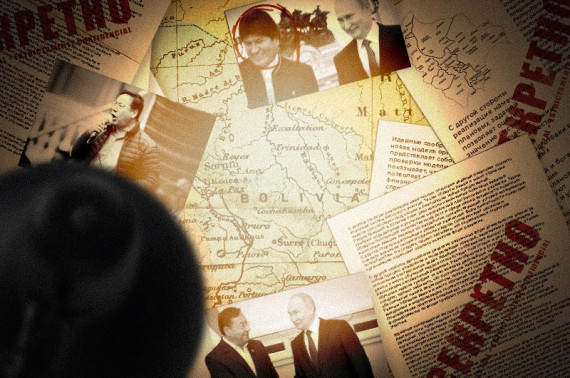
But a trove of 1,431-page Russian-language documents obtained by The Continent, an African news outlet, and shared with openDemocracy reveal the Kremlin had picked a side.

The Russians who arrived in La Paz that July were operatives working for a reincarnation of the Wagner Group, a paramilitary corporation that had been disbanded in 2023.

Over the next four months, as the documents reveal, these agents sought to shore up Arce’s government and discredit Morales, his rival, who had also been a popular leader both in Bolivia and the region.

Their proposed tactics included drafting Arce’s speeches, setting up a rapid-response communications unit within the government, false flag operations aimed at Morales, who was openly challenging the Presidency, and influencing Bolivia’s national elections and judicial elections.

It is unclear how influential the Russians were: Arce stayed on till his term ended the following year, but did not run in 2025. The MAS lost the election, which was won by the centre-right opposition led by Rodrigo Paz. One of Paz’s first moves as president-elect was to announce the resumption of economic and diplomatic ties with the United States after a 17-year hiatus.

The previously undisclosed story of the operation in La Paz offers a glimpse of Russian efforts to maintain the Kremlin’s influence in South America, and for the first time, evidence of political and propaganda operations by former Wagner contractors in South America. Previous reports have documented the presence of paramilitary soldiers linked to Wagner in Venezuela.

openDemocracy reached out to a lawyer acting on behalf of former president Luis Acre, as well as former ministers in his cabinet, former president Evo Morales, the office of current president Rodrigo Paz, the Bolivian Foreign Ministry, the Russian Foreign Ministry and the foreign intelligence service, and all individuals mentioned in this report for comment several days before publication.

This report shall be updated when they reply.

From Wagner to the SVR

Russia has three main agencies: the domestic counterintelligence security service known as FSB, the military intelligence directorate GU, and the foreign intelligence service SVR, explained Lou Osborn, member of the INPACT/All Eyes On Wagner collective, which tracks Russia’s hybrid warfare operations.

The SVR, Osborn told openDemocracy, “is focused on collecting intelligence in foreign countries with a perimeter related to political affairs, economic affairs and security”.

 
Is MAGA a religion? Why has protest been criminalised in England and Wales? Who is profiting from anti-immigration sentiment? And how can we engage with young men who’ve fallen down the alt-right pipeline? 
 
These are just a few of the questions that we’ve put to leading thinkers, frontline activists, and global experts on our new podcast, In Solidarity, over the past six months.
 
In Solidarity is a podcast for people who understand that politics doesn’t just happen in the halls of power. Every show, we tackle a new theme to uncover how authoritarianism spreads, who is benefiting from fear, and how solidarity is evolving into resistance movements around the world.
 
To ensure you never miss an episode of In Solidarity, subscribe to get an email notification whenever a new one is released. 
Subscribe to episode notifications
 

Then, there are “several Russian private military companies which have had ex-members of these services”, Osborn added. Wagner was one such company.

Wagner first made its presence known as a violent paramilitary operating under Russian oversight in Kremlin-occupied Donbas, before expanding its operations into Africa, and then Syria. Wagner played a significant role in Russia’s full-scale invasion of Ukraine in 2022, only for its self-proclaimed founder, Yevgeny Prigozhin, to fall out spectacularly with President Putin in 2023. Progizhin died in a plane crash soon after, and most of the group’s structure was subsequently taken over by Russian military intelligence.

“The big shift came after Prigozhin’s death, with a deeper involvement from security services in what the Wagner Group had created,” Osborn said.

What is left of the Wagner Group, she added, “especially in the Central African Republic and information operations, was rumoured to have been taken over by the SVR for years, and now these leaked documents are proving it”.

The documents contain strategies, workplans, budgets, accounting reports, staff biographies, profiles of targeted public figures, and briefings of media operations relating to Russian influence campaigns executed between January and November 2024 in at least 30 countries in Africa and Latin America, including in Bolivia and Argentina.

openDemocracy and a consortium including The Continent, Dossier Center and iStories (Russia), All Eyes on Wagner and Forbidden Stories (France) and two independent Russian-speaking journalists, have examined and fact-checked the documents and are publishing a series of stories on many of these activities.

A key document in this trove is a 54-page report titled “Strategy for increasing Russia's influence in Africa”, and likely dated in August 2023, which makes clear that these documents were prepared by operators linked to the Wagner group for internal use. In several places, the document calls for joint strategies of cooperation with the SVR. At least 17 of the more than 60 operatives deployed by 2024 and mentioned in these documents have previous links to Wagner.

Finally, openDemocracy was able to confirm that an interaction described in the documents – between the Russian operatives and a senior advisor to the Arce administration – did indeed take place.

“Defenders of the Peace”

The Bolivian operation was led from Russia by a man named Sergei Sergeyevich Klyukin, described in the documents as the “curator” of the mission. An internal biographical document analysed by openDemocracy states that Klyukin had joined ‘the Company’, as the group called itself in the documents, in 2018 after working as a political consultant in Russia...

You can read the rest of this investigation here.
 

COMMENTS

Sign in 💬

Our award-winning journalists can now respond directly to your comments underneath the articles on our site!

Just sign in or register underneath any of our articles to start leaving your thoughts and questions today.

Sign in and join the conversation

MORE FROM OPENDEMOCRACY

Weekly Newsletter
The Dark Arts
Bluesky Facebook X / Twitter Mastodon Instagram YouTube


openDemocracy, 18 Ashwin Street London, E8 3DL United Kingdom

Unsubscribe