If someone forwarded you this email you can subscribe. View in web browser.

Hi ,

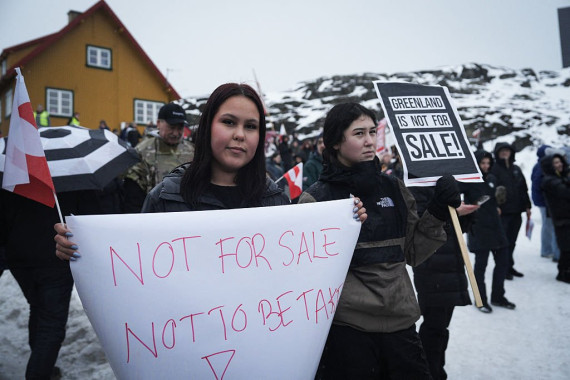
Donald Trump’s threat to invade Greenland has forced Danes and Greenlanders to confront urgent questions about sovereignty and security.

In Copenhagen, Greenland’s former deputy prime minister Jens B. Frederiksen warned that annexation would have consequences far beyond the island — even raising questions about Ukraine and Taiwan.

While many Greenlanders support independence from Denmark, recent polling shows only a small minority want to join the United States. For now, the threat has drawn Greenland and Denmark closer together.

Read more below.

- openDemocracy

 
EDITOR'S PICKS
 
1
How FGM victims got caught in the crossfire of Trump’s war on trans kids

Proposed new law increases likelihood of both female genital mutilation and suicides among trans youth, experts warn Read more... 

2
Protests, proscription and the power of the jury

As jurors acquit Palestine Action and a court overturns their proscription, is the government fighting a losing battle? Read more... 

3
PODCAST: Gaza's Illusionary Ceasefire: With Jamil Sawalmeh

Since the US-brokered ceasefire was declared in October last year, at least 463 Palestinians had been killed by Israel as of Jan 21 this year, of whom 100 were children.

The ceasefire hasn't ended, because it never began. Spotify | Apple


FEATURED STORY

In Copenhagen, Danes and Greenlanders told us why Trump’s threats matter

Sian Norris

If the United States takes over and annexes Greenland, what legal rights will they have to try to stop Putin in Ukraine?”

That was the question posed by Jens B. Frederiksen, Greenland’s former deputy prime minister, when we met over coffee in central Copenhagen last week. “Which legal rights will they have to try to defend Taiwan, if China wants Taiwan?” he continued. “Trump [is] just the same person as Putin. Trump wants to own Greenland. He wants to make the US bigger.”

Three weeks before our conversation, Frederiksen had addressed 30,000 Danes and Greenlanders as they gathered in the Danish capital to oppose Donald Trump’s threat to invade Greenland some 3,550 kilometres away. The strategically important island, two-thirds of which lies within the Arctic Circle, has been a semi-autonomous part of the Kingdom of Denmark for more than 70 years, and a Danish colony for 140 years before that.

One crucial dividing line in Greenlandic politics is independence. When the country was fully integrated into the Danish state in 1953, it established its own Parliament, constitution and introduced a host of electoral reforms. But in recent years, polls suggest around two-thirds of Greenlanders want to break away from Denmark, not least due to long-running issues such as pay inequality and the legacy of colonialism. For now, though, the threat from the US has prompted a renewed sense of unity with Denmark and Europe, with a poll from last month finding only 6% of Greenland’s adult population wants to join the US.

 
SUPPORT OUR INVESTIGATIONS INTO THE MILITARY INDUSTRIAL COMPLEX
 
When I saw that the UK government had seconded an official to work with Rothschild & Co on defence policy, all paid for by you and me, I knew this was something I had to look into. The revolving door between government, private finance and lobbying firms needs to be exposed if we are to understand how money and power work in our politics. Nowhere is this more urgent than on questions of defence and national security, at a time when the government is investing more and more of taxpayers’ money on rearming Britain.
 
You can help keep me on this beat, as I dig into the contracts and cosy relationships between Labour, defence, and big finance. Will you donate to support my work today?
Please donate now
 

“I would say that everybody has been agreeing that Greenland will be independent at some point, and the disagreements were on when,” said Camilla Siezing of Kalaallit Peqatigiiffiisa Kattuffiat Inuit, an organisation that represents Greenlanders living in Denmark. “But this situation has moved back a lot of things in this regard, because I think Greenland realised how fragile we are. A lot of the discussion for independence has been on the economic and social parts. But now we also have to think about the international security issue.”

The US has had extensive access to and a military presence in Greenland since 1951, when it signed the US-Denmark Defence Agreement as the Cold War intensified. The treaty granted it operational rights on the island, including over construction, logistics, military activity and mining. Earlier this year, the concession of Greenland’s Tanbreez mining project was sold to New York-based Critical Metals Corp.

For Trump, though, the agreement is no longer enough. He began signalling his expansionist aims towards Greenland in his first presidency, initially arguing that the White House should be able to buy the island from Denmark. Earlier this year, he upped the ante, claiming US annexation of the island is necessary to secure his “golden dome” defence system, in which the Pentagon would use Greenland to launch its air defences against a hypothetical missile attack from Russia.

Similarly, as the Arctic becomes a high-pressure region in terms of security and resources, the US president says he is also concerned by China’s expansionist aims. With Greenland, he says, he could better defend his country against any eastern aggression.

Defence experts say Trump’s logic is flawed. “The US falsely claimed that there has been an increase in Russian and Chinese presence in and around Greenland,” wrote Rachel Ellehus of the Royal United Services Institute, a UK defence and security think tank, last month. “Actually, there has been little to no Chinese and Russian military activity around Greenland over the last decade.” This was echoed days later by Spenser A Warren, the Stanton nuclear security postdoctoral fellow at Harvard’s Belfer Center, who branded Trump’s national security claims “grossly overblown” in the War on the Rocks blog.

There is a more extractive motivation behind the US’s interest in the Arctic. Greenland is rich in mineral wealth, including much-coveted rare earth minerals essential for technologies such as phones and the growing AI industry. Seizing Greenland would give the US access to the minerals and mining territories desired by its government and its billionaire class.

“To some of Trump's supporters, some of the tech billionaires, Greenland has become a new territory from where the US can expand and enlarge,” said Cecilie Felicia Stokholm Banke, a senior researcher at the Danish Institute for International Studies, when we met in her book-lined office in Copenhagen.

Greenland is not an empty island, existing only to provide minerals and military bases – despite how some members of the US right have sought to portray it in recent months. It’s home to 70,000 people, and has a diaspora of around 18,000 in Denmark.

 
Is MAGA a religion? Why has protest been criminalised in England and Wales? Who is profiting from anti-immigration sentiment? And how can we engage with young men who’ve fallen down the alt-right pipeline? 
 
These are just a few of the questions that we’ve put to leading thinkers, frontline activists, and global experts on our new podcast, In Solidarity, over the past six months.
 
In Solidarity is a podcast for people who understand that politics doesn’t just happen in the halls of power. Every show, we tackle a new theme to uncover how authoritarianism spreads, who is benefiting from fear, and how solidarity is evolving into resistance movements around the world.
 
To ensure you never miss an episode of In Solidarity, subscribe to get an email notification whenever a new one is released. 
Subscribe to episode notifications
 

Its population includes an Indigenous community with a close relationship with nature and the land, who “live in ways that are not only organised around capitalist markets and profits”, said Danish trade unionist, writer, campaigner and Red-Green Alliance member Bjarke Friborg. “Many people still hunt and fish, share food within families and communities, and plan their time around seasons, weather and ice conditions. When you depend directly on nature like that, it shapes how you think about work, time and what really matters.”

While Friborg is clear that the “Indigenous people have been subject to colonisation and domination from Denmark,” he warned against “how the US has treated its native populations. Greenlanders know this, too, and they are not encouraged.” Greenland’s Inuit people, he added, fear what a US annexation would mean for their wellbeing and safety.

Former deputy PM Frederiksen is a member of Greenland’s historically unionist Democrats Party, which has in recent years shifted its stance to support independence in the long term, as part of a gradual process that starts with increased self-determination. He pointed out that Greenlanders, like residents in Denmark, are entitled to free healthcare, receive payments to support their education, and a generous welfare system – which he fears could all be lost under US control.

“Look at Alaska, look at Puerto Rico,” he said, adding: “Our people are incredibly anxious. We are anxious about our country, our families, our own lives. We are anxious about all the connections we have. And it’s all just because a bully wants our country for his own ‘psychological welfare.’”

These anxieties have also led politicians on the island to put aside their differences, said Frederiksen. “Greenland’s political parties, at this time, realised they have to stand up together. You couldn't imagine that three, four months before that they should work together. And I was so proud, because I think it was a very, very strong signal to send to all the world that we don't want to be a part of the United States.”

The signal was particularly loud and clear when 30,000 people marched in Copenhagen. Anders Franssen, one of the co-founders of the Hands Off Greenland campaign group, told openDemocracy he knew he had to do something after Trump’s vice president, J D Vance, visited Greenland in March last year.

“We all know what that visit meant,” Franssen told openDemocracy. “It meant they were going to try to convert the Greenlandic people to look more positively on Trump and the Trump administration. “I called up the police, and I said, I'm going [to organise] a demonstration. He said, ‘How many people are gonna show?’ I said, it’s going to be me, then two cops, it’ll be three of us. We ended up being 3,500.”

Since then, the Hands Off Greenland protests have grown in size and number, with several large marches held in Danish cities and Greenland’s capital, Nuuk...

You can read the rest of this article here.
 

COMMENTS

Sign in 💬

Our award-winning journalists can now respond directly to your comments underneath the articles on our site!

Just sign in or register underneath any of our articles to start leaving your thoughts and questions today.

Sign in and join the conversation

MORE FROM OPENDEMOCRACY

Weekly Newsletter
The Dark Arts
Bluesky Facebook X / Twitter Mastodon Instagram YouTube


openDemocracy, 18 Ashwin Street London, E8 3DL United Kingdom

Unsubscribe