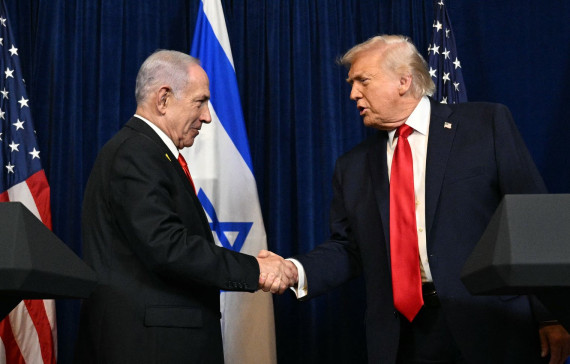
Tensions over Iran’s plans have been rising for more than a month, while the US has been steadily increasing the size of its military forces in the Middle East. These normally involve around 30,000 military personnel, mainly units in Jordan, Kuwait, Qatar, Bahrain, the UAE and Saudi Arabia, but also including Syria and Iraq, as well as forces permanently based in Israel.
Last month, the Pentagon announced it was moving an aircraft carrier strike group from the Philippines to the Middle East, and it has now ordered a second to move to the region, likely from the US East Coast, according to a report in the Wall Street Journal this week.
Trump this week repeated his threat to send a second carrier strike group to the region, while other reports suggest that more US F-35 strike aircraft are being moved to bases within range of Iran, with six aircraft having flown to the Middle East from the UK’s RAF Lakenheath earlier this week.
Despite this increased US readiness and Netanyahu’s hopes, getting Iran to give up on its ballistic missile programme is frankly unlikely. While there are indications that Iran’s economic problems, together with the mass protests last month, mean the theocratic leadership would like to see an easing of sanctions and avoid war, its willingness to respond only goes so far.
A revised nuclear inspection regime with the UN’s International Atomic Energy Authority may be the best the US and Israel can hope for. Not least because Trump’s claim last summer that the US attack on Iran’s underground nuclear projects had wrecked its whole nuclear programme was a gross overstatement; it likely set the programme back months, not years.
This is where Netanyahu’s problems start. Trump may point to huge forces being massed in the region, and analysts will certainly point to the immense power that the US and Israeli forces would have if they decided to launch a combined assault. Iran could be pummelled by air, drone and missile attacks stretching over weeks if not months, but Iran has at least two strengths of its own.
One is obvious: if Tehran is facing such an assault, then its ‘Samson Option’ response would be sustained paramilitary and drone attacks on oil and gas production and export plants, including the closure of the crucial Strait of Hormuz shipping channel. The global impact could be massive – on a par with the 1973/4 oil price surge that did much to usher in the global neoliberal era.