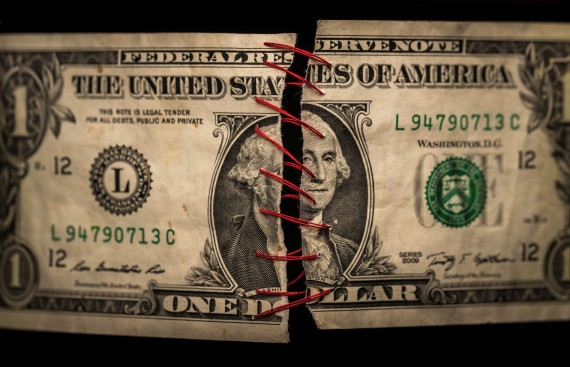
China is a key driver of the push to de-dollarise, with its own cross-border payment system, swap lines and a central bank digital currency. But it is not alone. Russia trades mostly in rubles and yuans. Heavily sanctioned for human rights violations, Iran sells most of its oil covertly to China via shadow tankers that bypass legal routes. China now settles a third of its trade in yuans, up from 20% in 2022.
So while there are many factors behind the US intervention in Venezuela, it is “part of a general strategy to slow the relative decline, to try to prevent de-dollarisation, and to control the oil supply”, according to Gabriel Merino, an Argentine international relations expert who focuses on China. “Maintaining control of global oil is a way to sustain the petrodollar. It's all connected in some way.”
Merino sees three fundamental conditions as pushing de-dollarisation. The first is the change in economic clout on the world map. More than half of the world’s GDP is now generated through Asia – primarily China and India – increasing the pressure to move away from the US dollar.
The second major factor is BRICS, the economic alliance of countries first established by Brazil, Russia, India, China and South Africa in 2006, but now numbering 11 emerging economies. Virtually since its inception, BRICS has signalled the need to move away from the primacy of the US dollar. So much so that Trump addressed the threat it poses to the US soon after he was elected to a second term as president in 2024, promising 100% tariffs on BRICS countries if they continue that trajectory.
The third factor is the economic war waged by Trump. As the US increasingly attempts to weaponise the dollar through sanctions and tariffs, a backlash has occurred.
Countries such as India and Brazil have developed their own domestic systems that enable customers to receive or make payments in their local currencies and avoid US-based payment methods, such as VISA or Mastercard, with their merchant fees. In December, a pilot project for a BRICS currency and payment system, called UNIT, was unveiled. The digital currency is 40% backed in gold and 60% in member currencies.
Brazil has also included the renminbi in its foreign reserves and devised frameworks to settle trade in the Chinese currency. But researchers say the move reflects a “pragmatic adaptation to shifting global dynamics” aimed at “diversification” rather than “de-dollarisation”. Other experts caution against overstating the forces of de-dollarisation.
“The dollar remains the dominant global currency,” Mihaela Papa, director of research at the MIT Centre for International Studies, who leads the BRICS Lab, said. Recent data from SWIFT shows the USD is used in more than 50% of the payment service’s transactions, by far the largest share. “Current debates around de-dollarisation focus on currency diversification rather than outright replacement,” Papa told openDemocracy.
“In practice, this takes the form of dollar risk management, reflected in greater use of local currencies for trade settlement, modest reserve diversification, and experimentation with new payment infrastructures.”
Papa believes that for BRICS’ efforts to have a significant international impact, cross-border operability needs to scale. The UNIT is at an early stage, so its adoption and success are still unclear, she noted.
And while Trump has made clear his intention to stop BRICS’ efforts at de-dollarisation, the factor has not emerged as a clear reason behind the US intervention in Venezuela, said Papa. Rather, it appears driven by a mix of more prominent motivations, including “leverage over oil revenues, regional security and stability, counter-narcotics efforts, migration pressures, and broader geopolitical interests.”
The United States upped the ante on its geopolitical interest in Latin America with the Trump corollary of the Monroe Doctrine, a foreign policy issued by President James Monroe in 1823 that lay claim to the Western Hemisphere as the US sphere influence, and closed to further European colonisation. The so-called Donroe Doctrine, issued in late 2025, revives that rationale, leading to comments like the ones made by Marco Rubio the day after the US attack.
“When they talk about the recovering control of the Americas, it’s not just about resources. It’s also about financial and commercial control,” Luca Ferrari, a professor at the National University of Mexico, whose work includes analysing the geopolitics of energy.
China controls the extraction and processing of 90% of minerals, he told openDemocracy. “Its weak point is that it depends on the importation of many things,” he said. And over the decades, it has woven deep ties in Latin America.
Suffice to say, exerting dominance in the region will take more than a military intervention. “China is now South America’s chief trading partner,” said Mantovani, the Venezuelan sociologist. “That is unacceptable for the US, it’s not sustainable for a reformulation of power.”
“You can think of US power as a table that has a leg that is being eaten by termites”, Mantovani said. “If you don’t act quickly, that leg is going to split and the table, that system of industrial, financial, military and cultural might, is going to fall down”.