If someone forwarded you this email you can subscribe. View in web browser.

Hi ,

At a summit in Brussels, far-right leaders claimed the left was attacking democracy. But the Epstein files tell a more complicated story.

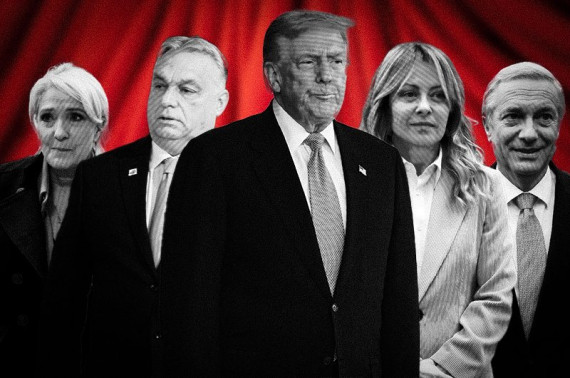
At the seventh annual transatlantic summit of the Political Network for Values in Belgium, it was clear that “Make America Great Again” politics have found strong allies beyond the US.

Far from being sidelined voices, the agenda was championed by prominent and influential figures, including current and former senior politicians from across Europe, the Americas and Africa.

Read more below.

- openDemocracy

 
EDITOR'S PICKS
 
1
What Latin America’s press misses about Venezuela

Spanish-language media moved from migration fatigue to geopolitical fervour after the kidnapping of NicolĂĄs Maduro Read more... 

2
Not just oil, the Venezuela invasion is about preserving the petrodollar

Money is power, and oil is a commodity – one that was once solely reliant on the dollar. The US knows that’s shifting Read more... 

3
PODCAST: After Maduro: Storm Warnings in Venezuela

Oil, Trump, an entrenched regime and a discontented populace make for an uncertain future in Venezuela Spotify | Apple


FEATURED STORY

Inside the summit uniting the world’s most successful far-right activists

Sian Norris

On a rainy Tuesday last week, Chile’s president-elect JosĂ© Kast took to a stage in the European Parliament to pledge allegiance to Donald Trump’s White House.

“We’ve worked together for so many years and generated links on both sides of the pond,” the incoming far-right president told his audience, hundreds of sharply dressed politicians, special advisers, think tank staffers and political influencers. “We want to see that alliance between the USA and Europe.”

In one month, Kast will be in power, having sold a now-familiar cocktail of populist anger, anti-immigrant sentiment, and anti-gender messaging around abortion and LGBTQ+ rights. In Brussels, his speech was both celebrated and echoed. “Freedom lovers around the world must work more closely with the US,” said Brazil’s former minister of foreign affairs, Ernesto AraĂșjo, when he was given the microphone. “This needs to be a transnational fight.”

Trump may spearhead that fight, but it’s a global war. And at the Political Network for Values’ seventh annual transatlantic summit in Belgium, which openDemocracy attended to report on, it was clear that Make America Great Again’s far-right agenda has a strong foothold in Europe, championed not by an oppressed and silenced majority, but by famous and influential actors, including current and former senior politicians from across Europe, the Americas and Africa.

 
SUPPORT OUR INVESTIGATIONS INTO THE MILITARY INDUSTRIAL COMPLEX
 
When I saw that the UK government had seconded an official to work with Rothschild & Co on defence policy, all paid for by you and me, I knew this was something I had to look into. The revolving door between government, private finance and lobbying firms needs to be exposed if we are to understand how money and power work in our politics. Nowhere is this more urgent than on questions of defence and national security, at a time when the government is investing more and more of taxpayers’ money on rearming Britain.
 
You can help keep me on this beat, as I dig into the contracts and cosy relationships between Labour, defence, and big finance. Will you donate to support my work today?
Please donate now
 

The Political Network for Values professes to be “a global platform of worldwide political representatives and leaders who actively promote and defend the values of family, life and freedom”. In practice, the network is one of the most skilled practitioners of using anti-gender politics to advance a wide-ranging attack on the basic tenets of liberal democracies around the world.

In the process, PNfV members have racked up political successes that other far-right groups can only dream of. Many of the summit’s speakers were politicians in their own countries, where they have already implemented anti-LGBTQ+ and anti-abortion policies, from Brothers of Italy attacking the rights of same-sex parents, Poland’s Law and Justice tightening restrictions on abortion access, Orban’s Fidesz passing “gay propaganda” laws, and Ugandan MPs passing one of the world’s most punitive anti-LGBTQ+ laws. Others were likely future leaders; the summit was co-hosted by Patriots for Europe, whose chair, far-right MEP Jordan Bardella, is leading polls to win France’s general election next year.

Also present were PNFV members from the US, with links to the powerful lobby shaping Trump’s America First strategy. They included representatives from the Heritage Foundation, the think tank that authored the Project 2025 blueprint for Trump’s second term; the Alliance Defending Freedom, which credits itself with overturning the right to abortion in the US; and Family Watch International, which the Southern Law Poverty Centre designates a “hate group” due to its campaigning against LGBTQ+ rights in Africa.

As the latest Epstein files exposed the American far-right’s influence over Europe’s politics, members of this ultra-conservative network were openly peddling their views on the need to stand up to the “left-wing metropolitan elites” and their “LGBT agenda” from a stage in the European Parliament, while also encouraging one another to channel their funding through shadowy cryptocurrencies. This, combined with their allyship with a White House that is pulling away from the European Union and threatening NATO members, raises concerns that their movement is not just an issue for human rights, but European security.

A supposed crackdown on freedom of speech is at the heart of the Political Network for Values’ strategy – and was the main focus of its event, which was billed as a discussion on “free speech vs regulated speech”. Speakers consistently expressed paranoia that the promotion of conservative values is under attack in Europe.

“By arguing for ‘free speech’, these actors aim to distract us from the necessary legal protections we need for personal data and social media regulation,” Neil Datta, director of the European Parliamentary Forum on Sexual and Reproductive Rights, told openDemocracy.

“This leaves us vulnerable to foreign disinformation aimed to alter our political choices, to polarisation and radicalisation as well as the monetisation of our personal data making us vulnerable to scams, grifts and all forms of commercial exploitation. All of this combined poses a security threat – to our social cohesion as well as to our political and economic independence.

“Far from being ‘patriotic’, these Christian right forces would like to see Europe under the vassalage of the USA and/or Russia. Their plan is simple – stop the EU from doing its job of regulating to protect Europeans and leave us vulnerable to the whims of the White House and the Tech Bros and to the imperial ambitions of the Kremlin.”


AUDIENCE DISCUSSION

openDemocracy will be hosting an hour-long call with members of our staff and our audience. The call will be an opportunity for you to meet some members of the team including our editor-in-chief Aman Sethi and will give participants the chance to share their thoughts on openDemocracy and what they like about our coverage and feel is important in the media. 
 
Click below to express your interest in joining the call!
Chat with our staff
 

From the stage in Brussels, PNFV president and Croatian MEP Stephen Bartulica accused British prime minister Keir Starmer of imprisoning people for tweets he “does not approve of”. Father Benedict Kiely, a Catholic priest from London, claimed he might face arrest for his conservative views on returning home. Paolo Inselvini, an MEP from the ruling Brothers of Italy party, urged the network and its allies to “defend Christian values, freedom of expression and dignity of human life” in the face of the woke assault.

Inselvini also accused progressive non-governmental organisations in the EU of “trying to do away with posts that speak an uncomfortable truth, such as that children are born from a man and a woman”. This was echoed by numerous speakers who said European NGOs and Marxists are seeking to create a “dictatorship of political correctness”, an “EUSSR via regulation”, and a “Europe of lies.”

Such accusations directly mirror Trump’s National Security Strategy, which was published in November last year and accuses the EU of undermining “political liberty and sovereignty, migration policies that are transforming the continent and creating strife, censorship of free speech and suppression of political opposition, cratering birthrates, and loss of national identities and self-confidence”.

The Trumpian strategy goes on to reference the far-right ‘great replacement’ theory that claims white people in the Global North are being ‘replaced’ by immigration and low birth rates, warning of a risk that “certain NATO members will become majority non-European” in the coming years. At the Brussels summit, fears over the great replacement theory could be seen in another common theme: ‘gender ideology’.

The president of Peru’s Constitutional Court, Luz Pacheco, complained that people are unfairly accused of “homophobia” when they advocate for the family. Ugandan MP Lucy Akello warned that LGBTQ+ people are “forcing children into homosexuality” and received cheers when she claimed to have been a victim of a witch hunt over her support for Uganda’s 2023 Anti-Homosexuality Act. Laws “do not kill homosexuals”, she insisted last week, overlooking the fact that the act imposed the death penalty for “aggravated homosexuality”.

Avoiding the great replacement theory, the US National Security Strategy says, will require the White House to “prioritise cultivating resistance to Europe’s current trajectory within European nations”. The paper reserves praise for the “patriotic European parties” that the US believes are already leading that resistance through their “growing influence”.

The shape of that resistance was further outlined by the editor-in-chief of the European Conservative magazine, Alvino Mario Fantini, who asked the audience: “Are you ready to do the work so that the culture of the Judeo-Christian West will be saved?”

Fantini put forward a three-point plan to save the West, urging audience members to “defy them, the progressive elites” and “populate the culture with your own products; build parallel institutions. Schools, yes. We need alternative universities, not just Oxford and Cambridge. They're under the control of other people [...] It’s very important to create these networks.”

The third part of the plan, Fantini said, is cryptocurrency. He encouraged attendees “to use alternative finance mechanisms to create new payment processing systems, to create crypto-funded media, to take control of how the money moves and where it is stored...

You can read the rest of this article here.
 

COMMENTS

Sign in 💬

Our award-winning journalists can now respond directly to your comments underneath the articles on our site!

Just sign in or register underneath any of our articles to start leaving your thoughts and questions today.

Sign in and join the conversation

MORE FROM OPENDEMOCRACY

Weekly Newsletter
The Dark Arts
Bluesky Facebook X / Twitter Mastodon Instagram YouTube


openDemocracy, 18 Ashwin Street London, E8 3DL United Kingdom

Unsubscribe