Now, as we are confined to an increasingly smaller area, Palestinians’ daily lives are being recorded without our consent and turned into data points for the Israeli military and its private-sector partners in the defence industry.
Even as we live under this high-tech occupation, we are denied basic resources. Hebron requires roughly 150 megawatts of power every day, yet there is practically no independent Palestinian production of electricity. Israel holds the power, literally. The West Bank is reliant on the Israel Electric Corporation, which sells Palestinians only two-thirds of what we need.
In winter, we get just ten hours of daylight and temperatures drop to lows of 0℃. The bitter cold creeps into our poorly insulated homes, forcing us to rely on electric heaters. As demand for electricity increases and our underdeveloped infrastructure struggles to cope, electricity is rationed, and the city experiences repeated power outages. During particularly cold spells, these can occur up to several times a day, plunging whole neighbourhoods into darkness over and over for hours at a time.
With our lights, internet and heaters depowered, we sit by the glow of the fire, waiting. A minute or two later, some lights come back on; not ours, those of the Israeli army base and illegal settlement next to my home. The Israeli military and settlements are connected to a separate back-up power grid that does not provide electricity to us. Bright white military floodlights are cast at my house, watching it, watching us.
These selective outages are about more than simply preventing us from adequately powering our homes – they are used to restrict our movement and our freedom. Of the 89 permanent military checkpoints in the West Bank, at least 28 are within one square kilometre in Hebron City. These checkpoints stand between Palestinian homes and our grocery stores, schools and workplaces. To enter or exit our own neighbourhoods, we have to pass through one or more.
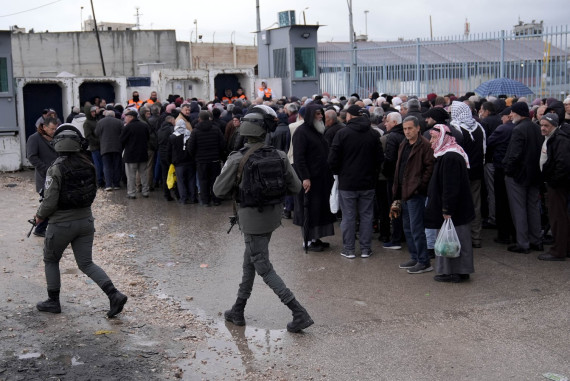
Despite being run by the Israeli military, these checkpoints are not hooked up to the same alternative emergency power grid as the army bases, infrastructure and settlements. When there is a power outage, they simply stop functioning. Turnstiles stop working, and people are trapped on one side, unable to enter or exit.
Soldiers refuse to let us use a different entry point, forcing Palestinians to wait for hours in the cold, in the rain, sometimes with young children, for the power to come back on. We are unable to go home, reach work, schools, or hospitals.
Sometimes the soldiers simply claim that a checkpoint has no electricity, even when the rest of Hebron has power, just to show us that they decide whether or not we pass. Israelis, on the other hand, can move around freely, driving on roads from Hebron to Jerusalem that have been permanently closed to Palestinians over the past 30 years, without passing through a single checkpoint or facing any disruption to life.