If someone forwarded you this email you can subscribe. View in web browser.

Hi ,

Something rare happened in Nairobi last November: people usually reduced to data points, risk scores or ‘beneficiaries’ came together as equals to challenge how technology is reshaping migration, borders and power.

The gathering brought together fellows from the Migration and Technology Monitor – a global initiative supporting people with lived experience of migration and occupation to investigate and resist the technologies governing their lives.

This is what they say must change.

- openDemocracy

 
EDITOR'S PICKS
 
1
Israeli border tech is not about security, it’s a tool for ethnic cleansing

In the West Bank, we are the unwilling test subjects for digital advancements in methods of population control Read more...

2
Fake visas and complex databases: Tech’s role in exploiting migrant workers

MPs sound alarm on self-swab kits, as new questions raised over how Bristol-based start-up Enough is failing women Read more...

3
PODCAST: After Maduro: Storm Warnings in Venezuela

Oil, Trump, an entrenched regime and a discontented populace make for an uncertain future in Venezuela Spotify | Apple


FEATURED STORY

Nothing about us, without us: Reclaiming power in an age of border technology

Petra Molnar, Florian Schmitz

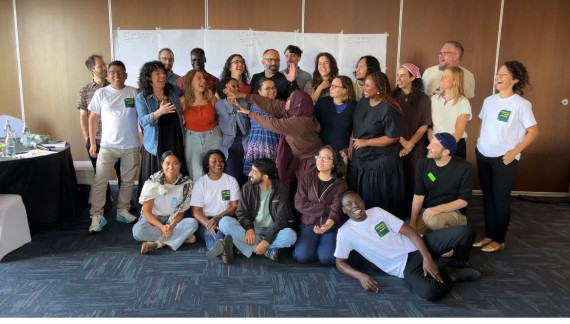
In November 2025, something rare happened in Nairobi, Kenya. People who are usually treated at worst as data points or risk scores and at best as ‘beneficiaries’ of innovation gathered as equals to collectively reflect on how technology is reshaping migration, borders, and power.

The occasion was the first in-person gathering of the Migration and Technology Monitor (MTM) Fellowship, a global initiative that supports people with lived experiences of migration and occupation to investigate, document, and challenge the technologies governing their lives.

Fellows travelled to Nairobi from across Africa, the Middle East, Southeast Asia, Europe, and the Americas. Some arrived after long, costly visa processes. Others were prevented from coming at the last minute, a reminder that borders do not pause even for those invited to discuss them.

This tension between connection and exclusion, care and control, lies at the heart of MTM’s work.

 
SUPPORT OUR INVESTIGATIONS INTO THE MILITARY INDUSTRIAL COMPLEX
 
When I saw that the UK government had seconded an official to work with Rothschild & Co on defence policy, all paid for by you and me, I knew this was something I had to look into. The revolving door between government, private finance and lobbying firms needs to be exposed if we are to understand how money and power work in our politics. Nowhere is this more urgent than on questions of defence and national security, at a time when the government is investing more and more of taxpayers’ money on rearming Britain.
 
You can help keep me on this beat, as I dig into the contracts and cosy relationships between Labour, defence, and big finance. Will you donate to support my work today?
Please donate now
 

Borders as testing grounds

Over the past decade, artificial intelligence (AI), automation, and data-driven systems have become central to how states control borders and manage migration. From biometric databases and predictive risk scoring to drones, spyware, and social media monitoring, borders have become laboratories for high-risk technological experimentation.

These tools are often introduced under the banners of efficiency, security, or innovation, but they operate in spaces where accountability is weakest and rights are most easily suspended. Crucially, people-on-the-move are almost always the first to experience these systems and the last to be consulted about them.

Much of this technological expansion is driven not only by states, but by a powerful and largely unaccountable border industry made up of defence contractors, data brokers, and tech firms that profit from exclusion. In this ecosystem, people-on-the-move are simultaneously framed as security threats and market opportunities, turning borders into lucrative sites of experimentation where harm is externalized and accountability is diffuse - where migration is seen as a problem to be solved by increasingly technological solutions, making passive profit for the private sector and centring power in computer labs and board rooms.

The Migration and Technology Monitor was created in 2020 to challenge this imbalance. Rather than producing research about affected communities, MTM is built on a participatory principle long articulated by disability justice movements and decolonial struggles alike: Nothing about us, without us.

After a rigorous application process (in 2025, we received 510 applications from all around the world), which includes vetting by the previous cohort of fellows, our colleagues-on-the-move are invited to incubate their work at the MTM for 12 months, supported by a full-time stipend, monthly webinars, and various resource support. In the three cohorts, we have incubated 16 fellows from all over the world and watched a unique global community take shape.

Our recently released report goes into broader detail of our methodology, lessons learned, and where we hope to go from here.


AUDIENCE DISCUSSION

openDemocracy will be hosting an hour-long call with members of our staff and our audience. The call will be an opportunity for you to meet some members of the team including our editor-in-chief Aman Sethi and will give participants the chance to share their thoughts on openDemocracy and what they like about our coverage and feel is important in the media. 
 
Click below to express your interest in joining the call!
Chat with our staff
 

A different kind of fellowship

MTM’s Fellowship Program flips the traditional research model on its head. Fellows are not research assistants or ‘field contacts’. They are investigators, researchers, journalists, technologists, artists, and organisers with lived experience of displacement – experts in their own right, people with lived experience of migration who are funded, supported, and trusted to lead inquiry into the technologies shaping their worlds.

Over the past three years, fellows have documented spyware attacks against journalists-on-the-move, biometric surveillance in refugee camps, algorithmic profiling at borders, digital harms faced by LGBTQI+ communities in displacement, and the quiet ways people resist and survive technological control. This work is deeply contextual. It is rooted in specific places like refugee camps, border zones, cities, and online platforms, and in everyday realities often invisible to policymakers and technologists. It is also collaborative: fellows learn from one another across regions, sharing strategies, tools, and care.

Supporting this work requires more than research funding. It means investing in digital security, psychosocial support, translation, and trust. It means accepting that knowledge production is slow, relational, and sometimes messy, especially when it is done with the explicit recognition that people with lived experience are the true experts on what is happening in their lives and communities.

Our goal at the MTM is not blind benevolence. Rather, we strive to integrate the expertise of our colleagues-on-the-move into broader debates on the future use of technology, especially because lived experience is hardly ever taken into account by stakeholders in the field, especially those developing and deploying technologies in the Global North.

The Nairobi gathering

After nearly a year of planning, the Nairobi gathering was the first time many of these collaborators met in person. Our fellows were joined by an invited group of stakeholders from the Global North working on border tech, and over two days, participants shared work, reflected on failures and successes, and named the emotional toll of researching harm while living inside it.

Importantly, the gathering was not a conference designed to extract insights for reports destined for distant audiences. It was a co-learning space, shaped by fellows themselves, that centred collective care, accountability, and future-building (we were also joined by some surprise spouses and two babies – a real look to the future!)

Participants spoke openly about the risks they face: transnational surveillance, online harassment, criminalisation, and burnout. They also spoke about joy, solidarity, and the power of being in a room where lived experience was not treated as anecdotal, but as expertise.

That shift, from being studied to being heard, is political – and powerful, too.

Towards a manifesto

One of the most significant outcomes of the gathering is the MTM Manifesto, a living document drafted by the MTM fellows. It is not a fixed policy document or a set of technical recommendations. Instead, it is a living articulation of values and principles for how technology in migration contexts should be imagined, governed, and resisted, written by those most affected.

The core text is published as the base for a more experience-inclusive debate on technology and how it affects all of us. The public is also invited to leave comments and make suggestions, which will gradually be transformed into amendments to the manifesto.

While the current narratives around migration frequently foster a mentality of ‘them vs us’, we instead aim at an open, inclusive, constructive, and holistic approach. Discussing the impacts of technology and formulating future guidelines functions as a connecting agent and allows us to also look at migration from different angles...

You can read the rest of this article here.
 

COMMENTS

Sign in 💬

Our award-winning journalists can now respond directly to your comments underneath the articles on our site!

Just sign in or register underneath any of our articles to start leaving your thoughts and questions today.

Sign in and join the conversation

MORE FROM OPENDEMOCRACY

Weekly Newsletter
The Dark Arts
Bluesky Facebook X / Twitter Mastodon Instagram YouTube


openDemocracy, 18 Ashwin Street London, E8 3DL United Kingdom

Unsubscribe