If someone forwarded you this email you can subscribe. View in web browser.

Hi ,

Washington calls it 'promoting democracy.' History calls it the Monroe Doctrine.

While the mainstream media focuses on the chaos of the moment in Venezuela, they are missing the 200-year-old pattern staring us in the face. From economic strangulation to regime change rhetoric, the US is dusting off a colonial playbook that treats Latin America not as a collection of sovereign nations, but as a 'backyard' to be managed.

To understand the present crisis, you have to look past the breaking news and look at the map. The names in the White House change, but the strategy remains remarkably consistent.

Read more below.

- openDemocracy

 
EDITOR'S PICKS
 
1
In a Hindu-Christian city, a Muslim family lights a lamp for Shabbat
Why openDemocracy still has hope as we go into 2026.
Read more...
2
In Ghana’s markets, ‘brotherly bonds’ with Nigeria are being testednts?
The Ghanaian government has taken a custom and levies approach to a centuries-old 'immigrant trader' phenomenon, that seems impossible to enforce.
Read more...
3
Israel is acting with impunity. Is it overconfident in Trump’s support?
Horrified by IDF war crimes in Gaza, more Americans are said to support Palestine than Israel for the first time ever.
Read more...
 

FEATURED STORY

Venezuela and the journey from Monroe’s Doctrine to Trump’s Jungle Law

Diana Cariboni

As the days pass, shock subsides over the kidnapping of Venezuelan president Nicolás Maduro and his wife, Cilia Flores, which was ordered by Donald Trump and carried out by the US military. That the victim is a dictator has helped to justify the illegal use of brute force.

There is a long history of US military intervention in Latin America. It’s been the expression of the most enduring principle that has governed relations in the American continent.

Everything Trump did in the first year of his second presidential term was old news: tariff wars, interventions in the internal affairs of other countries, threats, extortion and the revival of the old Monroe Doctrine.

What is new is the brazenness, the absence of even the slightest legal justification, or even the effort to frame actions within some interpretation of international law, however twisted it may be. There is no talk of democracy, freedom or human rights for millions of Venezuelans.

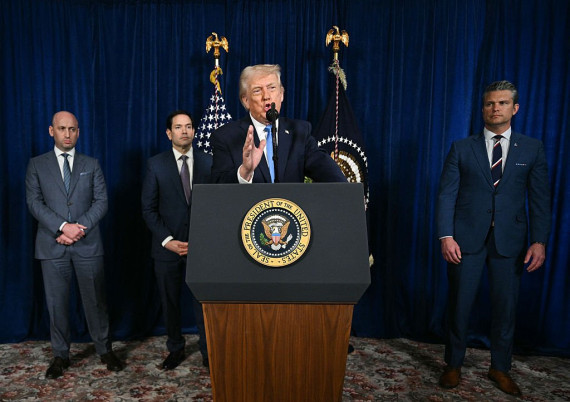
This is an unexplained and uncontested exercise of power. “What's next, Mr President, Colombia?” journalists asked Trump like subjects asking their emperor. “It sounds good to me,” he replied. Mexico, Colombia, Cuba, Greenland... “American dominance in the Western Hemisphere will never be questioned again.”

The threat is material – Maduro in handcuffs, the naval deployment in the Caribbean, the boats bombed for months – and at the same time diffuse. No one knows what the logic or the alleged motive for the next action will be.

The effect of Trump’s actions, already tested with the so-called “peace deal” for Palestine in the aftermath of the Israeli genocide in Gaza, is to sow confusion and division, and paralysis. The era of this new power has begun with little to oppose it, and with international laws useless like broken toys. And we are all warned.

Maduro was extracted from his bunker in eight minutes, which was enough time to kill 32 Cuban guards who were protecting him. The rest of the regime remains intact, now as the executive arm of Trump's designs, which have articulated only one priority: oil.

 
Is MAGA a religion? Why has protest been criminalised in England and Wales? Who is profiting from anti-immigration sentiment? And how can we engage with young men who’ve fallen down the alt-right pipeline? 
 
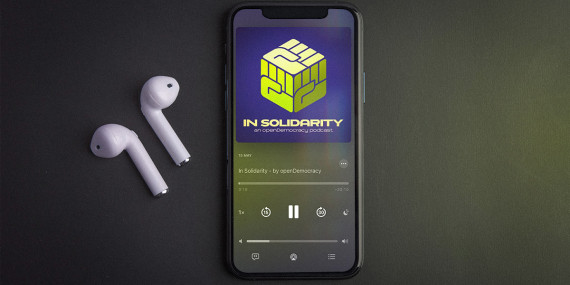
These are just a few of the questions that we’ve put to leading thinkers, frontline activists, and global experts on our new podcast, In Solidarity, over the past six months.
 
In Solidarity is a podcast for people who understand that politics doesn’t just happen in the halls of power. Every show, we tackle a new theme to uncover how authoritarianism spreads, who is benefiting from fear, and how solidarity is evolving into resistance movements around the world.
 
To ensure you never miss an episode of In Solidarity, subscribe to get an email notification whenever a new one is released. 
Subscribe to episode notifications
 

When asked about elections, democracy or the release of some 800 political prisoners, Trump and his secretary of state, Marco Rubio, reply that all this “is premature”. The nature of the events indicates the coup was orchestrated with a part of the regime whose head was Maduro.

Nothing remains of Venezuela’s Bolivarian revolution of the 1990s, not even dignity. Delcy Rodríguez, Maduro’s vice-president and one of the most vocal figures in his administration, has been appointed interim president, with Trump’s acquiescence. She and her brother Jorge, the president of the National Assembly, Diosdado Cabello, the minister of the interior, and Vladimir Padrino López, the head of the armed forces, have become administrators of a Trump protectorate – a new, perhaps provisional, status quo that sets Venezuela and all of Latin America sailing into uncharted waters.

The eternal misunderstanding

In a speech to the US Congress 202 years ago, US president James Monroe laid the foundations for his new country's relationship with the other republics emerging across the American continent amid struggles against the European colonial powers.

That relationship would be one of US dominance and Latin American subordination, although the Monroe Doctrine was presented as a warning against new European colonial adventures in America.

“America for Americans” – Monroe's phrase that coined the eternal misunderstanding – postulated that America, the continent, was for them, who called themselves “Americans”. In that single remark, the rest of the American peoples were left in an inferior category, confined to their nationalities or to a subordinate belonging to the same single continent (Latin Americans, South Americans, Central Americans or Caribbeans). Never simply Americans.

Other US presidents followed Munroe’s lead. More than five decades after his doctrine came Rutherford Hayes's corollary of 1880, on the need for the US to have exclusive control in Central America and the Caribbean, and therefore of any interoceanic canal, followed by Theodore Roosevelt's corollary of 1904, which postulated the freedom of the US to intervene by force in any country on the continent if it considered that its interests were affected.

Just a few weeks ago, on the anniversary of the Monroe Doctrine, Trump published his own corollary, which contains nothing new, though the foreign power to keep away now is no longer Europe but China. The novelty lies in what began in Venezuela.

The question of democracy

In December, the UN reported that Venezuela's human rights situation was continuing to deteriorate. In 2021, the International Criminal Court's prosecutor opened a formal investigation into crimes against humanity, such as torture, disappearances and executions at the hands of the state.

Like Delcy Rodríguez now, Maduro became interim president in 2013 after the death of leader Hugo Chávez. Shortly afterwards, he won the elections by a narrow margin and, from 2015 onwards, took an openly authoritarian turn when he refused to recognise the result of parliamentary elections that left him without a majority in the National Assembly.

Opponents of the regime tried different approaches to overthrow it. To name just a few: peaceful demonstrations, violent actions, calls for a military uprising, attempts to get neighbouring governments to blockade the country, support for economic sanctions by the US and the European Union, complaints to international organisations, boycotts of elections they considered rigged, negotiations with the regime mediated by third countries, and massive participation in elections. None of this moved the needle.

Despite the opposition's victory in the 2024 presidential elections, Maduro was once again proclaimed president, through fraud.

Then Trump reappeared, with a military deployment unseen in decades, indiscriminate bombing of ships in the Caribbean and the Pacific, and persecution and stigmatisation of Venezuelan migrants as terrible criminals and mentally ill people ravaging US cities.

The main opposition leader, María Corina Machado, who recently won the Nobel Peace Prize, clung to this strategy like a lifeline in the storm. She argued that the military siege, theaccusations of narco-terrorism against Maduro and his circle, and the imminent military action by Washington would bring down the regime and open the door to a transition. Shortly after Maduro's kidnapping, Machado proclaimed: “Today we are prepared to assert our mandate and take power.”

Trump's response could not have been colder. He removed her from the scene, claiming she lacked the necessary “respect” and “support” for the moment.

In an interview with Fox News on Monday, Machado tried again to court Trump and said she wanted to give him her Nobel Peace Prize, which the US president has long coveted and considers himself deserving of. The body that awards the prize, the Norwegian Nobel Institute, was forced to clarify that it cannot be transferred to third parties.

There were celebrations by Venezuelans in exile in cities across the western hemisphere when Maduro's overthrow was announced, but not within Venezuela. Maduro no longer governs there, but the same regime does, under Trump’s shadow.
 
Will you help defend democracy?
 
A world in turmoil needs fearless, independent investigative journalism that can overcome censorship and hold power to account. 
That’s the kind of media you deserve - and you can support it when you donate to openDemocracy today. When you give today, you can:
  • Keep openDemocracy free to read for everyone
  • Provide our team with the support they need to work safely in a dangerous world
  • Deliver the reporting that matters to you – and that reaches as many people as possible
Please support independent non-profit journalism by donating today.
Please donate now
 
Senior executives from BlackRock, one of the world’s most controversial companies, last week sat down opposite Keir Starmer and chancellor Rachel Reeves in Downing Street.
 
The government’s laser-focus on private investment as the key means of driving economic growth has inevitably led to a reliance on the world’s big money machines, such as BlackRock. But this is a relationship that Labour initially developed in opposition – and which has only become cosier since the party entered government.
 
The meeting on Thursday between Starmer, Reeves, investment minister Poppy Gustafsson and several members of BlackRock’s board was not the first time that senior figures from the world’s largest asset manager have met with ministers in recent months.
 
BlackRock CEO Larry Fink also made a star turn at Labour’s investment summit in October and posed for pictures with the prime minister when he visited New York in September. Senior BlackRock figures also attended a summer reception for business leaders at No 10, as openDemocracy revealed previously.
 

COMMENTS

Sign in 💬

Our award-winning journalists can now respond directly to your comments underneath the articles on our site!

Just sign in or register underneath any of our articles to start leaving your thoughts and questions today.

Sign in and join the conversation

MORE FROM OPENDEMOCRACY

Weekly Newsletter
The Dark Arts
Bluesky Facebook X / Twitter Mastodon Instagram YouTube


openDemocracy, 18 Ashwin Street London, E8 3DL United Kingdom

Unsubscribe