If someone forwarded you this email you can subscribe. View in web browser.

Hi ,

Ecuadorians have dealt President Daniel Noboa his first electoral defeat, rejecting all four questions in a referendum that polls had predicted would pass.

Voters turned down proposals to allow foreign military bases, cut public funding for political parties, shrink the National Assembly, and convene a constituent assembly to rewrite the constitution.

The vote came just days after Noboa responded with heavy-handed repression to nationwide protests and a 31-day strike sparked by his plan to scrap fuel subsidies.

Read more below.

- openDemocracy

 
EDITOR'S PICKS
 
1
Ecuador: When legitimate protest becomes ‘terrorism’

Taking from Trump’s playbook and reviving colonial trope, President Noboa labelled Indigenous protesters ‘terrorists’ Read more...

2
Yet another government has failed to deliver for Disabled people

Like her Conservative predecessors, Labour’s Reeves has blamed Disabled people for the state’s problems Read more... 

3
PODCAST: End Times with Renata Salecl: What Post-Socialist Societies Teach Us About Today

In this episode host Aman Sethi speaks to Renata Salecl,  a Slovenian philosopher, sociologist and political theorist to decode how the experiences of post-socialist countries can help us understand the crisis gripping the West Spotify | Apple


FEATURED STORY

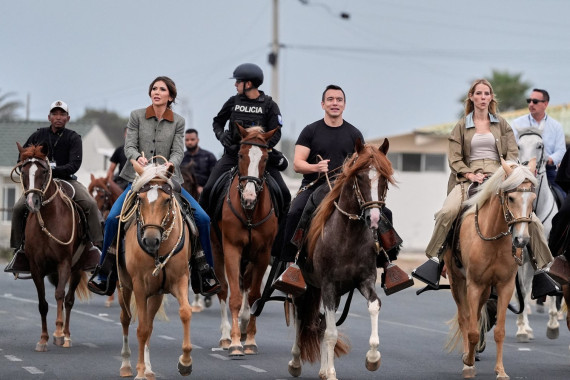
Ecuador referendum: No more blank cheques for President Noboa

Anahi Macaroff

This month, Ecuadorian citizens answered unexpectedly decisively in a four-question referendum proposed by president Daniel Noboa, defying all polls to deliver his government's first electoral defeat.

Voters were asked whether they supported building foreign military bases in Ecuador, cutting state funding for political parties, reducing the number of assembly members, and convening a constituent assembly to draft a new constitution.

They voted no on all four counts.

The referendum came days after Noboa responded with heavy-handed repression to protests and a 31-day national strike sparked by a government decree to remove fuel subsidies and increase the price of diesel – a measure demanded by the International Monetary Fund.


Will you help defend democracy?

A world in turmoil needs fearless, independent investigative journalism that can overcome censorship and hold power to account. 
That’s the kind of media you deserve – and you can support it when you donate to openDemocracy today. When you give today, you can:
  • Keep openDemocracy free to read for everyone
  • Provide our team with the support they need to work safely in a dangerous world
  • Deliver the reporting that matters to you – and that reaches as many people as possible
Please support independent non-profit journalism by donating today.
Please donate now
 

Arrogance and repression

Ecuador is facing a crisis in its health system and levels of crime that, according to the most recent surveys, are increasing general feelings of pessimism in the country.

In January 2024, two months after he took office at a snap election, Noboa declared the existence of a “non-international armed conflict” due to public insecurity, making the discourse of war the central theme of his government's agenda.

The president used this argument to increase VAT – claiming the extra fiscal resources would be used to combat drug trafficking – and override the rules and procedures of democratic institutions. His government militarised the streets and prisons and suspended rights such as the inviolability of the home and freedom of assembly for almost a year.

Despite these measures, 2025 appears to have been the most violent year in the history of Ecuador, with a 6% increase in the homicide rate compared to the second-worst year, 2023.

Bolstered by winning the April 2025 presidential election and entering his second term with control of Parliament, Noboa used a measure intended to fast-track ‘urgent economic laws’ to push through regulatory reforms to fight the ‘armed conflict’, such as authorising the interception of communications without a court order and allowing authorities to use techniques such as fake identities – effectively legalising infiltration into social and cultural groups, Indigenous movements, and trade unions.

These reforms were soon accused of being unconstitutional, leading the Constitutional Court to provisionally suspend 17 articles. The president then declared the court “an enemy of the people” and launched a crusade against it. He decided to submit four reforms to citizens for consideration, including a proposal to draft a new constitution – an idea he had raised during the election campaign.

Noboa’s main argument for both needing a new constitution and holding this month’s referendum was the need to fight organised crime.

This was the same argument he had used for the 2024 referendum, when voters were asked 11 questions that required constitutional reforms, such as whether to allow the army to support the police in combating drug trafficking and increase criminal penalties for terrorism. The public said yes to the nine questions that related to security issues and rejected the two on labour flexibility and international arbitration.

This year, two of the four questions on the referendum had little to do with security: the elimination of state funding for political parties and the reduction of the number of legislative seats. Both appealed to the alleged popular discontent with the political system and were expected to receive majority support. Some analysts considered them to be ‘bait questions’, designed to provoke an emotional reaction and elicit a ‘yes’ response.

The other two questions – on the approval of foreign military bases and the call for a new constituent assembly – monopolised the debate between the Yes and No campaigns.

The No vote, a citizen campaign

On all questions, the government-led Yes campaign was riddled with contradictions.

 
Is MAGA a religion? Why has protest been criminalised in England and Wales? Who is profiting from anti-immigration sentiment? And how can we engage with young men who’ve fallen down the alt-right pipeline? 
 
These are just a few of the questions that we’ve put to leading thinkers, frontline activists, and global experts on our new podcast, In Solidarity, over the past six months.
 
In Solidarity is a podcast for people who understand that politics doesn’t just happen in the halls of power. Every show, we tackle a new theme to uncover how authoritarianism spreads, who is benefiting from fear, and how solidarity is evolving into resistance movements around the world.
 
To ensure you never miss an episode of In Solidarity, subscribe to get an email notification whenever a new one is released. 
Subscribe to episode notifications
 

Noboa went so far as to claim that everything was ready to install a US military base in the Galapagos, an archipelago in the Pacific that contains more than 20% of the planet's biodiversity and has been declared a World Heritage Site by UNESCO.

After a backlash, Noboa backtracked and said that the Galapagos was no longer being considered as a location for any bases.

A few days before the referendum, he contradicted himself again by saying the bases’ primary purpose would not be for the military, but “the control of illegal fishing and the protection of ecosystems” – even though the question specifically referred to “foreign military bases”.

As for the call for a constituent assembly, the main argument for establishing one was that the current constitution’s guarantee of rights does not allow for progress in the fight against organised crime. The president said a new constitution would have just 180 articles (down from 444), though he refused to reveal the changes he would propose, saying they would be announced after winning the referendum.

The No campaign questioned this request for a blank cheque. In another blunder, the president mentioned that a new constitution could be drafted using artificial intelligence.

But the content of the economic laws rejected by the Constitutional Court and the statements by the spokespeople for the Yes campaign reveal a three-line political agenda.

The first line is the advancement of a repressive institutional framework and immunity for the armed forces that committed human rights violations. This was particularly worrying when details emerged of the disappearance and murder of four children in Guayaquil, who were illegally detained by military personnel in December last year.

The second is the attempt to eliminate free higher education, reduce health benefits under the social security system and cut labour rights.

The third is the deepening of Ecuador’s extractive model, which involves the extraction and export of raw materials like oil, gold, and copper. Doing so would require removing the constitutional recognition of nature as a subject of rights and returning to international arbitration in cases of conflict with foreign companies. This was one of the two questions that were rejected in last year’s referendum.

The government tried to portray the current constitution, adopted in 2008, as the brainchild of former president Rafael Correa, a controversial figure in Ecuadorian politics, who introduced progressive reforms, reduced poverty and invested a lot of public funding in infrastructure, but also attacked the Indigenous movement and was described as “economically populist, socially conservative, [and] quasi-authoritarian” in The Washington Post. While living in exile in Belgium in 2020, Correa was jailed in absentia for corruption, which he denies.

But those who backed the No campaign against a new constitution did so without the political banner of Correa’s party (or any other party), which allowed for a renewal of voices in a campaign with little unification of messages and a lot of freshness, giving it a strongly civic character.

While the ruling party invested large amounts of money in adverts on social media and in the media, even violating electoral rules, diverse and well-argued spokespersons for the No vote promoted emotive messages that focused on the future, rather than the past.

The No campaign took advantage of the media space available, while also doing a great job of reaching out to the public with songs, motorcades through parks, the delivery of a T-shirt to Pope Leo XIV, videos by influencers such as a former Miss Ecuador, and multiple actions by different organisations and movements. It channelled discontent with the authorities, overcoming the usual polarisation between Correa supporters and opponents.

Even though the government has refused to recognise the result of the referendum as a defeat, several analyses point out that the president ended up turning it into a plebiscite on his image. This means the result is not only a rejection of the proposed changes, but also draws attention to the government's performance and signals the end of the people's patience with this administration.

The No vote also constitutes a limit to the war rhetoric that until now has served as an umbrella for repressive and austerity policies, without tangible positive results in either security or economic recovery.

When analysing the vote in territorial terms, it is possible to see the effects of the national strike against fuel price increases; in provinces such as Imbabura, the epicentre of the demonstrations and repression, the No vote reached almost 70%.

However, it would be a mistake to read the results as direct support for Correísmo or left-wing political parties. It remains to be seen whether the rejection of Noboa's questions can be translated into the capitalisation of an alternative political project.

 

COMMENTS

Sign in 💬

Our award-winning journalists can now respond directly to your comments underneath the articles on our site!

Just sign in or register underneath any of our articles to start leaving your thoughts and questions today.

Sign in and join the conversation

MORE FROM OPENDEMOCRACY

Weekly Newsletter
The Dark Arts
Beyond Trafficking and Slavery 
Bluesky Facebook X / Twitter Mastodon Instagram YouTube


openDemocracy, 18 Ashwin Street London, E8 3DL United Kingdom

Unsubscribe