If someone forwarded you this email you can subscribe. View in web browser.

Hi ,

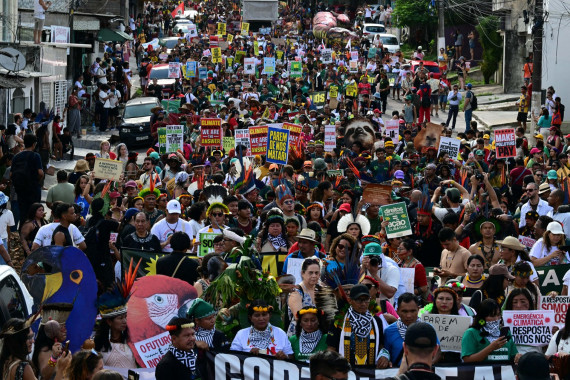
As COP30 concludes in Brazil, the question remains: whose voices shape the decisions made? Citizens’ assemblies — representative groups of ordinary people tasked with deliberating on policy — could help bridge the gap between governments, corporations, and the public.

Below, you can also explore our coverage from the past days of COP30, including reporting on the fossil fuel lobby, extractive industries, and the global push for climate justice.

- openDemocracy

 
EDITOR'S PICKS
 
1
COP30: It will take disaster in Global North to bring real climate action

Extreme weather is already killing people across Global South, but fossil fuel lobby’s influence is preventing change Read more...

2
The missing piece in COP30’s climate plan

A decade after the Paris Agreement, a new global race has begun Read more...

3
Indigenous women leaders: ‘Climate finance is a right, not a favour’

At a COP30 fringe summit, women who’ve protected the rainforests for centuries demand access to UN climate funding Read more...


FEATURED STORY

People are demanding a seat at COP30. It’s time they get one

Marcele Oliveira

BELÉM, Brazil - When I was 18, taking the bus from my neighbourhood in Realengo, Rio de Janeiro, to university, I noticed the stark absence of trees and green spaces. What should have been ordinary public spaces, parks where children could play or families could come together, didn’t exist. It was a sign that some lives, some communities are systematically excluded from decisions about the world they live in.

I, like many young people in my community, refused to accept it. We fought to transform an abandoned army munitions factory into Parque Realengo Susana Naspolini, a place where culture, community and nature intersect. That pulled me into climate activism and eventually led to my appointment as the Presidency Youth Champion for COP30.

My path has shown me that real change happens when people have the power to act, when their voices shape the policies that affect their lives.

Right now, our societies are being pulled apart by polarisation and distrust. This division is stopping us from taking the actions that everyone knows are necessary. The climate crisis doesn’t just demand new technologies but a new kind of politics that can bring people together across divides and give everyone a real voice in our shared future. Facing denial and disinformation will take both courage and strategy.


Will you help defend democracy?

A world in turmoil needs fearless, independent investigative journalism that can overcome censorship and hold power to account. 
That’s the kind of media you deserve – and you can support it when you donate to openDemocracy today. When you give today, you can:
  • Keep openDemocracy free to read for everyone
  • Provide our team with the support they need to work safely in a dangerous world
  • Deliver the reporting that matters to you – and that reaches as many people as possible
Please support independent non-profit journalism by donating today.
Please donate now
 

At the heart of today’s political crisis lies a deep sense of exclusion. Decisions about our lives, our communities and our planet are too often made behind closed doors by officials who are too often disconnected from our lived experiences. Many people feel that politics happens to them, not with them. Everyone deserves a voice. Only through deeper democracy and true inclusion can we move fast enough and put justice at the heart of the climate transition.

Countless governments and communities around the world have already shown what this looks like in practice. In 2020, the OECD published ‘Catching the Deliberative Wave’, a report documenting how citizen deliberation has helped tackle some of the hardest challenges we face. But it barely scratched the surface, overlooking many of the deep participatory traditions across the Global South.

In Brazil, participatory budgeting gives millions a direct say in how public funds are spent, building trust in governments. In Indonesia, the practice of Gotong Royong (mutual cooperation) and Bali’s Subak irrigation cooperatives have sustained social and ecological harmony for centuries. Across Kenya, Uganda, and Tanzania, the Baraza system brings communities together to hold leaders to account in public forums. And today, youth-led initiatives are connecting local solutions to global climate goals through the MutirĂŁo das Juventudes, a platform that maps projects from young people around the world and ensures voices feed into the broader COP30 Agenda.

These approaches share a deeper understanding of politics, one not built on competition or consensus alone, but on mutual respect and deep listening. When people truly hear one another across differences, new possibilities emerge. For example, the Citizens’ Assembly on abortion in Ireland mobilised participants who began with opposing views (anti-abortion and pro-choice) and ended up expressing profound respect, even affection, for one another. That process paved the way for historic legislation protecting women’s rights.

COP30, the people’s COP, is our opportunity to bring this spirit to the global stage. It must be remembered for launching a new kind of politics, one that deliberately brings together those who disagree, not to win arguments, but to understand each other’s realities and constraints, in order to build together a transition that works not only for the greater good but also for each one of us.

This is exactly the goal of the Citizens’ Track, just launched by the COP30 Presidency to connect thousands of local community assemblies worldwide to a permanent Global Citizens’ Assembly. The first track cycle aims to engage over 100,000 participants in 30 countries, with the initial findings to be presented next year at the Bonn Climate Conference.
 
Is MAGA a religion? Why has protest been criminalised in England and Wales? Who is profiting from anti-immigration sentiment? And how can we engage with young men who’ve fallen down the alt-right pipeline? 
 
These are just a few of the questions that we’ve put to leading thinkers, frontline activists, and global experts on our new podcast, In Solidarity, over the past six months.
 
In Solidarity is a podcast for people who understand that politics doesn’t just happen in the halls of power. Every show, we tackle a new theme to uncover how authoritarianism spreads, who is benefiting from fear, and how solidarity is evolving into resistance movements around the world.
 
To ensure you never miss an episode of In Solidarity, subscribe to get an email notification whenever a new one is released. 
Subscribe to episode notifications
 

The decisions ahead of us are not simple: How do we extract vital minerals for the green transition without destroying ecosystems or dividing communities? How do we protect forests while supporting the people who live within them? How do we care for workers in high-emitting sectors when their livelihoods are at risk? How do we bring justice, human rights and culture to the center of climate action?

Answering these questions requires more than expert reports or top-down policies, it requires listening to the people most affected. That is the spirit of the Global MutirĂŁo, a concept from Indigenous peoples of Brazil and put forward by the COP30 presidency: connecting local communities, their concerns and their willingness to act to global decision makers and climate goals.

One example of this approach, endorsed by Brazil, is the Global Citizens’ Assembly, which brings together both local and global assemblies where people can deliberate and share their perspectives, but also take action and request others to act.

In the words of Ana Toni, the CEO of COP30, “there is no sustainable transition without democracy”. That is why Brazil is committed to making COP30 the People’s COP, and to bring back citizen participation to the core of climate negotiations. Let’s now make sure that we pursue that vision beyond BelĂ©m.

Some politicians say we’re ‘losing the argument’ on climate. But that’s simply wrong. Strong and stable majorities across the world support more ambitious climate action. Over 80% of citizens globally say they support stronger measures, and 69% claim they would contribute 1% of their income to address the crisis.

The problem isn’t public apathy but political disconnection. Citizens’ assemblies can help to bridge that gap. That’s why I believe that they could become COP30’s most enduring legacy: to stop simply fighting for the planet and start reimagining how humanity decides its future, together.


Marcele Oliveira is the COP30 Presidency Youth Climate Champion and is leading the mobilisation of children, teenagers and youth in the Global Mutirão against Climate Change. Director of Perifalab, she is a cultural producer and has been working since 2019 to fight environmental racism in Realengo, in Rio de Janeiro's West Zone. Founder of Coalizão o Clima é de Mudança, she was part of the Realengo 2030 Agenda and the Youth Climate Negotiators program.


COMMENTS

Sign in 💬

Our award-winning journalists can now respond directly to your comments underneath the articles on our site!

Just sign in or register underneath any of our articles to start leaving your thoughts and questions today.

Sign in and join the conversation

MORE FROM OPENDEMOCRACY

Weekly Newsletter
The Dark Arts
Beyond Trafficking and Slavery 
Bluesky Facebook X / Twitter Mastodon Instagram YouTube


openDemocracy, 18 Ashwin Street London, E8 3DL United Kingdom

Unsubscribe