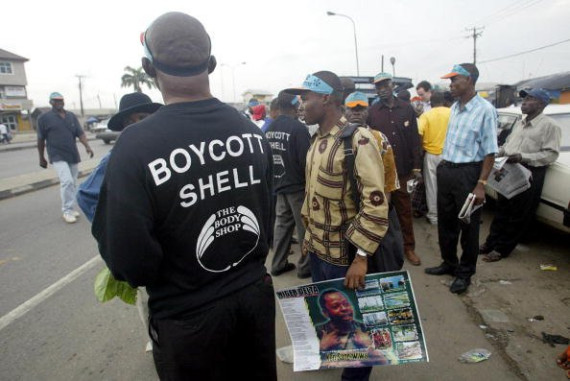
Instead of taking responsibility, oil companies continue to exploit Nigeria’s weak regulatory framework and have failed to implement meaningful clean-up efforts. Shell, in particular, has instead invested in PR campaigns that are widely considered to be misinformation; underreporting oil spills caused by operational failures, exaggerating those attributed to sabotage or illegal ‘bunkering’, relying on flawed spill investigations, and criminalising local communities.
After years of denials, multinational oil companies are now fleeing the scene of their devastating pollution. In January this year, Shell announced its full divestment from onshore Nigerian assets, following a decade-long withdrawal from individual oil mining leases. While framed as a response to operational challenges and a commitment to the energy transition, many international organisations and Nigerian activists have argued that this is a calculated retreat to avoid accountability for billions in accrued liabilities.
Local resistance and international solidarity
Despite the deteriorating situation on the ground, the Ogoni people and Niger Deltans more broadly remain steadfast in their determination to continue the fearless struggle ignited by the Ogoni Nine.
Grassroots activist and director at We the People, Ken Henshaw, believes the core pillars of Saro-Wiwa’s campaign – community mobilisation, inclusive organising, and international solidarity – endure today. “The tactics might have developed, but the fundamental strategy remains unchanged,” he said.
This was made clear at the Niger Delta Climate Change Conference I attended in July, which convened grassroots actors and international allies. Stressing Saro-Wiwa’s vision for ecological justice, self-determination and a rights-based approach to resource governance, activist Celestine AkpoBari spoke about the Niger Delta Alternative Manifesto. This paper builds on the Ogoni Bill of Rights to call for a comprehensive ecological audit, reparations, bans on gas flaring (the controlled burning of excess natural gas that is released during oil extraction), and long-term climate resilience strategies.
As the struggle evolves, new tactics have also emerged to demand accountability – most notably, litigation, with communities pursuing justice through international courts.
In 2015, Ogoniland’s Bodo community, represented by UK law firm Leigh Day, won a landmark £55m settlement from Shell for damages caused by two devastating oil spills in 2008, which released over 500,000 barrels of oil and destroyed over 2,000 hectares of mangrove forest. The oil giant’s inadequate clean-up efforts came under further scrutiny at an ongoing trial that began in May this year, with the claimants requesting further remediation costs estimated at over £500m. That the environment allegedly remains unclean 17 years after the spill – despite litigation having placed it in the spotlight - reveals Shell’s resistance to clean up across the Niger Delta broadly.
Leigh Day is also representing more than 13,000 members of the Bille and Ogale communities in ongoing claims for compensation and environmental remediation. Following a four-year meritless jurisdictional challenge by Shell, the case, which was filed in 2015, is finally set for trial in 2027, after a key legal ruling in June 2025 that clarified Nigerian law in favour of the claimants.
These cases highlight both the promise and the limitations of litigation: while not a panacea, legal action can amplify community voices, expose corporate wrongdoing, and reinforce the nonviolent, democratic values that Saro-Wiwa championed.
As the energy transition has been co-opted by corporate interests, the Ogoni Nine’s legacy reminds us that the struggle for environmental justice is a global fight against corporate exploitation. It must endure until true accountability and liberation is achieved universally.
In this spirit, we stand in solidarity with the Ogoni people’s resistance to the proposed resumption of crude oil extraction in Ogoniland. We urge the UK government to use its leverage over North Sea licences to press Shell for environmental remediation and compensation in Nigeria. We call on citizens everywhere to stand in solidarity with the Niger Delta and all oppressed peoples, demanding a just transition, including justice for past harms and liberation from neocolonial grip of corporate power.
Saro-Wiwa’s final words before his execution were prophetic: “The struggle continues.”
Indeed, it does – and we all have a role to play.