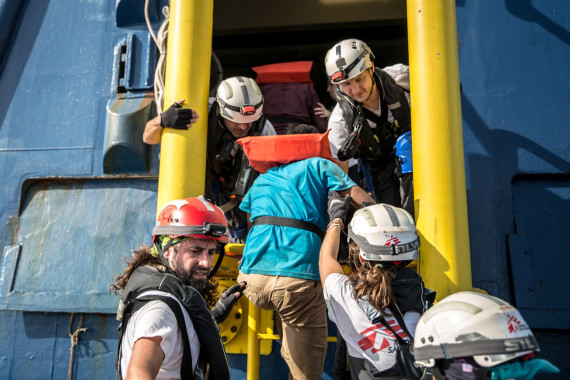
Lighthouse Reports’ 2024 “Desert Dumps” investigation – covering Libya, Tunisia and Morocco – revealed how security forces systematically drove migrants deep into the Sahara desert and abandoned them, often without food, water, or access to healthcare. The report also alleged EU complicity.
The EU, which had recently inked a lucrative deal with Tunisia that included funding for migration control, faced some scrutiny. And by the end of the year, the European Commission had agreed to review its Tunisia financing following allegations of beatings and sexual violence by the forces it backed. But then Foreign Secretary David Lammy, undeterred by the reports, offered in January 2025 to provide the Tunisian coastguard with night vision gear, surveillance equipment and an offer of cooperation to “smash the gangs”.
Border empires
Academics call this process border externalisation: the export of border infrastructure to evade accountability, invisibilise violence, and solve domestic political debates through pushing them into other countries. From Australia to El Salvador, these policies have made some people very rich, whilst failing to achieve either their aims or respect people’s basic rights and dignity.
Compared to the US or EU, the UK is a relatively small player. Its most significant piece of externalisation so far has been the much-derided Rwanda deal, which Starmer closed before a single person was deported out of Britain. But whilst it scrapped the Rwanda arrangement, Britain’s new government quietly continued and extended its predecessor’s border externalisation agenda.
In 2021, then Home Secretary Priti Patel toured the prison-like camp on Samos, Greece where accusations of serious abuses are numerous and conditions have been found to cause or exacerbate the psychological and physical suffering of those held in the site. In a 2024 bilateral meeting, Starmer and his Greek counterpart agreed to deepen joint work on preventing migration. This followed a British-made documentary alleging Greek security forces’ role in the deadliest Mediterranean migration shipwreck on record.
Starmer’s praise for Giorgia Meloni’s agenda in Italy was meanwhile swiftly followed by an attempt to replicate her plan for offshore camps in Albania. This was despite Meloni’s Albania deal collapsing, with €100m in public money “squandered”, as one Italian MEP put it. The British delegation left Tirana empty-handed – but soon afterwards No. 10 insisted nine other countries were interested in similar arrangements. Kosovo has now agreed to accept rejected asylum seekers.
The UK has also been closely involved – under both the Conservatives and Labour – in border cooperation with Poland, which last year “temporarily” abolished international refugee law at its border with Belarus. This came after three years of building walls, massive military deployments, migrant injury and deaths in the inhospitable border forest, and the persecution of humanitarians trying to help.
Most recently, Starmer inked a deal with the Vietnamese government to fast-track deportations for Vietnamese nationals who arrive in the UK irregularly – despite concerns raised by Human Rights Watch about the country’s political prisoners, and high prevalence of modern slavery among Vietnamese migrants.
Meanwhile in both Lebanon and Turkey, the UK supports migration regimes that have also seen violence and arbitrary detention, with Syrians forced back across the border into war zones.
No mercy
Another war zone is of particular relevance to Britain. European countries are increasingly keen to strike deportation deals with Afghanistan’s Taliban government. British participation in a disastrous two-decade war in Afghanistan could not keep the Taliban from regaining power, and in the process worsened conditions in the country, leading Afghans to be now vastly overrepresented among those arriving on small boats across the Channel.
Meanwhile, horrific new war crime allegations have emerged against British special forces in Afghanistan, with a single special forces officer vetoing over 1500 asylum applications from Afghans who served alongside the British military. Britain also put thousands of Afghans at risk from reprisal in dozens of data breaches, forcing people to flee. At least 49 relatives and colleagues of those named in the data breach have now been killed.
Nigel Farage is not normally someone you’d imagine to be friendly with the Taliban or the EU, but his poll-topping Reform UK is demanding the UK follows Europe in sealing a deportations deal with Kabul. One would be hard-pressed to find a more obvious example of border externalisation being proposed as a solution to a migration emergency generated in large part by foreign policy failures.
Closer to home, as France eyes bringing its deadly tactics from overseas territories in Africa to bear in the Channel, the UK is stepping up its engagement through the one-in one-out deal. The deal’s effectiveness was recently brought back into question after an Iranian man returned to the UK on a dinghy after being removed to France.
Despite Britain’s crippling cost of living crisis, billions have been ploughed into Channel projects. Whilst expensive surveillance towers built by US weapons companies spring up on English beaches, a joint Anglo-French fund has expanded its reach, including support for increasingly violent attempts to prevent people crossing to France from Italy.
Collectively, this broad strategy involves and extends Britain’s border machinery, weapons and surveillance firms, and security forces across the rest of the world.
Self-defeating grand strategy
After barely days in office in July 2024, the UK government took centre stage at the European Political Community summit to pledge £84m for projects in Africa and the Middle East that would tackle “illegal migration at source”, including for Libya, Egypt, Chad, and Ethiopia.
This funding was to come from the overseas aid budget. Starmer would later follow the US and many European countries in cutting that budget back, signalling an intent to use what remained in a more transactional manner. Now externalising logic is being embedded into its policy across the board.
In March this year, Starmer hosted a major international summit dedicated to “tackling illegal migration”. Forty countries were invited to build the basis of an international border control coalition. Commitments included £30 million for “high impact operations” across Europe, the Western Balkans, Asia, and Africa.
Predictably, there was no engagement with the evidence on the real root causes of smuggling, as laid out in openDemocracy’s recent series on the criminalisation of migration. A combination of states restricting safe routes, maintaining political and economic models that fuel conflict and inequality – and of course the role of European cooperation in supporting violent actors who are also linked to both smuggling and trafficking – has created a perfect storm of factors pushing people migrating to rely on ever more dangerous routes and unscrupulous actors.
Starmer will not be rewarded by Britain’s right for his reactionary international turn on migration. He has pursued this strategy since day one in government, but nevertheless his popularity has collapsed relative to Reform; alienating progressives whilst failing to woo conservatives. But whilst his rhetoric can never be as inflammatory as Trump’s call for the UK to use the army against migrants, in policy terms he is creeping ever closer to the hard-right consensus on migration management.
In practice, externalisation is not border control – it’s border chaos. It undermines rather than strengthens sovereignty, dissipating force and responsibility across unaccountable global structures. It expands a mostly for-profit machine driven by political interests and untethered to any real metric of effectiveness – much less to fundamental moral or legal principles.
The Labour government internally frames such radical shifts on migration as a last-ditch attempt to preserve the international order and outflank the radical right. In fact, it risks simply developing, at public expense, ever more dangerous global infrastructure for more malicious actors to use.