If someone forwarded you this email you can subscribe. View in web browser.
Author Photo Aman Sethi
Editor-In-Chief

“The vagabond is by definition a suspect,” historian Daniel Nordman wrote in Frontières de France, his 1998 book on how states came to monopolise free movement in the 17th and 18th centuries. And so it is today for migrants (like me), refugees (like my grandparents), asylum seekers and their descendants.

Here in the UK, Reform, the Tories and sadly even Labour have raced to blame, marginalise, and scapegoat anyone who isn’t white for the many economic and social malaises plaguing this country, without actually crossing the line into outright racism (until Reform MP Sarah Pochin this week went on a properly racist rant about seeing too many Black and Asian faces on television). 

But as our stories for this week reveal, racism, xenophobia, and anti-immigrant sentiment are on the rise across the world, with country after country treating outsiders as outright criminals who must be detained and isolated from the rest of society.

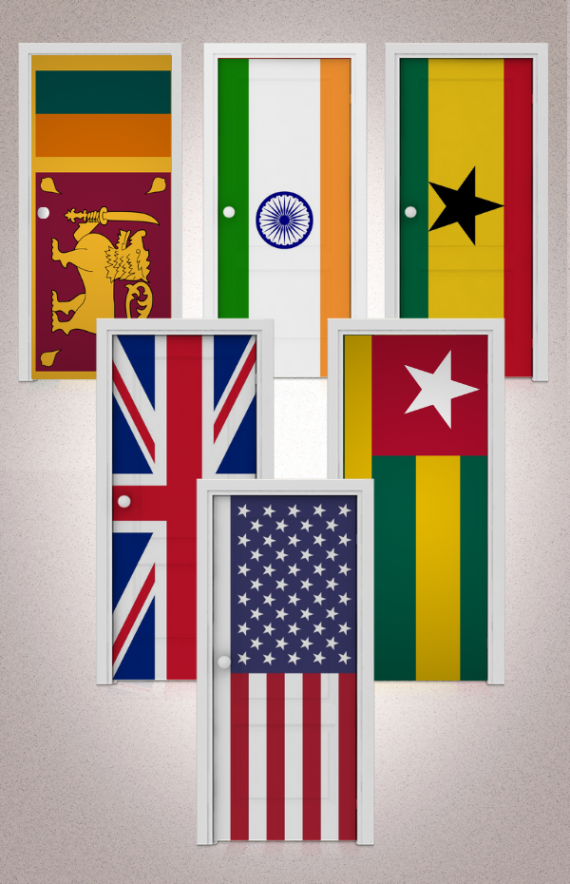
In this edition, we bring you news from Ghana, the UK, Brazil, India, and Venezuela via Germany – each united by a common thread: the profoundly human desire for freedom, opportunity and safety, pitted against the coercive impulses of nation states. 

We invariably get a lot of comments whenever we publish stories about immigration; I understand this is a sensitive subject for many. So if you have a different view, don’t unsubscribe – write us a comment and stay on for the conversation.

Ghana and Trump are bargaining with lives. Ghanaians are pushing back • Emmanuel Ameyaw, Ayodeji Rotinwa, Indra Warnes

After they were captured by ICE, after they were booked for deportation proceedings from the US, and after they were put on a plane bound for the Ghanaian capital of Accra, the deportees arrived at what would be their temporary ‘home’ in Ghana: the Bundase Military Camp.

At the camp, none of the deportees had access to running water or bedding, women were denied sanitary products, and those who were sick were denied healthcare, according to Oliver Barker-Vormawor, a lawyer representing 11 of the deportees in court. “The place was not designed to keep humans,” said Barker-Vormawor of the conditions the deportees told him they were held in.

Barker-Vormawore believes 42 deportees have arrived in Accra from the US in groups of around 10 to 15 over the past few weeks. The lawyer said the Ghanaian government’s secrecy makes it difficult to establish the exact number of arrivals...

Continue reading

Kavin came here to work. He ended up a modern slave. • Sian Norris

When Kavin* travelled to the UK from Sri Lanka last year, he was excited for a fresh start. A keen sportsman who’d previously worked as a personal trainer, he’d secured a visa and a job in a convenience store in the north of England, and was full of hopes and dreams for his new life. But his reality quickly descended into a nightmare. The shop’s manager, whom Kavin’s family had known in Sri Lanka and who had sponsored his visa, took away his phone, passport and visa when he arrived in the UK. He forced Kavin to work long hours without breaks or any possibility of time off. After a month of gruelling labour, Kavin was paid £100 – far, far below the national minimum wage. But when Kavin raised these issues with his manager, he was threatened with losing his job – and his right to remain in the UK...

Continue reading

LGBTQ+ migrants at risk in UK detention centres due to poor staff training • Sian Norris

Private companies awarded lucrative government contracts to run immigration detention centres in the UK are failing to properly train staff on the needs of LGBTIQ+ migrants, new documents reveal.

openDemocracy has reviewed diversity and equality training slides for staff at immigration removal centres run by Serco and Mitie, two of the UK’s biggest immigration service providers. The slides wrongly refer to the migrant people who are held in the centres while awaiting deportation or release, many of whom are very vulnerable, as “prisoners”.

And while the training materials, which were obtained by London-based charity Rainbow Migration under Freedom of Information laws, educate staff on how to recognise and combat racism, they often fail to offer equivalent information on tackling homophobia or addressing the specific vulnerabilities of LGBTIQ+ detainees...

Continue reading

Brazil refugees: Forming collective resistance where policy fails • Clarissa Paiva, Beatrice Jemeli Chelimo, Mariana Zawadi Kitenge Mukuna

It is 10 a.m. in downtown São Paulo, Brazil, and a queue is already forming outside the civil society organisation Pacto pelo Direito de Migrar (PDMIG – Pact for the Right to Migrate). They are men, women, and children from Angola, Venezuela, the Democratic Republic of Congo, Cameroon, Afghanistan, and many other countries. Each face tells a story, carries pain, and holds hope.

PDMIG has become, for many, a place of new beginnings. People share their stories of hunger, war, persecution, gender-based violence, and joblessness. They have questions answered and draw on support while they await the outcome of their visa and asylum applications. One thing unites all who go there: the desire to be recognised, to legally exist in a foreign land so they may rebuild their lives...

Continue reading

Displacement from Venezuela taught me that class has no borders • Erick Moreno Superlano

We were forced to leave our home in Venezuela after government supporters attempted to kill my mother. I cut short my undergraduate degree and travelled to Germany, where I sought refuge.

I was determined to continue studying, convinced that education would be my way forward. But the German system made it hard for someone like me to get in. I could only access university by taking a year-long preparatory course, which required passing a competitive entrance exam.

On exam day, I stood in line with dozens of non-European students. Another Venezuelan there had studied at the Humboldt School, one of Caracas’s most elite institutions. Around us were students from Lebanon, China, Nigeria, Brazil – graduates of international schools, fluent in German and English, prepped to circulate globally.

I didn’t make the cut...

Continue reading

Worse Than Trump: India is Deporting Its Own Citizens | With Abhishek Saha

🎙️ Indian authorities have been rounding up Muslim citizens and deporting them with horrific callousness, sometimes going as far as pushing them off of boats into the ocean


We know immigration is a sensitive issue. Whether you share our views or not, we want to hear what you think.

I have thoughts (email supporters@opendemocracy.net)

Previous weekly poll: Does the new right feel different from the past?

 Yes (72%)  
 
 No (28%)  
 

Will you help defend democracy?

A world in turmoil needs fearless, independent investigative journalism that can overcome censorship and hold power to account. 
That’s the kind of media you deserve – and you can support it when you donate to openDemocracy today. When you give today, you can:
  • Keep openDemocracy free to read for everyone
  • Provide our team with the support they need to work safely in a dangerous world
  • Deliver the reporting that matters to you – and that reaches as many people as possible
Please support independent non-profit journalism by donating today.
 

Please donate now


COMMENTS

Sign in 💬

Our award-winning journalists can now respond directly to your comments underneath the articles on our site!

Just sign in or register underneath any of our articles to start leaving your thoughts and questions today.

Sign in and join the conversation
Bluesky Facebook X / Twitter Mastodon Instagram YouTube


openDemocracy, 18 Ashwin Street London, E8 3DL United Kingdom

Unsubscribe