The following day, his son’s sixth birthday, police found a decapitated body stuffed into a bag in the area where they think Laurta arrived in his canoe. It was Martín Palacios, the Uber driver, who had been reported missing by his family and whose burned-out car was found on the outskirts of Córdoba days earlier. Laurta didn’t want to leave any witnesses.
On 15 October, when Laurta was taken to court for questioning, he shouted to journalists: “I did it all for justice.”
For Argentinian feminists, Laurta’s plan and killings reveal more than individual brutality: they mark the consolidation of a new phase of politically motivated gender violence, in which far-right discourses align with those of the online ‘manosphere’ and translate into fatal real-world actions.
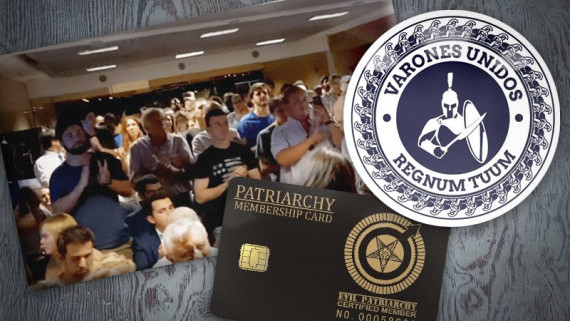
Laurta, a Uruguayan media entrepreneur, has spent more than a decade building an increasingly influential network of men who share his ideology. In Montevideo in 2014, he founded Varones Unidos (VU, United Men), a group that he said seeks to “raise greater awareness about the violation of men’s human rights”. VU’s website says one of its objectives is: “to combat the promotion of hatred against men and the implementation of abusive, predatory, or discriminatory policies against men”.
Two years before Laurta killed her, Giardina had reported him to the Argentinian police for domestic violence, alleging that he threatened, beat and attempted to strangle her. A restraining order was placed against him – a measure often taken by the area’s courts while police investigate – which he was later arrested for violating by spending three days hiding under the family’s water tank to spy on his former partner. After being released on bail, Laurta fled to Uruguay, where he began repeatedly posting far-right and misogynist talking points online, claiming Córdoba’s “feminist justice system” had facilitated the “abduction” of his son.
“What this double femicide exposes is the complete alignment between misogynist violence and far-right propaganda,” Verónica Gago, from Argentinian social movement against feminicide Ni Una Menos, told openDemocracy. “There’s a direct link between digital hate, masculinist supremacy and femicidal violence. Media coverage that legitimises these narratives helps create the conditions for such crimes.”
VU’s support for gender-based violence like that committed by Laurta is clear on its website. One blog post examines the case of a man who murdered his ex-wife and then killed himself, which it calls a “tragedy of passion”. VU blames the murdered wife, claiming: “If we look at the facts, these men have largely not been violent toward women in general, and often do not have a history of aggression toward their partners, but rather explode into violent outbursts as a result of some perceived betrayal of loyalty between spouses.” It adds: “when feminism incites women to disrespect, offend, attack men… it encourages these unfortunate acts of violence against which it claims to fight”.
Despite its extreme views, the group has 112,000 Facebook followers and has forged close and well-documented links with at least five current and former senior politicians in Uruguay’s National Party and Colorado Party, which were part of a right-wing conservative coalition that left government in March after five years in power.
These politicians worked closely with VU to pass a much-criticised law on shared parental custody in 2023, as well as inviting Laurta to speak at conferences in Uruguayan Parliament. In 2018, Laurta was given a parliamentary venue to host an event to promote The Black Book of the New Left, a book that has become a cornerstone for Latin America’s conservative and anti-gender movements. The 2016 book was co-authored by Nicolás Márquez, the official biographer of Argentina’s far-right president Javier Milei, and Agustín Laje, the founder of a conservative think tank that promotes Milei’s libertarian ideas. Both Márquez and Laje attended the event.
The notion of the “manosphere”, online communities that promote misogyny and gender violence, is now part of everyday conversation. VU, the group Laurta founded, illustrates the manosphere in action: The group often takes its cues from influential well-known right-wing figures – both in Latin America and around the world.
As well as Laje, Márquez and Milei – who in January told the World Economic Forum in Davos that “gender ideology is nothing less than child abuse” – VU has drawn inspiration from powerful figures in the US, including president Donald Trump billionaire X owner Elon Musk, in its efforts to adapt the global far-right ‘men’s rights’ playbook to Uruguay’s local politics.
Last year, Musk reposted an argument on his X account that since “only high T [testosterone] alpha males and aneurotypical people” are able to think freely, “a Republic of high status males is best for decision making. Democratic, but a democracy only for those who are free to think.” Trump, meanwhile, often walks on stage to James Brown’s It’s A Man’s Man’s Man’s World and has made countless misogynistic comments over the past decade, such as telling an audience during last year’s election campaign that his opponent, Kamala Harris, “certainly can’t handle [Russian President Vladimir] Putin, President Xi of China. She will get overwhelmed, melt down and millions of people will die”.
These are not just throw-away comments; they are calls from two of the world’s most powerful people to men around the world, such as VU’s tens of thousands of followers, to join the resistance against women who ‘threaten their rights’. The men these messages attract “are organised, coordinated, and united around the same goal,” warned Sara Barni, an expert in family law and the founder of Argentine feminist network Red Viva that has been following Laurta’s crimes.
Anthropologist Pablo Camacho, who has studied VU for years and has interviewed Laurta and other members of the group, told openDemocracy that members believe the world has tipped too far toward women’s rights, leaving men marginalised. When Camacho asked group participants how they came to join VU, some replied with stories such as: “I tried to hit on a girl in high school and she ignored me because she was a feminist, so she doesn’t like men,” or “Feminism gave women too many rights; they’ve gone too far.”
“These conceptual leaps position themselves as victims and feminism as the great threat to society – an enemy attacking Western male culture,” Camacho said, explaining that this framing leads the men to believe feminists “must be stopped”. That constant assertion of masculine authority, he added, “is always present, because behind correction lies power. If I want to correct you, it’s because I hold power over you.”