If someone forwarded you this email you can subscribe. View in web browser.

Hi ,

Across Latin America, progressives are divided on how far to go in condemning Israel’s war on Gaza.

While Colombia’s Gustavo Petro joined pro-Palestinian protesters in New York and Chile’s Gabriel Boric called at the UN for Netanyahu to face the International Court of Justice, others have been far more cautious.

Leaders like Uruguay’s Yamandú Orsi and Guatemala’s Bernardo Arévalo have avoided using the word “genocide”, opting instead for calls to end civilian suffering, support a two-state solution, and secure the release of Israeli hostages.

Read more below.

- openDemocracy

 
EDITOR'S PICKS
 
1
In Ghana, an Israeli attempt to whitewash Gaza genocide faces pushback

An Israeli film festival accused of being ‘propaganda’ was marred by protest, prompting one sponsor to pull out Read more...

2
Daring to dream after two years under fire: Life in Gaza

For two years, our lives have been on hold amid constant air strikes and fighting. Now, we finally have reason to hope Read more...

3
PODCAST: Now that we have to say 'genocide' | With Lila Hassan
Did Western media manufacture consent for Israel's ongoing genocide of Palestinians in Gaza? Read more...


FEATURED STORY

Cries and silence: Latin American progressives divided on criticism of Israel

Dacil Lanza

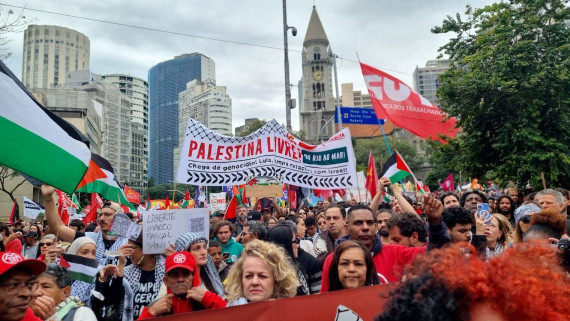
Last month, Colombian president Gustavo Petro used a megaphone to support pro-Palestinian protesters on the streets of New York while wearing a keffiyeh. Days earlier, his Chilean counterpart, Gabriel Boric, had told the UN General Assembly that he wanted to see Israeli prime minister Benjamin Netanyahu brought before the International Court of Justice.

These were powerful moments. But after two years and 67,000 Palestinians killed, Israel’s war on Gaza still has not elicited the same unanimous condemnation among Latin America’s progressive parties and governments as the South African apartheid did in the twentieth century.

While Petro and Boric, as well as Brazilian president Luiz Inácio Lula da Silva and Mexican foreign minister Juan Ramón De la Fuente Ramírez, denounced Israel’s attacks on Gaza as “genocide” at the UN last month, other leaders of the so-called regional progressivism have avoided using such language.

Instead, Yamandú Orsi, president of Uruguay, spoke at the UN of “barbarism” and “the suffering and death of the civilian population in Gaza”. Guatemala’s Bernardo Arévalo voiced support for the two-state solution and the release of the remaining 48 Israeli hostages (20 of whom are believed to still be alive) who are still being held by Hamas, having been kidnapped during the group’s attack on southern Israel on 7 October 2023.


Will you help defend democracy?

A world in turmoil needs fearless, independent investigative journalism that can overcome censorship and hold power to account. 
That’s the kind of media you deserve – and you can support it when you donate to openDemocracy today. When you give today, you can:
  • Keep openDemocracy free to read for everyone
  • Provide our team with the support they need to work safely in a dangerous world
  • Deliver the reporting that matters to you – and that reaches as many people as possible
Please support independent non-profit journalism by donating today.
Please donate now
 

Latin America is broadly supportive of Palestinian rights. All states in the region except Panama recognise the state of Palestine – even Argentina, whose right-wing government led by Javier Milei was one of just 10 countries to vote against a UN resolution on a two-state solution last month – and only Guatemala does not have a Palestinian embassy. Mexican president Claudia Sheinbaum also officially welcomed the country’s first Palestinian ambassador, Nadya Rasheed, earlier this year – becoming the latest country in Latin America to do so.

But the region has been less united on how far it is willing to criticise Israel’s assault on Gaza over the past two years.

Weeks after the assault began, Bolivia, along with four other countries in Africa and Asia, filed a complaint against Israel with the International Criminal Court (ICC), sparking an investigation into alleged war crimes and crimes against humanity. Two months later, in January 2024, Chile and Mexico also denounced possible “war crimes” committed in Palestine before the ICC. The investigation has since led the ICC to issue arrest warrants against Israeli authorities and Hamas leaders.

Also in January 2024, Brazil became the first Latin American nation to describe Israel’s actions as a possible “genocide”, with its foreign ministry releasing a statement in support of a South African lawsuit accusing Israel of genocide at the International Court of Justice (ICJ).

Colombia officially applied to join South Africa’s genocide case in April 2024, and Mexico did so the following month, while former president Andrés Manuel López Obrador was still in office (Sheinbaum, who took office in October last year, did not use the word “genocide” until a press conference last month). Chile applied to join in September 2024, Bolivia in October 2024, Belize and Cuba in January 2025, and Brazil last month.

None of this was endorsed by Uruguay, which is often upheld as particularly progressive and has been governed by a left-wing coalition of parties called Frente Amplio (FA, which translates as Broad Front in English) since March this year.

Its government has refrained from denouncing Israel’s actions as “genocide”, despite pressure from social movements and some sectors of the FA, although the coalition’s parliamentary groups did not shy away from calling it such in a statement released last month. “The terrorist act perpetrated by Hamas on 7 October 2023 does not justify, under any circumstances, the ongoing genocide,” they said.

“There are no differences within the political force,” Fernando Gambera, the president of the FA's International Affairs Commission, told openDemocracy, saying that the coalition and the individual parties that comprise it “have concluded that what is happening in Gaza is genocide”.

But activist Mónica Riet from Uruguay's Coordination for Palestine, an umbrella network of trade unions, student and social organisations, told openDemocracy that the FA “has not had a clear definition of condemning genocide and breaking ties with the Zionist government”.

Yamandú Orsi’s administration, Riet noted, has instead merely paused Uruguay’s academic exchange contract with Israel, while other countries in Latin America have taken more drastic measures. Bolivia, Colombia and Nicaragua, for example, have severed diplomatic ties with Israel, and Bolivia, Colombia, Cuba and Honduras have joined the The Hague Group, which seeks to apply legal and diplomatic sanctions against Israel for its breaches of international law. Petro's government in Colombia has also banned coal exports to Israel.

Chile versus Argentina

Neighbours Chile and Argentina, which have historically both been supportive of a two-state solution, could not be further apart in their positions today. Chile is governed by a coalition of left-wing and centre-left parties, while Argentina’s right-wing administration is allied with Donald Trump and Binyamin Netanyahu.

Chile is home to nearly 400,000 people of Palestinian descent – the largest Palestinian community outside the Arab world – and has been clear in its support for Palestine over the past two years.

In October 2023, weeks after the assault on Gaza began, Chile made a $200,000 contribution to the United Nations Relief and Works Agency for Palestine Refugees, and later went on to receive 68 refugees from Gaza. Under pressure from the Chilean-Palestinian Interparliamentary Group and the Chile-Palestine Friendship Group in the Senate, President Boric also withdrew Chile’s military attachés and recalled its ambassador to Israel.

The Chilean Defence Ministry also excluded Israeli companies from the 2024 International Air and Space Fair in Santiago, while the country’s Foreign Ministry told openDemocracy that it has introduced bills to ban “the import of products produced in illegally occupied territories”. Israel is Chile’s primary arms supplier, but the ministry said it is taking measures to “stop depending on Israeli industry”.

“We have supported diversifying defence suppliers and thereby cutting contracts with Israeli suppliers [given] their total disregard for international law, which are the common rules to which all armed forces in the world must submit,” ruling party MP Jorge Brito, a member of the Chilean-Palestinian Interparliamentary Group and the parliamentary defence committee, told openDemocracy.

Argentina’s right-wing President Milei, meanwhile, has unsurprisingly displayed unwavering alignment with Israel and the US. What is more shocking, though, is the lukewarm response from the country’s progressive opposition, which is in stark contrast to the position the Argentine government held on apartheid in the 1980s. Back then, president Raúl Alfonsín cut all diplomatic relationships with South Africa and joined the international boycott against South Africa.

While former president Cristina Fernández de Kirchner, the leader of Congress’s largest centre-left movement, was quick to condemn the 7 October 2023 Hamas attack on Israel, she remained silent on Israel’s actions in Gaza until last month, when she posted a video of a right-wing politician denouncing Israeli crimes on X with a caption that accused Israel of “genocide”.

Fernández’s coalition movement, the Unión por la Patria (Union for the Motherland), which has a left-wing Peronist majority, did not speak out about Israel’s war crimes in Gaza until in February of this year, when it drafted a resolution urging the executive to “reject the statements made by US president Donald Trump about ‘cleaning up the Gaza Strip”’.

The Unión por la Patria has since drafted a motion against Israel's plans to occupy the Strip militarily and to “express concern about the serious humanitarian crisis affecting the civilian population” in Gaza. The coalition also called for Netanyahu to be “declared persona non grata” after it was announced that the Israeli prime minister was planning to make an official visit to Argentina (Milei later cancelled the visit, reportedly fearing the political fallout ahead of the parliamentary elections.) But still, for most of the past two years, its members and parties have largely avoided using the word “genocide” to criticise Israel, only doing so in the last few days as pressure mounted on Israel to agree to a ceasefire.

One of Unión por la Patria’s members, the Peronist Justicialist Party, also failed to accuse Netanyahu of “crimes against humanity” until last month, when it for the first time criticised Israel’s expansion in the West Bank and “indiscriminate killing in Gaza”.
 

WE RECOMMEND

When documentation, not rights, decides who belongs, citizenship itself gets rewritten – Varalika Singh shows how India’s giant biometric ID system is doing just that.

We're a leading international research network examining how criminal justice, state power, and migration control intersect. 

To get in-depth insights like this in your inbox every month, sign up to our newsletter.

Sign up now
 

And La Cámpora group, a Peronist progressive youth organisation led by Fernández’s son, Máximo Kirchner, has also been accused of failing to take a stand against Israel. Asked about this by openDemocracy, a source from the group said its website had been hacked in 2024 and some of its positions on Gaza had been “lost”. The source also shared two statements published on its website in September 2024, which criticised Israel's blockade of humanitarian aid and announced a day of reflection to highlight the situation in Palestine.

Meanwhile, Peronist politician Marina Femenía, an Argentinian member of the Mercosur Parliament for the South American trade bloc (which has no formal legislative powers), told openDemocracy that at the end of June, she and five others drafted a resolution to ask Mercosur member states to “enforce the ICC arrest warrants in the event that Netanyahu visits any of the member countries”.

But all of these actions and statements are considered insufficient by Argentine Trotskyist parties, who accuse Peronist leaders of “complicity” with Israel.

At more than 170,000 people, Argentina’s Jewish community is among the five largest in the world outside Israel. Similarly, there is a large Argentine community in Israel, and 21 of the 250 people taken hostage by Hamas on 7 October 2023 were Argentinian, as were nine of the people killed during the attack, according to the Argentine Foreign Ministry.

Two events in Argentina’s history, which were traumatic for society as a whole, but particularly for Jews, weigh heavily on its political positions: a terror attack on the Israeli Embassy in 1992 and on the Argentine Israelite Mutual Association (AMIA) in 1994. These attacks, which killed a total of 104 people and left nearly 500 wounded, remain unpunished.

Journalist and writer Ezequiel Kopel, an expert on the Middle East, told openDemocracy that these attacks “brought the Middle East conflict closer to the country and the local Jewish community” and “conveyed the feeling that they could be targets and not spectators”. Kopel added: “There is very strong support from Argentine institutions for what Israel is doing today.”

Although Argentina’s Jewish community has diverse positions on the conflict in Gaza, some of the institutions that hold more extreme opinions are particularly influential among the public, according to Kopel. In early 2024, for example, the then vice-president of the influential Delegation of Argentine Jewish Associations (DAIA), Sergio Pikholtz, asserted: “There are no innocent civilians in Gaza, perhaps only children under the age of 4”.

While Pikholtz was removed from his position for his “unfortunate statements”, his words resonated with some in Argentina’s Jewish community and even gained support on social media. The DAIA has flagged officials, legislators, journalists, and artists for criticising Israeli policy, which it labelled as anti-Semitism, and even files cases against left-wing leaders “for defending Palestine.”

“Jewish Institutions try to impose silence by accusing anyone who strongly criticises Israel of anti-semitism,” Kopel said. “And you have to ask, who wants that label? No one, least of all a progressive.”

Even the Argentine branch of human rights organisation Amnesty International was accused of pro-Israeli bias in August, after it failed to share a report on the genocide in Gaza that had been translated into Spanish and posted on the websites of Amnesty Chile and Amnesty Spain. Amnesty Argentina rejected the accusations and stated that “reports and positions on human rights violations in Gaza, as in any other part of the world, are also endorsed by Argentina, without ambiguity”, although it still did not use the word genocide.

A source at the Argentina office told openDemocracy that the report is now available on the Argentine branch’s website because “the entire organisation raises the same message: Israel must put an end to the genocide against the Palestinian population of Gaza and cease practices that cause death, deliberate starvation, destruction of civilian infrastructure, and forced displacement.” The source would not say when the report was published on the site.

“Argentine progressives are a special case,” said lawyer Andressa Soares, Latin American coordinator for the BDS (Boycott, Divestment and Sanctions) movement, which advocates international economic pressure against Israel. “Historically, Argentina has been a country that supported the state of Israel, and although the Palestinian state has been recognised by Argentina, it has generally been very difficult for progressives and even some human rights movements to speak out or begin to take action.”

But Soares says change is underway, especially in certain social and workers’ movements. “Argentine society is waking up, and this can be seen in its organisations. Recently, a dockworkers’ trade union called for sanctions, and several education trade unions are speaking out and calling for an academic boycott of their institutions [towards Israel].”


Dacil Lanza is a journalist specialising in international politics, currently working for France 24 in Spanish. She has contributed to media outlets such as the Italian newspaper Il Manifesto, Nueva Sociedad magazine and Cenital, among others. She worked for the Télam news agency and El Destape. She has reported from Brazil, Chile, Colombia and Spain, as well as countries in the Middle East, including Israel, Palestine and Egypt.


COMMENTS

Sign in 💬

Our award-winning journalists can now respond directly to your comments underneath the articles on our site!

Just sign in or register underneath any of our articles to start leaving your thoughts and questions today.

Sign in and join the conversation

MORE FROM OPENDEMOCRACY

Weekly Newsletter
The Dark Arts
Beyond Trafficking and Slavery 
Bluesky Facebook X / Twitter Mastodon Instagram YouTube


openDemocracy, 18 Ashwin Street London, E8 3DL United Kingdom

Unsubscribe