Alon Liel, a former diplomat and former director general of Israel’s Foreign Ministry, believes the festival is part of Israel’s larger hasbara programme, which takes its name from a Hebrew word meaning ‘persuasion’ and is widely understood to be propaganda.
Liel said his country’s hasbara efforts since 7 October have been futile and “the dream of peace” is the only way to improve Israel’s image.
“Hasbara will not change our situation,” He said. “The only thing that will change the Israeli situation for the better is a change of policy, ending the war, pulling out of Gaza and starting negotiations.”
Mohamad Elmasry, a professor of media Studies at the Doha Institute for Graduate Studies in Qatar, agrees with the hasbara characterization, explaining that it has intensified in recent years, driven by “an unprecedented image crisis.”
“One dominant approach has been to set context for the 7 October 2023 attacks on Israel, and ignore Israel’s destruction of Gaza and aggression in the West Bank,” Elmasry said. This plan has largely failed, he added, saying: “Most audiences see through the spin, and the result is often deeper resentment.”
The Israeli embassy denied the festival was propaganda, telling openDemocracy that it “was a pure culture event” – more of which “are coming”.
“The goal was to offer authentic stories that provoke thought and conversation, not to present a singular narrative,” the press officer, Appiah-Dolphyne explained.
Unease with Israel association
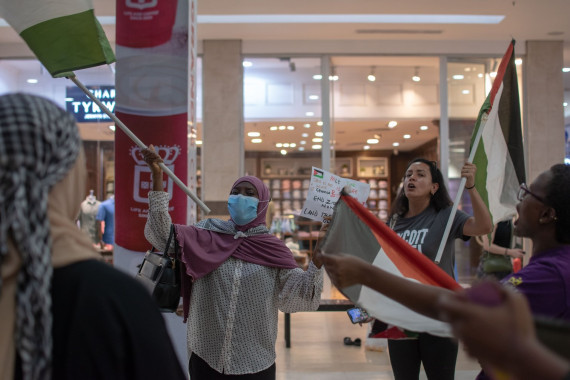
The protesters not only wanted to call out Israel’s “whitewashing” but to embarrass the host of the festival. They said Silverbird cinemas – whom they called “Silverblood” in their chants – was as guilty as those providing bombs to drop on Gaza, and hoped that calling it out would cause the event to be cut short.
The cinema seemed spooked. An agitated member of its management came down and tried unsuccessfully to talk down the protesters. Senior employees of the mall also tried to stop the demonstration, which they told openDemocracy was bad for business and was disrupting other shops.
The festival may not have been called off, but the controversy surrounding the protest appeared to cause one of its sponsors to have second thoughts.
The Kempinski Hotel Gold Coast City, a five-star hotel in Accra that is part of the Switzerland-based Kempinski Hotels brand, which owns dozens of luxury hotels around the world, had been advertised as a partner of the festival on social media posts by the Israeli Embassy since at least 29 August.
But on the day the festival was due to start, the company issued a statement to local media in the Ghanaian capital denying its involvement with the embassy and requesting the removal of its name and logo from the festival’s promotional material.
The hotel’s name was not featured on any subsequent social media posts, although it could still be seen on the pre-produced banners, posters and even the tickets for the screenings. The hotel declined to offer any further comment when openDemocracy reached out for clarity on its affiliation with the event.
The state-run University of Media, Arts and Communication’s Institute of Film and Television – some of whose students’ films were being screened at the festival – was also advertised as a leading partner of the event.
But various representatives of the school conveyed unease at the association with the festival. Only one of the student filmmakers attended any of the screenings, while a faculty member, Sela Adjei, told openDemocracy that some at the school did not want any association with Israel because of its genocidal actions against Palestine, warning that “we’ll become complicit”.
“If the whole world is standing in solidarity with Palestine because of the unfair treatment by the Israeli government and its military, then what business do we have partnering for cultural activities and cultural events?” Adjei asked.
A spokesperson for the university, Nana Efua Rockson, said that “management met three or four times to discuss the best approach to participating in the festival”, and ultimately decided that “we have no stance on what is going on in the global space”. Many will consider this sentiment at odds with the social justice-oriented ethos of former Ghanaian prime minister Kwame Nkrumah, who established the school’s journalism institute in 1959. Nkrumah wanted Ghana to produce journalists aware of political struggles abroad and actively involved in the emancipation of Africa at a time when most of the continent was still under colonial rule.
Asked how the school came to be involved with the festival, Rockson noted that it had signed a memorandum of understanding with the Israeli Embassy, but would not disclose further details. She emphasised that advancing its academic mandate was the school’s priority.
“We are a public institution here to promote academic excellence. So for us, any platform that gives us and our students the chance to showcase their work, we will take it,” she explained. The student shorts provided by the school for screening were dramas that had themes like mental illness, faith and even marital infidelity.
Other sponsors of the event included Israeli construction firm Rolider Ghana Limited; the Accra-based EON Engineering Solutions, whose two founding partners are Israeli; the STL Amandi Foundation, the charitable arm of a Ghanaian tech company whose CEO and business director are Israeli; and Sienna Services, an engineering and construction company operating in West Africa. None of the companies had responded to openDemocracy’s request for comment at the time of publishing.
For Silverbird, its association with the festival “was purely business”. The company’s business manager, Nana Yaw Twum Barima Yeboah, told openDemocracy that the cinema chain had a contract with the Israeli embassy and was being paid. “If Palestine comes here tomorrow,” he added, “I will host them and take their money.”
Twum also pointed out that Silverbird has held similar events under the banner of various consulates in the past. “The UK high commissioner has been here. The American consul has been here. The Indian high commissioner has been here; Peru, Mexico, Brazil, Colombia, Spain, a host of them,” he said.
But protestors believe this argument is not good enough, saying Israel’s actions in Gaza mean it must be met with greater moral fortitude.
“Tens of thousands of civilians are being killed,” said Gyan*. “I am not proud to be a Ghanaian citizen if Israel is allowed to carry on as if it is business as usual, because it is not.”
*names have been changed for source’s safety.