If someone forwarded you this email you can subscribe. View in web browser.

Hi ,

Who should be first in line for reparations?

Across the US, generations of Black children have grown up without fathers – a legacy of slavery, segregation, the War on Drugs and systemic racial violence. The fallout is clear: cycles of poverty, incarceration, and community violence.

Reparations scholar and activist Kamm Howard argues that reparations must start with Black fathers. A new plan combining basic income grants, training, and community support could begin to break the cycle.

Read more below.

- openDemocracy

 
EDITOR'S PICKS
 
1
How tech became the new frontier of domestic violence against women and girls

The government will not meet its pledge to halve violence against women and girls unless it tackles tech companies Read more...

2
Why we’re giving incarcerated women cash relief

We’re the first project to give women in prison recurring cash support. Our long-term goal is prison abolition Read more...

3
PODCAST: Sri Lanka, Bangladesh, Nepal: Is This A South Asia Spring? | With Roman Gautam
Journalist Roman Gautam and Editor-in-Chief Aman Sethi discuss if we are witnessing a South Asian version of the Arab Spring Read more...
 

FEATURED STORY

Reparations for racial injustice: Black fathers must be first in line

Kamm Howard

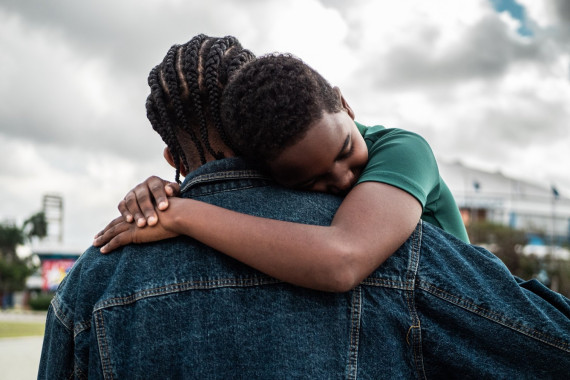
Across the US, increasing numbers of Black children are growing up without fathers. Some of these families have been fatherless for up to four generations, which has profoundly impacted the wellbeing of their children for decades.

These families’ fathers are absent because of systemic racial violence and the many societal practices that led to this violence. Children – especially boys – who grow up without their dads are more likely than their peers to get caught up in that cycle of violence themselves.

Black boys are disproportionately more likely to end up in prison than their white peers, and Black people are more likely to experience police misconduct than white people. Large cities with the largest Black populations suffer from some of the highest levels of community violence in the United States. From murders to shootings and carjackings, the statistics are bleak.

We want to interrupt this cycle. Many of the egregious racial injustices which formed our current system constitute crimes against humanity. These are crimes which should be accounted for, and justice should be had. I believe there’s no better place to start than with Black men growing up fatherless. This country needs widespread reparations to heal the wounds caused by institutional racism, slavery, segregation and the War on Drugs.

I am a reparations scholar and activist, and the executive director of Reparations United, a US organisation educating and organising people for restorative justice. We have designed a programme to support fatherless men to stay in and help heal their families and communities, through a combination of reparative basic income grants, training and community support.

We’ve set up a new entity, the Federal Redress Advancement Network, and we’re currently asking the Department of Labor to establish a work and skills restoration initiative with a reparative basic income to redress the Jim Crow-era crimes that it, the department itself, committed. Our plan is ready: it now needs to be put into action.


FOLLOWING THE FLOTILLA

openDemocracy stands with the Global Sumud Flotilla as it sails to Gaza carrying vital medical and food supplies.
 
We will be tracking its progress every day in our newsletters, and sharing photos from its journey.
 
To find out more about the flotilla and see how you can get involved and support its efforts, click the button below.
Find out more about the flotilla here
 

The community impact of absent fathers

The term ‘fatherlessness’ refers to a home where a father or father-figure is not present or engaged in nurturing, educating or supporting children in the household. Numerous studies show a correlation between fatherlessness and community violence, as well as truancy and school drop-out rates.

Where one has a low chance of employment in the formal economy, one must turn to the informal economy. Although informal work includes a wide range of legal and benign jobs –from babysitting and home barbers to street mechanics and repair work – many young people find opportunities in non-legal work that can sometimes lead to violence.

Fatherless Black men are also susceptible to being drawn into the drug economy, which has low barriers to entry. Many enter after being referred by someone else, and start off in roles such as a ‘lookout’ or a ‘runner’. Often their first packages are given on consignment or ‘fronted’ to them – requiring no upfront cash to start.

This flow into criminalisation – which is facilitated by over-disciplining in schools, and Black boys often being undereducated, misunderstood, and devalued – creates what is effectively a school-to-prison pipeline. The school to prison pipeline refers to the policies and practices that effectively push children out of schools into the juvenile justice system. Forty to sixty percent of juvenile offenders become adult offenders. And once suspended from school, they face many challenges in returning and many never graduate.

RBI could interrupt the cycle

For many men, breaking out of this and entering the formal labour market would require going through an intentional process of employability. This could include participating in courses and programmes such as life skills, trauma counselling, anger management, job skills, parenting skills, high school, and vocational education.

Many of these services are already available for free or at a low cost, but the incentives for using them are limited. The disincentives, on the other hand, can be formidable (starting with exposing oneself to the perception of being ‘damaged’, ‘dumb’, or ‘dangerous’).

A multi-year guaranteed reparative basic income (RBI) conditioned on engagement with these services could shift these dynamics. Lack of drug-use or related arrest, weekly attendance, and course completion could also be conditions for receiving the reparative basic income. These rules alongside the payment would not only incentivise reduced criminality, but also ensure participants could engage consistently without worrying about where their next meal will come from.

The average monthly income for street level drug dealers is $900-$1200. Our hope is to match that amount with a basic income of $900 – a straight trade between two life paths that doesn’t come with a financial penalty.

 
Will you help defend democracy?
 
A world in turmoil needs fearless, independent investigative journalism that can overcome censorship and hold power to account. 
That’s the kind of media you deserve - and you can support it when you donate to openDemocracy today. When you give today, you can:
  • Keep openDemocracy free to read for everyone
  • Provide our team with the support they need to work safely in a dangerous world
  • Deliver the reporting that matters to you – and that reaches as many people as possible
Please support independent non-profit journalism by donating today.
Please donate now
 

Through this reparative programme, participants would acquire the skills and training to enter the formal economy. We believe this would greatly help them to secure a steady income and become more active members of their communities – as neighbours, friends, brothers, colleagues and fathers.

The reparative effect on our communities would therefore be twofold. Levels of violence would be immediately reduced, because less men would be engaged in informal work with gangs and in the drug economy. And more men would have the resources to engage with and support their families and communities. In this way, we could interrupt the generational cycle of fatherlessness and violence and start to heal community wounds.

Why reparations?

There is a growing understanding in the US that the disparities that exist in Black communities compared to mainstream America rest on the crimes committed during the enslavement and Jim Crow periods. With this acknowledgement also comes the understanding that these disparities will continue long into the future, unless targeted resources – or reparations – are directed to address them.

In the 2021-2023 Congressional session, 88% of the Democrats sitting in the two chambers supported reparations bills. Three states and dozens of cities have established or are pursuing reparations committees, task forces or commissions. Evanston, Illinois has already distributed $7m through its reparations housing programme.

In 2001, the United Nations held the World Conference Against Racism, Xenophobia, and Related Intolerances (WCAR) in Durban, South Africa. At WCAR, the global community affirmed the international human right to be repaired from the gross violations incurred through the transatlantic slave trade, institutionalised systems of apartheid, and colonialism. They declared that the acts were “crimes against humanity”. The global economic order was built on these crimes, and as such, reparations are obligatory, both morally and legally.

The Durban Declaration gave people of African descent a global reparations framework for reparations. It holds that where crimes against humanity were committed, and where there are continued impacts from those crimes, reparations are mandatory. This is the framework around which we have based our reparative basic income programme. 

US policies that led to high rates of fatherlessness

Beyond the institution of slavery and apartheid laws during the Jim Crow era, decades of US government policy has targeted and torn apart Black families.

In 1965, President Lyndon B. Johnson called for a ‘War on Crime’. This brought in the Law Enforcement Assistance Act, which empowered the national government to take a direct role in militarising local police. For the first time, local police forces were armed with surplus military weapons, equipment, and vehicles. This led to more violence toward the community and more arrests.

Read the full article here.
 

COMMENTS

Sign in 💬

Our award-winning journalists can now respond directly to your comments underneath the articles on our site!

Just sign in or register underneath any of our articles to start leaving your thoughts and questions today.

Sign in and join the conversation

MORE FROM OPENDEMOCRACY

Weekly Newsletter
The Dark Arts
Beyond Trafficking and Slavery 
Bluesky Facebook X / Twitter Mastodon Instagram YouTube


openDemocracy, 18 Ashwin Street London, E8 3DL United Kingdom

Unsubscribe