If someone forwarded you this email you can subscribe. View in web browser.

Hi ,

"Slavery is not just the carceral system’s history. It is its present."

In the United States, the 13th Amendment outlawed chattel slavery but carved out an exception for those convicted of crimes. That loophole was exploited in the aftermath of emancipation, when Southern lawmakers criminalised everyday Black life and funnelled people into convict leasing schemes.

Today, more than two million people are imprisoned in the US, with Black Americans incarcerated at five times the rate of white Americans. The carceral system has become the last stronghold of slavery, its economic extraction and racial injustice continuing into the present.

Read the full article below.

- openDemocracy

 
EDITOR'S PICKS
 
1
How to stop anti-rights actors? Fund Black feminists

Black Feminist Fund co-founder Hakima Abass discusses how philanthropic groups can fight global attack on human rights Read more...

2
Rescue ship shooting: Where is the EU’s red line with Libya?

The Libyan Coast Guard attacked a rescue ship in international waters, but EU shows no sign of ending partnership Read more...

3
PODCAST: Worse Than Trump: India is Deporting Its Own Citizens | With Abhishek Saha

Indian authorities have been rounding up Muslim citizens and deporting them with horrific callousness, sometimes going as far as pushing them off of boats into the ocean. Read more...


FEATURED STORY

Prison labour: the last stronghold of slavery in the US

Bianca Tylek

In the United States, freedom has never been free. For Black Americans, in particular, the price of freedom has been immense, paid through generations of impossible decisions and forced compromises with the loss of history, family unity, financial stability, and privacy.

Costs that emerged in efforts to escape chattel slavery now continue as many fight to escape its legacy in our carceral system, revealing an ongoing scheme of racialised community destabilisation and economic extraction. In this context, efforts to establish a universal basic income in the United States must not be seen as charity or even policy innovation, but as necessary reparations and redress.

The 13th Amendment did not abolish slavery – it revised it and shrouded it in secrecy. By including an exception clause allowing slavery “as punishment for a crime”, Congress preserved the legal grounds for forced labour. In the aftermath of emancipation, Southern lawmakers used the clause to criminalise everyday Black life through Black Codes and funnel newly freed people into profitable “convict leasing” programmes.

The US prison population quickly went from predominantly white to predominantly Black, with labour exploitation at the system’s core. This laid the groundwork for today’s carceral state, a brutal system that now cages over two million people. They remain unprotected from slavery, and Black Americans are incarcerated at five times the rate of white Americans.

Slavery is not just the carceral system’s history. It is its present.


FOLLOWING THE FLOTILLA

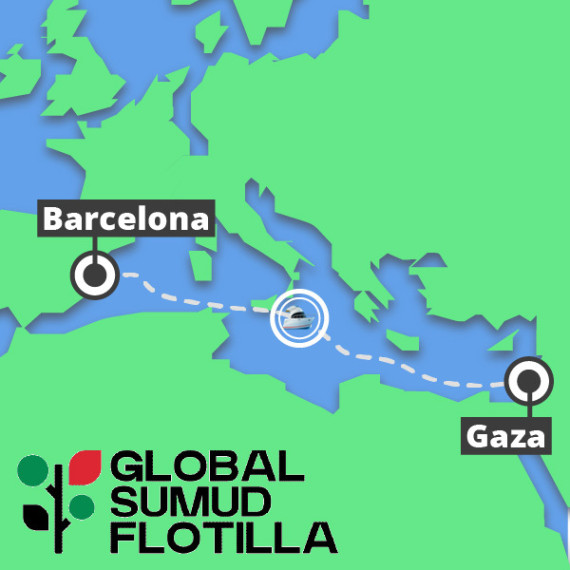
openDemocracy stands with the Global Sumud Flotilla as it sails to Gaza carrying vital medical and food supplies.
 
We will be tracking its progress every day in our newsletters, and sharing photos from its journey.
 
To find out more about the flotilla and see how you can get involved and support its efforts, click the button below.
Find out more about the flotilla here
 

Slavery behind prison walls

Behind the cover of prison walls, people are forced to work in unsafe conditions for little to no pay under the threat of further punishment, including the loss of family visits – a common antebellum punishment for disobedience. Incarcerated people toil on farms, fight wildfires, sew uniforms, clean public buildings, manufacture state furniture and more, all while being denied basic labour rights and protections.

Organising is reframed as rioting to justify violent retorts that demand obedience. Just as enslaved people were reduced to tools of labour, incarcerated people are treated as disposable assets of the state – valuable only to the extent that they demonstrate compliance and generate returns.

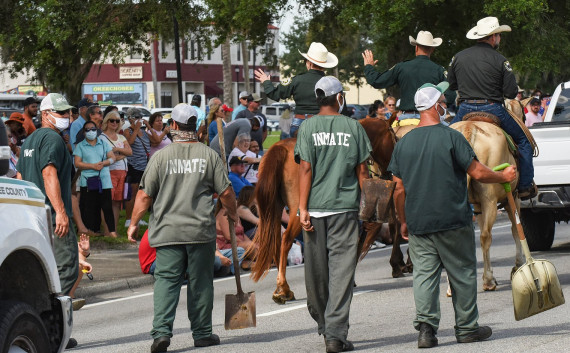
The language used throughout our carceral system reinforces these dynamics and pays homage to the system’s roots in slavery, intentionally. Uniforms read “Sheriff’s Inmate” and paperwork labels people “Property of the State”. Solitary confinement, another common punishment for refusing to work in prison, is commonly referred to by incarcerated people and staff alike as “the hole” or “the box” – both plantation-era references to similar punishments during chattel slavery.

Even when incarcerated people are paid for their labour, they typically earn less than a dollar per hour, rates that amount to a systemic theft of labour value. A recent cost-benefit analysis estimated that between $11.6 billion and $18.8 billion is stolen from incarcerated workers in wages every year. These stolen wages represent not only lost income for incarcerated individuals, but also lost support for their children, families, and communities – further entrenching financial instability, undermining rehabilitation, and perpetuating cycles of poverty and incarceration.

The human cost

The cost of this centuries-long institutional racism has been devastating to Black Americans. As detailed in a new report by FWD.us, We Can’t Afford It, incarceration is costing families with incarcerated loved ones almost $350 billion each year in lost earnings and new costs, like those for phone calls, commissary goods, and medical care.

 
Will you help defend democracy?
 
A world in turmoil needs fearless, independent investigative journalism that can overcome censorship and hold power to account. 
That’s the kind of media you deserve - and you can support it when you donate to openDemocracy today. When you give today, you can:
  • Keep openDemocracy free to read for everyone
  • Provide our team with the support they need to work safely in a dangerous world
  • Deliver the reporting that matters to you – and that reaches as many people as possible
Please support independent non-profit journalism by donating today.
Please donate now
 

Today, nearly 50% of adults in the US have had an immediate family member incarcerated. Among Black Americans, that number is even higher: 63% have had a family member imprisoned. Black families also spend two-and-a-half times more than white families supporting incarcerated loved ones. Little changes upon release, as the over 600,000 people that return home each year in the US often find themselves burdened with debt, stripped of income, and locked out of jobs and housing.

As a result, these families are routinely forced to choose between providing for their own basic needs and supporting incarcerated loved ones. Mothers, who often serve as the primary financial and emotional support system for families impacted by incarceration, go into debt trying to do both.

One in three families with an incarcerated loved one takes on debt to pay for calls and visits alone. Children suffer the fallout in the form of housing instability, food insecurity, and eventually lost parental guidance. Nearly half of Black children in the US have had a parent incarcerated – a figure that reflects deliberate state design and intergenerational economic warfare.

The long road to repair

To confront the unfinished business of abolition, Worth Rises launched the #EndTheException campaign, calling for an end to the exception in the 13th Amendment that has fuelled forced prison labour and mass incarceration more broadly since the formal abolition of chattel slavery. By demanding that the Constitution reflect a true and final end to slavery, #EndTheException lays the groundwork for broader reparative policies.

Repairing this most enduring form of racialised harm in the US requires more than acknowledgment; it demands redistribution. Reparations are the minimum, and a targeted basic income – regular, unconditional cash payments to people most impacted by incarceration – is an obvious and effective vehicle. These payments would represent a historic reversal, with public funds finally flowing into the hands of people whose wealth has been systematically stolen by state violence for generations.

The legacy of slavery cannot be separated from the institutions that followed it: convict leasing,

Redlining (the denial of services to specific neighbourhoods), Jim Crow segregation, and mass incarceration. These are not isolated chapters of history – they represent a continuous process of exploitation, extraction, and control.

Through that lens, it is easy to see that the carceral system is not broken, but functioning precisely as it was meticulously designed. Ending the exception in the 13th Amendment and providing a basic income to those impacted by it are two ways we can begin to stop and repair its harm, past and present.

 

COMMENTS

Sign in 💬

Our award-winning journalists can now respond directly to your comments underneath the articles on our site!

Just sign in or register underneath any of our articles to start leaving your thoughts and questions today.

Sign in and join the conversation

MORE FROM OPENDEMOCRACY

Weekly Newsletter
The Dark Arts
Beyond Trafficking and Slavery 
Bluesky Facebook X / Twitter Mastodon Instagram YouTube


openDemocracy, 18 Ashwin Street London, E8 3DL United Kingdom

Unsubscribe