If someone forwarded you this email you can subscribe. View in web browser.

Hi ,

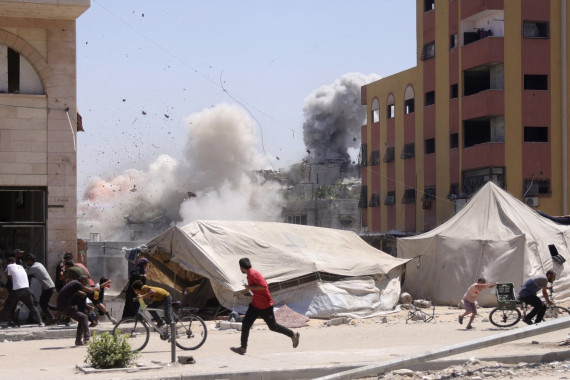
Every day in Gaza, the equivalent of a classroom of children is lost to starvation and violence. Since the war began in October 2023, just 80 children have been granted UK visas through humanitarian routes.

By comparison, more than 52,000 children from Ukraine arrived in the UK on emergency visas within the first 18 months of Russia’s invasion.

With famine now confirmed in Gaza, campaigners argue the government must go further than limited medical evacuations and urgently introduce a Gaza Family Visa Scheme.

Read the full opinion piece below.

- openDemocracy

 
EDITOR'S PICKS
 
1
Women working on UK farms report sexual harassment and financial insecurity

New paper reveals stark gender inequalities with the Seasonal Worker Scheme, which government recently renewed Read more...

2
PODCAST: What has Labour done for women? With Penny East

A year into the Labour government's tenure how have they lived up to their pledges to tackle misogyny and improve the lives of women across the country? Read more...

3
Government spends £8m compensating children sexually abused by British troops

Taxpayer payouts for historic child sex abuse paint ‘stark and worrying picture’ for Ministry of Defence, lawyers say Read more...


FEATURED STORY

The UK must introduce a Gaza Family Visa Scheme as it did with Ukraine

Amreen Qureshi

A classroom of children dies every day in Gaza. Twenty-eight children lost daily to starvation and violence. Yet since the war started in October 2023, only 80 children have been granted visas to come to the UK through humanitarian routes. By contrast, 52,900 children from Ukraine arrived in the UK on emergency visas in around the first 18 months after Russia’s invasion.

The UN confirmed last week what we have long known to be true: there is a famine in Gaza. The 320,000 children under the age of five in the territory are at risk of acute malnutrition, a crisis compounded by the collapse of essential services, water, electricity and healthcare.

UK prime minister Keir Starmer recently spoke about the “catastrophic failure of aid”, citing images of “starving babies [and] children too weak to stand”, which “will stay with us for a lifetime”. Yet his government’s actions so far barely scratch the surface of what is needed.

At the beginning of this month, ministers began drawing up plans to evacuate children from Gaza who are severely ill or injured and require urgent medical care. It is expected that a group of between 30 and 50 children will be evacuated in the coming weeks. While this is a welcome first step, a Gaza Family Visa Scheme should be next.

 
Will you help defend democracy?
 
A world in turmoil needs fearless, independent investigative journalism that can overcome censorship and hold power to account. 
That’s the kind of media you deserve - and you can support it when you donate to openDemocracy today. When you give today, you can:
  • Keep openDemocracy free to read for everyone
  • Provide our team with the support they need to work safely in a dangerous world
  • Deliver the reporting that matters to you – and that reaches as many people as possible
Please support independent non-profit journalism by donating today.
Please donate now
 

Under normal immigration rules, Gazan citizens would need to apply for a UK visa and submit biometric data in person at the British visa application centre in Gaza – a near impossible task since the building was destroyed and there are no functioning consular services in the territory. Extraordinary circumstances require extraordinary flexibility.

The UK has demonstrated flexibility in past crises. In 2014, the Vulnerable Persons Resettlement Scheme helped Syrians reunite with their families. Afghans evacuated during the Taliban takeover in 2021 were joined by immediate family through the Afghan Relocations and Assistance Policy and Afghan Citizens Resettlement Scheme, followed by the ‘Separated Family’ pathway last year. In 2022, the Ukrainian Family Scheme was launched within weeks of Russia’s invasion, bringing thousands of children and families to a safe route.

Given these very recent precedents, Gaza should not be an exception. We need a way for vulnerable Palestinians to reunite with relatives in the UK. Modelled on the Ukrainian Family Scheme, the scheme could simplify the application process by offering individuals options such as using an app to verify their identity or providing their biometrics upon arrival in the UK.

Campaigners have long called for such a scheme. It was first proposed by the Gaza Families Reunited campaign in April 2024, and support has since grown steadily. By June of this year, 67 peers and MPs across the political spectrum had signed a letter urging the government to allow Palestinians trapped in Gaza to join their relatives here safely.

 
Is MAGA a religion? Why has protest been criminalised in England and Wales? Who is profiting from anti-immigration sentiment? And how can we engage with young men who’ve fallen down the alt-right pipeline? 
 
These are just a few of the questions that we’ve put to leading thinkers, frontline activists, and global experts on our new podcast, In Solidarity, over the past six months.
 
In Solidarity is a podcast for people who understand that politics doesn’t just happen in the halls of power. Every show, we tackle a new theme to uncover how authoritarianism spreads, who is benefiting from fear, and how solidarity is evolving into resistance movements around the world.
 
To ensure you never miss an episode of In Solidarity, subscribe to get an email notification whenever a new one is released. 
Subscribe to episode notifications
 

The number of people coming to the UK under such a scheme would likely be manageable, given there are relatively few Palestinians in the UK to begin with, and only a small proportion of them will have immediate family in Gaza who are able and willing to travel.

Yet the impact would be profound, saving lives and offering hope in the face of ongoing devastation. As well as demonstrating diplomatic pressure and leadership, the UK can mitigate some of the suffering by creating a safe and controlled pathway, adjusting visa requirements, and ensuring a rapid, scalable scheme.

A classroom of children dying each day in Gaza is not just a statistic – it is a stark reminder of the urgent steps the government must take to respond to this humanitarian crisis. It is imperative for the UK to act decisively, especially as the war grinds on, with no end in sight.

While a visa scheme would not end the war or feed all of Gaza, every measure that could bring safety, sanctuary and hope to Gaza’s civilians is worth pursuing.

COMMENTS

Sign in 💬

Our award-winning journalists can now respond directly to your comments underneath the articles on our site!

Just sign in or register underneath any of our articles to start leaving your thoughts and questions today.

Sign in and join the conversation

MORE FROM OPENDEMOCRACY

Weekly Newsletter
The Dark Arts
Beyond Trafficking and Slavery 
 Facebook  X / Twitter  Linkedin  Instagram  Youtube


openDemocracy, 18 Ashwin Street London, E8 3DL United Kingdom

Unsubscribe