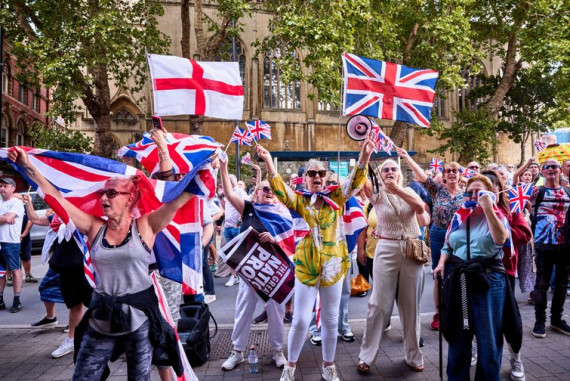
In the no-man’s land between the two protests, trapped between two lines of police, I bump into Priyanka Raval from the Bristol Cable. We decide to team up and cross the police line together, not an easy task when one officer refuses to let us pass despite our press cards. We keep an eye out for each other as we speak to the far right. That’s when the women start shouting.
“We don’t like immigration,” a woman with blonde hair and sunglasses says to me, when I ask why she is here.
Why not? I ask. She shakes her head. “Don’t get me started on that.” The chants start. “Send them back,” she shouts down a loudspeaker. “Who are you?”
“They’re rapists,” I hear another woman yell out. “They’re dirty rapists.”
Unlike the counter protest, which is a diverse crowd representative of Bristol’s community, the far right group is almost all-white. Most of the small crowd are middle-aged and older, but there are younger men and women taking part too. One woman has even brought her kids.
“I’m here to represent England and Bristol,” a teenage attendee tells me. He and his two friends are aged 14, 15 and 16, and carrying flags. “What they are doing is letting illegals in and it’s ruining England. They’re taking our rights away.”
“What rights?” I ask. He looks momentarily confused. “The rights to freedom, the rights to do what we want to do,” he says. “They’re invading our country.”
His words, once extreme, have now become part of the mainstream anti-migrant rhetoric: in 2022 the former Home Secretary Suella Braverman described the “migrant crisis” as an “invasion”. I’m about to ask a follow-up question, when an older man interrupts and asks where I work. “openDemocracy,” I say brightly. He turns to the teenager and warns him off talking to me. “The only good media is GB News,” he says. The teen looks a bit embarrassed, as if he has been caught out.
GB News is one of several media outlets that pushes misinformation and anti-migrant talking points. One of its star presenters is Reform UK’s leader Nigel Farage, who branded asylum-seeking people a “danger to our country.” But GB News is not alone. A report by the race equality think tank the Runnymede Trust found that “racist discourse from the highest levels of UK society, including politicians and the media, is used to frame immigration as an existential threat to the British way of life.”
Dr Hannah Ryan, from the University of Birmingham, says that “it is important to acknowledge the role of the British press in spreading sensationalist news stories based on anti-immigrant rhetoric. From the over-reporting of migration to the consistent use of the factually incorrect term ‘illegal asylum seeker’, the tabloid press in particular create the narrative of asylum seekers as problematic and threatening.” Media imagery, she told openDemocracy, “emphasises asylum seekers as dangerous others with a particular focus on men of colour who are represented as ‘breaking into Britain’.”
Media reporting and political quotes find its way onto social media, where the far right increasingly gets its information.
“I get all my news from X,” a young male protester tells me. “I’m not an idiot, I check things.” He’s keen to chat, hopping from one foot to the other with frustrated energy, his face often stiff with outrage at the chants and flags of the counter-protesters. “They’re communists!” he shouts, arms waving. It’s true that the Communist party has brought along a hammer and sickle flag.
He’s not racist, he insists. But “we're a tiny island in the North Atlantic. When is it going to be enough? We need to use the Navy to stop the boats. Not to hurt them. But to send them back.”
He’s the second person I speak to that day who insists that the Navy should be in the Channel to return small boats to France. Earlier, before the protest started in earnest, Priyanka and I approached a man who was livestreaming the event and is a regular at anti-migrant protests.
“I am tarred as a Nazi with a camera,” he says. All we have asked is what brought him here today. “I served in the British army in Germany so being called a Nazi and a racist and a fascist, it’s offensive. I’ve got opinions. I think we should stop the boats. [...] I would get the Navy to do the job they are supposed to do. Protecting our borders like they are supposed to do. The people on the boats would be turned back to France.” He stares at us, challenging us to react, to tell him the risks for an overcrowded dinghy meeting a huge gunboat. “Does that make me a racist? I don’t want them to come here anymore.”
A common enemy?
There is one thing both protests have in common: an anger with the current government and the broader political system. While the anti-migrant crowd chant “Keir Starmer is a wanker,” the counter-protest condemns Starmer’s Labour as “the enemy”, accusing the Prime Minister of enabling Reform and the rise of far right influencer Tommy Robinson.
Both sides are angry about homelessness, low productivity, unemployment, poor public services, long waits in the NHS. But while these issues have been caused by more than a decade of austerity under Conservative rule, and the financial crisis that preceded it, the far right has chosen to blame migrant people, claiming falsely that people seeking asylum are receiving preferential treatment and benefits, including by being housed in hotels.
“They arrive here and go straight into hotels and receive £49 per week,” a young man draped in a St George flag tells me. I politely correct him: asylum seeking people in hotels get £9.95 a week along with food. Far from luxurious, a 2022 report by the Borders Inspectorate found hotel food was directly attributing to nutrition related illnesses in migrant residents, such as diabetes and weight loss in babies and young children.
“We need to be looking after the homeless, the veterans, the drug addicts who are sick and need help,” he continues. “I’m protesting the atrocities of this government. Because British citizens should be their first priority. The asylum claims of the people on boats are false. They come here for financial reasons.”
In fact, between 2018 and 2024, the asylum grant rate for people who arrived by small boat was 68%, higher than the grant rate for all asylum applicants. The majority of small boat arrivals are from Iran, Afghanistan, Syria, Eritrea and Sudan, with almost all going on to be granted asylum due to the conflicts and oppression in their home countries.
The protester tells me he used to work in security in a hotel that was “closed so it could house migrants.”
“There was a hotel that had families and married couples with children, I don’t have a problem with them,” he explains. “It’s the fighting age males.”
You can read the rest of the article here.