If someone forwarded you this email you can subscribe. View in web browser.

Hi ,

Recent immigration enforcement policy changes under the Labour government focus less on irregular crossings and more on illegal work.

This change is partly due to the realisation that policing borders is politically and diplomatically complex. It is also due to the government’s emerging understanding that, despite public and media narratives around migration in the UK, the majority of migrants with some element of irregularity in their papers did not arrive via the Channel.

Often migrants with a legal right to be in the country but who have been denied the right to work will turn to exploitative delivery apps to earn cash, but the government is cracking down on this source of income too.

Read the full piece below.

- openDemocracy

 
EDITOR'S PICKS
 
1

Visa reform is the minimum owed to exploited care workers

The UK government’s failed rematching scheme shows ministers fundamentally misunderstand the reality of care work. Read more...

2

Exclusive: Watchdog probing Starmer aide’s secret lobbying of Tory ministers

openDemocracy findings on Varun Chandra’s activities at Hakluyt prompted official watchdog to launch investigation. Read more...

3
PODCAST: Planet Patriarchy with Rahila Gupta

Patriarchy stretches to every corner of the world. Rahila Gupta takes us from Riyadh and Russia to Rojava to spotlight the women who dare to resist. Read more...


FEATURED STORY

Delivery riders caught between algorithms and immigration raids

Nando Sigona and Stefano Piemontese

“The Home Office is everyone,” Ibrahim said, during a fleeting conversation outside a gathering point for delivery riders in Birmingham. Ibrahim is from Sudan. He originally entered the UK on a sponsored care worker visa, but lost his job shortly after when the Home Office revoked his sponsor’s authorisation.

A recent arrival with few contacts, and given just 60 days to find a new employer, Ibrahim was unable to maintain his visa. As a last resort, he applied for asylum and started working as a delivery rider, using the account of a registered rider.

Ibrahim’s story is not uncommon – we have heard several such stories while researching migrant drivers in the UK. But in recent weeks we’ve noticed that migrant workers have become less willing to talk about themselves. They are now more guarded when speaking to strangers, more reluctant to share their views, and increasingly concerned about who we are, what we’re researching, and for whom.

Recent policy changes under the Labour government are the source of this newfound hesitancy. From now on immigration enforcement will focus less on irregular crossings and more on illegal work. This change is partly due to the realisation that policing borders is politically and diplomatically complex. It is also due to the government’s emerging understanding that, despite public and media narratives around migration in the UK, the majority of migrants with some element of irregularity in their papers did not arrive via the Channel.

 
Will you help defend democracy?
 
A world in turmoil needs fearless, independent investigative journalism that can overcome censorship and hold power to account. 
That’s the kind of media you deserve - and you can support it when you donate to openDemocracy today. When you give today, you can:
  • Keep openDemocracy free to read for everyone
  • Provide our team with the support they need to work safely in a dangerous world
  • Deliver the reporting that matters to you – and that reaches as many people as possible
Please support independent non-profit journalism by donating today.
Please donate now
 

Ibrahim exemplifies this. He entered on a valid visa. Now that he has an open asylum application, he still has the legal right to be in this country. But he has no legal right to work.

The government appears to have understood that the conflation of groups has led to policy failures, most notably the prolonged concentration of enforcement resources at the UK’s geographical borders. This new policy is a course correction to restrengthen the hostile environment. As always, migrants will pay the price.

What makes a migrant irregular?

There are entrenched misconceptions in media and political discourseabout what constitutes irregular migration and who irregular migrants are. The line between regular and irregular migration is far more fluid and context-dependent than often assumed.

Entering a country without authorisation, like those crossing the English Channel or the Mediterranean Sea on unseaworthy vessels, does not automatically make a person an irregular migrant. If the person applies for asylum in the country of arrival, he or she will be legally resident while the asylum application is considered. Their right to stay will only be reviewed once a final decision on the asylum case is taken. Appealing a negative decision can further extend the process, and the right to stay of the applicant.

However, in the UK there is no automatic right to work for asylum seekers. Asylum seekers can request work authorisation only after their case has been in the adjudication process for over six months. A positive answer is not guaranteed. Asylum seekers without work authorisation are expected to survive on a weekly allowance of £49.18 to cover for food, clothes, toiletries and public transport.

Migrants arriving by other pathways can also fall from regularity into irregularity, sometimes very swiftly. This can be a consequence of overstaying a visa or breaching the terms and conditions of a visa. It can also happen for reasons entirely outside the migrant’s control, as Ibrahim experienced. Officials targeted his sponsor, not him, but his visa ended up as collateral damage.

The architecture of the post-Brexit immigration system has made the situation on the UK border even more fluid. It has introduced more short-term visas and raised the costs of visa renewal. It has also tied migrant workers more closely to specific sponsors, limiting or entirely removing the worker’s right to change employer or sponsor while in the country.

From ‘smash the gangs’ to ‘smash the workers’

In Birmingham, Labour’s war on illegal work is becoming increasingly visible on the ground. Freedom of Information data obtained from the Immigration Enforcement department show a marked increase in immigration raids since Labour came to office.

In the first nine months of the new government, 349 immigration raids were carried out in Birmingham, an increase of 79% from the previous nine-month period under the Tories (195 raids). These raids are unevenly distributed. Two postcode areas (B21 and B26), which include some of the most ethnically diverse and economically deprived parts of the city, have been particularly targeted.

Abetting this crackdown is a growing campaign against modified e-bikes. Here we see the convergence of a traditional right-wing anti-immigration stance with a more liberal-leaning concern for street safety and vehicle compliance. Police forces are being deployed to stop riders for bike checks, and they are verifying immigration statuses at the same time. If any irregularities are found, riders are referred to immigration enforcement.

 
Is MAGA a religion? Why has protest been criminalised in England and Wales? Who is profiting from anti-immigration sentiment? And how can we engage with young men who’ve fallen down the alt-right pipeline? 
 
These are just a few of the questions that we’ve put to leading thinkers, frontline activists, and global experts on our new podcast, In Solidarity, over the past six months.
 
In Solidarity is a podcast for people who understand that politics doesn’t just happen in the halls of power. Every show, we tackle a new theme to uncover how authoritarianism spreads, who is benefiting from fear, and how solidarity is evolving into resistance movements around the world.
 
To ensure you never miss an episode of In Solidarity, subscribe to get an email notification whenever a new one is released. 
Subscribe to episode notifications
 

Apart from the threat of referral, this ostensibly safety-related measure is also an oblique attack on hundreds of migrant livelihoods. Modified e-bikes that reach speeds well above the legal limit are now seen as a necessity by many in the delivery business, as falling per-delivery fees and other algorithmic tweaks have made it too difficult to earn a living on a regular bike.

As Benedito explained: “You can’t survive anymore with a normal bike. The distance between orders is bigger now. If you don’t use an e-bike, you’ll be too slow, and the app will give you fewer deliveries.”

Yet now this tool of the trade has become another immigration enforcement trap.

A hostile environment indeed

This government’s war on illegal work is making it harder for migrant workers to survive in the UK. But immigration raids and bike traps aren’t the only tools in its arsenal. Other, more longstanding policies that exclude migrants from safety and support remain at work as well.

E-bikes and motorbikes allow riders to cover longer distances and increase the number of deliveries. But they provide little protection, leaving riders vulnerable to abuse, theft and gang attacks during their shifts.

As our recent report shows, riders have few options when such incidents occur. Reporting thefts to the police is often futile and potentially risky. Interviewees feared that doing so could trigger checks on their immigration status.

Platforms, too, offer no protection. As Giovanna, a Brazilian delivery rider, explained: “I reported [a customer attack] to the company, but they said I was the one who treated the customer badly … even though it was them who mistreated me.” Another rider, Rayan, echoed this sense of abandonment: “If I get hurt, if something goes wrong, the company won’t do anything. They don’t even know I exist.”
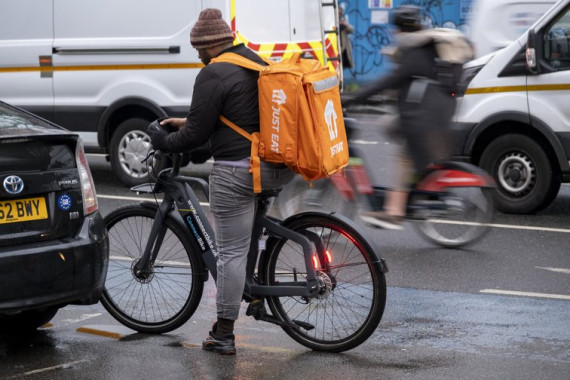

Account deactivation is frequent and can happen instantly, without explanation or recourse. As Guilherme, a Brazilian with settled status, put it: “You just disappear. The app stops giving you jobs, and you don’t know why.”

In this hostile environment, riders depend on each other. Gaetano explained: “The only help I got was from another migrant who told me how to appeal a platform ban. If it wasn’t for that, I would’ve lost everything.”

These informal solidarities are powerful, but also fragile and uneven. The consequences of immigration enforcement and algorithmic control extend well beyond the riders themselves, shaping family life, housing, health, and long-term aspirations.

Our research shows that the food delivery sector is no longer just a site of informal economic survival for precarious migrants. It has become a laboratory for a new mode of migration governance. In this hybrid regime, algorithmic control merges with immigration enforcement, producing a workforce that is as vulnerable as it is visible: highly surveilled and functionally expendable.

These developments reveal a troubling alignment between the UK’s hostile environment and the infrastructure of gig capitalism. Migrants are simultaneously legal enough to be used but not legal enough to be protected. Vulnerability is neither incidental nor accidental. It is produced, monetised, sustained, and now it’s getting worse. Labour has taken the baton from the Tories, and decided to run with it.

Note: All names have been changed to protect identities.

COMMENTS

Sign in 💬

Our award-winning journalists can now respond directly to your comments underneath the articles on our site!

Just sign in or register underneath any of our articles to start leaving your thoughts and questions today.

Sign in and join the conversation

MORE FROM OPENDEMOCRACY

Weekly Newsletter
The Dark Arts
Beyond Trafficking and Slavery 
 Facebook  X / Twitter  Linkedin  Instagram  Youtube


openDemocracy, 18 Ashwin Street London, E8 3DL United Kingdom

Unsubscribe