If someone forwarded you this email you can subscribe. View in web browser.

Hi ,

Critics demand that anti-trafficking organisations abandon rescue narratives. In today's main story Hannah Lewis discusses why they don't, and what a 'post-victim' anti-trafficking movement might look like. 

Find out more below.

- openDemocracy

 
EDITOR'S PICKS
 
1
Trump’s support of Israel’s war aims will scupper his hope of a Nobel prize

The US president is desperate for a peace prize. That doesn’t align with Netanyahu’s plans for ethnic cleansing in Gaza. Read more...

2
‘One in, one out’ Channel deal is just another cruel gimmick

Don’t be fooled by Labour’s show of providing safe migration routes. It’s justifying a cruel trade in people. Read more...

3
🎧 PODCAST: Who funds Nigel Farage's Reform UK - and why?

Reform claims to represent the working man, so why are its coffers being filled by 'the elite' it rallies against? Read more...


FEATURED STORY

Could anti-trafficking survive without victims to rescue?

Hannah Lewis

Rescuing ‘victims’ remains a core goal of many anti-trafficking organisations, and this requires a victim to be found. Each idea perpetuates the other: a victim needs rescue, and rescue requires a victim.

But searching for victims is far more problematic than one might think. Lives are messy, and many scholars and activists have argued that reducing people to victimhood strips them of their agency. It simplifies complex situations into sensationalist, racist and sexist tropes.

Some people experience severe exploitation. But how they ended up there, what prevents them from leaving, and what the best solution is for them going forward are all questions that cannot be satisfactorily answered with ‘they are victims’ or ‘they need rescue’. So why do many still rely on a narrative of victimhood to guide their ‘fight against modern slavery’?

We need to start by understanding why the concept of victimhood has endured for so long in modern slavery interventions despite its ability to cause damage. Then perhaps we can contribute to building better responses to severe exploitation, and to supporting the people impacted by it.

What’s wrong with victims?

Leveraging victimhood to mobilise resources around modern slavery has long been questioned on the grounds of both appropriateness and relevance.


WE RECOMMEND

Podcast: How to stop the arms trade

While the arms trade is vast and secretive, there is a groundswell of people across the world taking action to challenge its power, from the gates of arms factories to our highest courts.

Find out more from the latest New Internationalist Podcast - The World Unspun.

Listen to The World Unspun for FREE


Sensationalist images and language minimise human agency and dehumanise their subjects in order to evoke pity. They have a strong influence on the public and are a staple of the “spot the signs” campaigns found in airports and on shopping trolleys. But they also give a false impression of what exploitation looks like in a majority of cases.

As a result, such images have serious practical implications for identification, support and prosecution procedures, as they push stakeholders to expect extreme coercion or hapless victims. They also influence the kinds of people whom governments and donors are willing to support. In some cases, people exiting exploitation have been required to “tick boxes” demonstrating their victimhood in order to access support, creating barriers to recovery.


Dehumanising people as victims can also create an urgency that fuels saviourism. This closes down space for discussing potential safeguarding measures, legal advice around identification, or whether those being exploited would, in this instance, benefit from being rescued.

Take what happened to textile workers in Leicester, UK, where modern slavery investigations compelled suppliers to shift location in 2020 and hundreds of people lost their jobs. The investigations might have been well meaning, but they focused on identifying modern slavery rather than on why the workers were there or what their alternatives were.

They also left the use of exploitative business practices unexamined, omitting the fact that, in this economy, decent work in clothing factories is nearly impossible to achieve. The result? Hundreds of workers were left unprotected and jobless, and some ended up in even worse working conditions than before.

Sometimes rescue comes with public identification, which can lead to terrible outcomes. This can be personal, as when sex workers are outed to their communities, or legal, as when there is no firewall between the immigration authorities and support, employment, health or education environments.

In the UK, data-sharing agreements with the Home Office are held by nearly all bodies likely to encounter people who disclose severe exploitation. These include the NHS, the police, the Gangmasters and Labour Abuse Authority, educational institutions, banks and even the Salvation Army, a Christian charity contracted to deliver the government modern slavery victim care system.

People are routinely referred to the National Referral Mechanism (NRM), the UK’s system for identifying modern slavery cases, without understanding data sharing agreements with the Home Office and the subsequent risk of exposure to immigration enforcement and deportation.

Rejecting victimhood

While international legal frameworks and definitions still revolve around the term ‘victim’ (of human trafficking), efforts to engage alternative language and reject sensationalism have expanded globally. Civil society has led on these initiatives. Despite the risks of tokenism, the shift towards ‘survivor engagement’ entails a tangible shift in the dynamics of a sector challenged by whiteness and saviourism.

Many in civil society promote ‘survivor’ over ‘victim’ on the grounds that it conveys resilience and agency, in preference to ‘victim’. This new term has found its way into high-level guidance, such as in the Organisation for Security and Cooperation in Europe’s Code of Practice for Ensuring the Rights of Victims and Survivors of Human Trafficking.
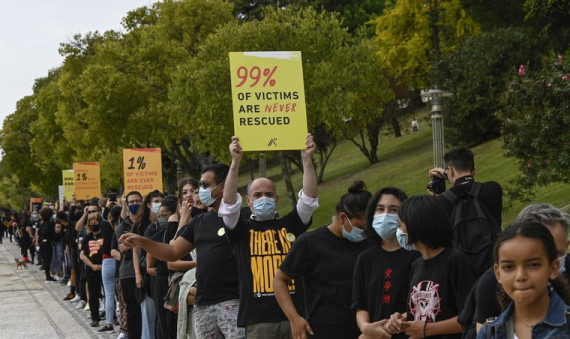

 

In 2018, the UK published the first Trafficking and Modern Slavery Survivor Care Standards to guide high quality care framed around empowerment of survivors. The Office for Victims of Crime in the USA are developing similar standards. Research into framing modern slavery and public perceptions highlights the need to evoke respect and empathy, not pity and sympathy. The gap in ethical guidance for faith-based organisations was also filled in 2025 with the publication of a global set of ethical guiding principles for anti-trafficking.

Freedom United are close to meeting their target of 30,000 individuals, companies and institutions who pledge to represent survivors with dignity. Unhidden, our collaborative photography project to produce alternative images of journeys into and out of modern slavery, was developed into content guidelines training with Freedom United, supporting uptake by UK anti-trafficking leaders.

Victimhood is politically and practically useful

Despite both sustained critique and efforts to shift how public communications, practice and policy depict and define modern slavery, the figure of the victim of human trafficking endures. The dyad of the exploiter and the victim is not only a powerful rhetorical device that adds weight to political statements against modern slavery. It also serves a practical purpose. It assists civil servants, authorities, and third sector advocates and activists to access and manage resources.

 
Will you help defend democracy?
 
A world in turmoil needs fearless, independent investigative journalism that can overcome censorship and hold power to account. 
That’s the kind of media you deserve - and you can support it when you donate to openDemocracy today. When you give today, you can:
  • Keep openDemocracy free to read for everyone
  • Provide our team with the support they need to work safely in a dangerous world
  • Deliver the reporting that matters to you – and that reaches as many people as possible
Please support independent non-profit journalism by donating today.
Please donate now
 

With colleagues, I conducted research from 2017 to 2020 in the UK, Spain and the Netherlands on faith-based responses to modern slavery. We found that frontline organisations acknowledge the problems associated with declaring people victims. They nevertheless deploy victimhood strategically to accomplish political influence, charitable giving or material outcomes for the people they support.

One faith-based organisation described using sensationalist and stereotypical descriptions of victims to evoke responses from donors as “just basic communications”. They went on to tell us:

I think these words are maybe – this might sound bad, but – more for funders and the general public to relate to the issue, as opposed to being for people in the field or professionals to understand what you do.

Another said:

It's just a more emotive word. I still use the word victim even though it [assumes powerlessness], when I need people coming on my side… and that's usually within the [local authority] housing team, or with benefits.

This advocate followed up by demonstrating how they understood the potential for the term ‘victim’ to have direct negative impacts, clarifying that they wouldn’t use it “in front of the client”.

One former CEO of a faith-based organisation delivering support as part of the NRM explained how government and media narratives denigrating ‘illegal migrants’ as undeserving produce a public perception of a “hierarchy of sympathy”. This may shape a “subconscious” prioritisation of protection interventions which they considered to be “more acute” among Christian groups:

… where a sexually exploited female, particularly if she was physically abducted is right at the top and then you move down. If you're just, oh well, I was a migrant fruit picker and they never paid me any wages, you're quite at the bottom actually. Well, that's almost an illegal immigrant, isn't it?

A manager in the same organisation noted the challenges of fundraising for their work with men, explaining: “put a man on the front of our magazine and our donations will drop”. This demonstrates how the perception of hierarchical victimhood is widespread in society, and the practical decisions fundraisers have to make to appeal to and thereby perpetuate the image of the ‘perfect victim’ to secure donations.

From people to victims, and back again

The pull of the dehumanised victim remains a powerful force across humanitarian and charitable interventions. In crowded political, policy and charity donor spaces, victimhood is a core tool in advocates and activists’ clamour for attention.

Each of these accounts indicate how and why the idea of the ‘victim’ endures in anti-trafficking, despite its problems. This endurance does not exist in a vacuum. At least in the UK, it must be seen within the context of struggling for resources in an austerity-era, corroded welfare state. Evoking victimhood helps to fight against the mistrust generated by prevailing anti-immigration politics and the criminalisation of young people to attract the attention of donors, who provide funds and basic welfare provision where the state does not.


A focus on a victim/exploiter dyad is also useful to states, who want to be seen as human rights protectors while also supporting the border violence and deregulated labour markets that allow severe exploitation to flourish. When civil society organisations describe using the word ‘victim’ as a matter of ‘basic communications’ or a fundraising necessity, they occlude their own complicity in these state imperatives.

Building better responses

So, where do we go from here? Is retreat to victimhood an uncomfortable necessity, as it – and only it – garners the attention and funding needed to enable any kind of political and policy response? Or are there other, more respectful ways to reach the same result? Are there already enough ethical guidelines, or is there still a gap that needs to be filled? In light of their pragmatic role in mobilising scant attention and resources, is it worth devoting our limited time and energy to relentlessly opposing dehumanising and sensational depictions of severe exploitation?

Anti-trafficking cannot commodify suffering without replicating exploitation. It therefore must remain a priority to abandon victimhood. A pragmatic, prevention-focused and effective response to severe exploitation requires building solidarities with the movements tackling complex causes.

The rejection of perpetuating hierarchies of suffering is not an optional extra. These hierarchies propel divisions which in turn produce and legitimise the grossly unequal social and legal positions that exploitation requires to function. Ongoing vigilance to actively shift away from simplistic, unrealistic and dehumanising binaries must be central to any human trafficking or modern slavery agenda.

 
Is MAGA a religion? Why has protest been criminalised in England and Wales? Who is profiting from anti-immigration sentiment? And how can we engage with young men who’ve fallen down the alt-right pipeline? 
 
These are just a few of the questions that we’ve put to leading thinkers, frontline activists, and global experts on our new podcast, In Solidarity, over the past six months.
 
In Solidarity is a podcast for people who understand that politics doesn’t just happen in the halls of power. Every show, we tackle a new theme to uncover how authoritarianism spreads, who is benefiting from fear, and how solidarity is evolving into resistance movements around the world.
 
To ensure you never miss an episode of In Solidarity, subscribe to get an email notification whenever a new one is released. 
Subscribe to episode notifications
 

There is plenty of help out there to do this. Key fields of social policy and international development intervention have developed thorough guidance for shifting away from externally-designed, misguided saviourism. Organisations, initiatives, state institutions and the public sector should put these to use, adopting and adapting such ethical guidance and principles for their own use. The extractive ‘poverty porn’ of 1980s charity communications must be fully consigned to the dust bin of bad ideas as part of the maturation of the sector.

This examination must be both outward- and inward-looking. Staff churn, the ongoing emergence of new initiatives and organisations, as well as the expansion of the modern slavery frame demand repeated engagement, staff training, and introspection to review practices, priorities and representation in written and visual communication.

This work must involve the respectful, meaningful and adequately-resourced involvement of people with experiences of severe exploitation. It’s true that some of these individuals may use the term ‘victim’ to describe themselves or to process what happened to them. It is certainly their right to do so. But organisations should not take such personal use as licence to make victim narratives the spiritual centre of their work or to impose the label on others.

Building real and acceptable alternatives by demanding decent work and livelihoods for all requires ambition and creativity. The alternatives to falling back on victimhood are inspiring, challenging and enriching. Embrace them, campaign on them, educate donors around them, and the financing will follow.


This blog has benefited from discussions with collaborators during three research and public engagement projects: Gwyneth Lonergan, Rebecca Murray, Emma Tomalin and Louise Waite (Faith Responses to Modern Slavery); Jeremy Abrahams, Lara Bundock, Amber Cagney, Rachel Mullan-Feroze and Minh Dang (Unhidden); and Joanna Ewart-James and Miriam Karmali (My Story, My Dignity Ethical Representations of Modern Slavery).

COMMENTS

Sign in 💬

Our award-winning journalists can now respond directly to your comments underneath the articles on our site!

Just sign in or register underneath any of our articles to start leaving your thoughts and questions today.

Sign in and join the conversation

MORE FROM OPENDEMOCRACY

Weekly Newsletter
The Dark Arts
Beyond Trafficking and Slavery 
 Facebook  X / Twitter  Linkedin  Instagram  Youtube


openDemocracy, 18 Ashwin Street London, E8 3DL United Kingdom

Unsubscribe