If someone forwarded you this email you can subscribe. View in web browser.

Hi ,

A Silicon Valley-style start-up called Enough is promising to be the "breathalyser of rape", can a tech approach to "deterring" sexual violence work?

Students in Bristol have found themselves surrounded by orange t-shirt clad volunteers representing the start-up, offering free DNA-testing kits to be used following a sexual assault. 

But there is concern from experts that the methodology of Enough puts victims at risk of “increased trauma”. 

Find out more below.

- openDemocracy

 
EDITOR'S PICKS
 
1
⚔️ We can't keep ignoring human trafficking in war

Human traffickers are rarely held accountable during or after conflict. This is dangerous for everyone. Read more...

2
✍️ OPINION: Why Israel won’t stick to any Trump-brokered ceasefire in Gaza or Iran

Horrific attacks on Gazan civilians this week confirm how far Binyamin Netanyahu is prepared to go to reach war aims Read more...

3
🎧 PODCAST: Who funds Nigel Farage's Reform UK - and why?

Reform claims to represent the working man, so why are its coffers being filled by 'the elite' it rallies against? Read more...


FEATURED STORY

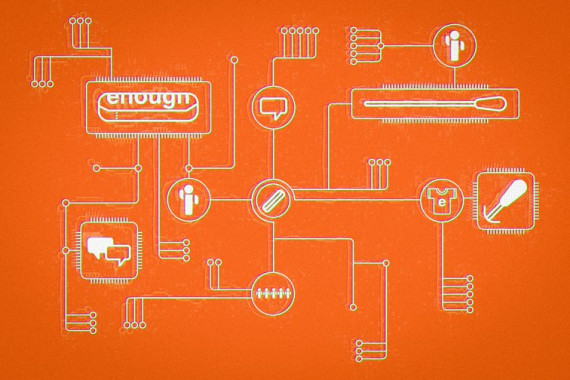
The Silicon Valley-style start-up targeting rape survivors at UK universities

Sian Norris & Lucy H Watson

It was a classic Silicon Valley success story. Katie White bumped into Tom Allchurch at a party and the pair started talking about an idea that would become their start-up. The year was 2023, and White was a 27-year-old brand consultant from Oxford, England, living in San Francisco. Allchurch, the father of one of her friends, was a highly successful English tech entrepreneur based in New York.

“Katie came straight out with the name, and it was [a] word-perfect explanation of the idea,” Allchurch subsequently recalled on an Instagram livestream. “And I looked at her and thought, oh my God, that is so brilliant. And it was pretty much at that moment that I just thought, well, this is going to work.”

Two years on and three thousands miles away, White’s idea is well underway. It’s a Wednesday night in Bristol, England, and small groups of young volunteers wearing bright orange T-shirts emblazoned with the word ‘Enough’ are heading out into the city’s thriving student nightlife to offer unsuspecting partygoers self-swab DIY rape kits.

The idea behind White and Allchurch’s not-for-profit is simple, and brimming with the earnest self-importance of tech evangelism that seeks to solve a social problem that has defied all other solutions. In this case, it’s the sexual violence epidemic in England and Wales, where the majority of victims never go to the police, and those who do get stuck in a cripplingly slow criminal justice system that delivers convictions on less than 2% of reported rapes.

 
Will you help defend democracy?
 
A world in turmoil needs fearless, independent investigative journalism that can overcome censorship and hold power to account. 
That’s the kind of media you deserve - and you can support it when you donate to openDemocracy today. When you give today, you can:
  • Keep openDemocracy free to read for everyone
  • Provide our team with the support they need to work safely in a dangerous world
  • Deliver the reporting that matters to you – and that reaches as many people as possible
Please support independent non-profit journalism by donating today.
Please donate now
 

What is needed, White and Allchurch believe, is a radical new offering that directly empowers individuals to take action, and then make social media content about it. Enter Enough, a self-described “revolutionary platform” that enables victims of sexual assault to self-administer DNA tests, anonymously share their experiences online, and access online ‘recovery’ resources (videos about managing trauma).

The premise is straightforward. The company is primarily aimed at students in Bristol, who can obtain free DNA-testing kits from Enough ‘ambassadors’ or at named local venues. This kit allows them to take a DNA swab following a sexual assault. They then complete an online form, where they are invited to write a description of the incident, and post their swab off to a lab, which will confirm if another person’s DNA is present in the sample. The sample and its results are then stored for 20 years.

The kits can also be bought from the Enough website for £20, and Allchurch has spoken of plans to sell them in pharmacies and on Amazon. Allchurch was previously Amazon’s vice-president of brand and growth in Europe, before going on to found and lead the US branch of HelloFresh, a tech start-up that delivers meal kits to consumers’ homes.

Enough’s DNA-testing kit, White told openDemocracy on a recent Zoom call, gives victims “the ability to confirm, simply and discreetly, that something bad happened to them and to confirm that this wasn't okay. To be able to say I'm putting it in a box, I'm retaining control and power and agency, are essential steps for recovery and moving forward.”

Once their existence is widely known, White added, these kits will act as an overwhelming social deterrence against rape, leading to behaviour change as would-be perpetrators think twice before assaulting their victims.

White told openDemocracy that while Enough always directs victims and survivors to report to the police or to a sexual assault referral centre (SARC) first, the company offers an “alternative to doing nothing” for those who don’t wish to go to the authorities. She added that Enough has “cracked something which the police and SARCs can benefit from” by creating the “breathalyser of rape”.

But is the best alternative to engage with a firm seeking to sell a solution to a social crisis? Enough is not just another online campaign pushing for new thinking on an old problem, it is a company seeking public funding and gathering and storing the sensitive personal information of vulnerable people. This cannot be overlooked when asking whether some interventions, even when sparked by the best of intentions, risk doing more harm than good.

Since launching in Bristol in September 2024, criticism of Enough has focused on doubts over whether the DNA kits’ results would be admissible as evidence in police investigations. Now, a months-long investigation by openDemocracy, reveals the concerns about Enough go far beyond such questions.

Young women approached by Enough’s orange-clad ambassadors told openDemocracy that they felt triggered, cornered, outnumbered and violated while making their way across Bristol’s university campuses, or while looking to have a night out with friends. Survivors who engaged with Enough and subsequently shared negative feedback on its approach said they weren’t listened to by the company.

Experts in the women’s sector are alarmed that Enough’s DNA kit could promote victim-blaming, that its online ‘reporting’ mechanism is not trauma-informed, and that its recovery resources are not safe. Many experts and young women we spoke with were afraid to speak on the record due to fears of legal threats from Enough. At least one organisation has received a cease and desist letter from a high-profile law firm acting on White and Allchurch’s behalf after it raised concerns about Enough’s approach.

Institutions in Bristol, including the city’s two universities and its police force, have written to the company expressing concerns with its approach in email exchanges obtained by openDemocracy via Freedom of Information laws. The emails allege the company is misrepresenting statistics and its relationships to authorities, while Enough’s responses are often fractious and borderline aggressive, accusing universities of stifling free speech.

No one we spoke to, aside from Enough and its ambassadors, could see how the company’s product will succeed in its aim of “deterring” rape, not least if perpetrators know that there are question marks over whether the self-swabs would be admissible in court..

“In many ways, self-swab rape kits are a metaphor for everything that is wrong with the system we currently have” said Ciara Bergman, CEO of Rape Crisis England and Wales.

The charity was one of the few that would go on the record to talk to openDemocracy about self-swab rape kits, with Bergman saying: “A lack of universally available and community based services, coupled with poor responses when sexual violence is known about or reported, means that audiences can be vulnerable to under-researched ideas which on a surface level may seem to make sense, but which may actually make things worse”.

Ultimately, there is the inescapable sense that Enough is subjecting vulnerable rape victims to Silicon Valley’s ‘move fast and break things’ playbook, or as White described it to us, a “hypothesis, and then pilot to test and learn” approach, or, as a student at University of Bristol put it, the use of rape victims as unwitting participants in a social experiment.

Bristol via New York and Nairobi

Allchurch and White have repeatedly described their idea as a “revolutionary”, never before tried solution to the crisis of rape. But Enough isn’t the first company to attempt to market self-swab DNA tests to survivors. It's not even the first such company that Allchurch has been involved in.

Before there was Enough, there was Leda Health. The firm, which sold an at-home alternative to hospital rape kits, was set up in the US in 2019 by Madison Campbell, then a 23-year-old former beauty queen and entrepreneur, who has since described sexual assault as a “multi-billion-dollar industry.”

Leda Health raised $9m from 15 investors, according to the Tracxn database, before floundering in a haze of cease and desist orders. In a February 2023 profile of the company published by The Cut, an American online magazine, ex-staffers described “a chaotic, often hostile environment where boundaries were nonexistent”.

The idea did have some supporters, though. An adviser to Leda Health, who had once been a VP at Amazon, told The Cut that Campbell’s idea was “far more ambitious, far crazier, and far less likely to work” than anything his former boss, Jeff Bezos, had ever come up with. The company, he added, had the disruptive potential of Elon Musk, who was “going to do more than any other human being on the planet to change climate”.

This Amazon-alumnus-turned-Leda-adviser was Allchurch. Three months after The Cut article was published, he would discuss a similar idea with White at a party, and the pair would go on to co-found Enough. Allchurch has previously spoken of how he was drawn to find new solutions to gender violence after a loved one was assaulted when in high school.

Allchurch may have been impressed by Leda Health, but the company’s success rate should worry Enough.

The Cut article reported that no Leda kit had been used to help support a prosecution or secure a rape conviction. Nine months after its publication, Pennsylvania’s attorney-general, Michelle Henry, sent Leda a cease and desist letter, saying: “These kits essentially offer false promises to consumers by misleading them to think evidence collected privately at home can result in a criminal conviction.” Similar letters were sent from attorney-generals in other states, including Maryland, Washington, and New York.

Leda Health finds no mention in any of Enough’s campaigns. The company does not appear on Allchurch’s LinkedIn page, and he did not mention it during an Instagram Live when sharing Enough’s origin story. Instead, he told viewers that launching a project like Enough in the US would be challenging due to Donald Trump’s opposition to women’s sexual and reproductive health and rights.

In a statement, Enough told openDemocracy: “Our team has been interested in the concept of self-testing for years and has tried to help others wherever possible. Tom has been supporting others who have tried, and we are grateful to the learnings from that. Leda is very different to Enough. Enough is a not-for-profit, the kit’s primary aim is social deterrence, Enough has leading digital mental health resources, social media and a student ambassador team power our impact.”

Like Leda in the US, Enough has faced pushback from authorities in the UK. Soon after the company launched in Bristol in September 2024, Avon and Somerset Police, which is responsible for the city’s policing, put out a statement saying that “self-swabbing kits may introduce evidential challenges during any criminal prosecution that follows”. This is because if a victim were to use an Enough kit soon after an assault, the swab could compromise any future criminal evidence collection.

This information is not printed on Enough’s kits, or in the accompanying leaflet. Instead, it is buried in Enough’s privacy policy, which admits the swabs could “have an impact on results from a subsequent forensic medical examination and will affect interpretation by a forensic scientist”.

Other authorities and experts have also expressed concerns with Enough’s product. The Faculty for Forensic and Legal Medicine wrote in a position paper in September 2024 that “we do not advocate the use of ‘self-swabbing’ kits”. White dismissed this in a “mythbusting” video on Instagram, saying: “Nowhere in the paper do they ban the use of self-testing DNA kits, which they could do if they actually oppose them”. The FFLM confirmed to openDemocracy that it does not have any powers to ban the kits, as it is not a regulator.

Rape Crisis England and Wales, meanwhile, published a statement warning that “any evidence gathered may not be legally admissible and self-swab kits can’t collect all the evidence that might be needed” to prosecute an attacker.

Enough’s own message on its kits’ admissibility in criminal cases has seemingly changed over time. The company initially said the self-swab DNA kits “would likely be admissible” in court – a message repeated by Allchurch in an Instagram Live at the start of this year. In the same livestream, White added: “Most of the time, for people who report to the police, an Enough kit will help them.”

Now, Enough says the kits “can” be admissible, stating in the FAQs on its website: “If a survivor will testify that an Enough sample was collected following the instructions then leading lawyers confirm it can be admissible. The kit was developed and made by the same people that make kits for the police.”

 
Is MAGA a religion? Why has protest been criminalised in England and Wales? Who is profiting from anti-immigration sentiment? And how can we engage with young men who’ve fallen down the alt-right pipeline? 
 
These are just a few of the questions that we’ve put to leading thinkers, frontline activists, and global experts on our new podcast, In Solidarity, over the past six months.
 
In Solidarity is a podcast for people who understand that politics doesn’t just happen in the halls of power. Every show, we tackle a new theme to uncover how authoritarianism spreads, who is benefiting from fear, and how solidarity is evolving into resistance movements around the world.
 
To ensure you never miss an episode of In Solidarity, subscribe to get an email notification whenever a new one is released. 
Subscribe to episode notifications
 

Enough sometimes claims that authorities and experts are opposed to its DNA-testing kits because they are so revolutionary that there is no “evidence base” for them. On other occasions, it says that research conducted in Kenya by the University of Leicester’s Lisa Smith is evidence that there is a precedent for self-swab kits.

While Smith praised Enough for raising awareness of sexual violence at universities, she told openDemocracy of concerns over this application of her research, saying: “There’s a big difference between our work and what Enough is offering.”

Smith explained that her project looked at how DNA evidence can be used to identify perpetrators of sexual violence in a scenario where they are more likely to be strangers and consent is not disputed. “At universities most rapes are committed by people known to the victims,” she said. “In those cases, DNA is not going to be useful because prosecution will hinge on proving lack of consent – not on the identity of the perpetrator.”

Another difference comes in the setting of the DNA testing. Enough’s model promotes tests that the survivor can take themselves, in their own home. Under Smith’s project, survivors are offered the option to self-administer the swab, but only in a healthcare setting under supervision. This is in order to protect the chain of custody, meaning the swabs could be admissible in criminal prosecution. The kits are not distributed outside of a clinical setting.

Smith described the Kenyan clinics in which the swabs are taken as “similar to” the UK’s Sexual Assault Referral Centres, where survivors can provide forensic evidence that is collected and stored in a safe and consensual setting. Survivors who attend SARCs can choose whether they want to involve the police – either immediately, or at a later stage.

‘Inviting in bad memories’

Enough’s model is built on the premise that everybody responds to traumatic events differently; some victims are open to going to the police or an SARC, while others might want to stay in the privacy and safety of their homes.

But when Lily* came across Enough during her second year at one of Bristol’s universities, she was troubled by what she saw as the company’s emphasis on allowing victims to “self-test discreetly”.

“They are promoting isolation,” she said, noting the contradiction of Enough’s brightly hued volunteers creating a highly visible campaign to nudge rape victims into the privacy of their homes.

“Why should women be forced to be discreet?” she added. “There is nothing to be ashamed of. There is absolutely nothing to be ashamed of, if this has happened to you. I couldn’t imagine after being raped, having to – to put it crudely – swab my vagina on my own. That is not something you should have to do on your own.”

Lily also felt uncomfortable with the idea of keeping a rape kit in her home, which she saw as undermining a safe space. “I saw the Enough campaign outside the university library and they handed me a rape kit, I didn’t want it! It was like they were inviting in bad memories.”

A survivor herself, Lily said: “What victims need is community. The female nurses at the SARC are kind, they spend their whole lives doing this work. They're professional, they're trained, they help you. I feel like that's what you need. I thought that rape kits would be really isolating.”

Lily had first become aware of Enough when saw a poster in a toilets asking “are you a survivor and do you want to help end rape?” and scanned the QR code to fill out an online form. “Katie White [then] called me,” Lily said. “She wanted me to tell her about my experience of sexual assault. I was confused because it was none of her business. Why did she need to know?”

Gathering victims’ testimonies (usually via an online form) and sharing them on social media is central to Enough’s approach, as White highlighted in her interview with openDemocracy. “We’re a campaign that is creating social deterrents through the presence of self-testing kits, yes,” she said, “but also through the anonymous testimonies that people are submitting that are shared thousands of times on social media, and through the wider conversation that we're starting.”

As with the kit, the effectiveness of online testimonies in deterring rape is not clear. Enough is not the first example of women sharing their experience of sexual violence online, and the mass outpouring prompted by MeToo has has not prevented rape.

An expert in sexual violence, who wished to remain anonymous due to Enough’s reputation for making legal threats, said that disclosing a traumatic experience such as assault for the first time in a setting that “isn’t supportive or trauma-informed can trigger overwhelming and distressing emotions”.

This can put victims at risk of “increased trauma, flashbacks and a sense of isolation”, they said. “If someone is posting a testimony online, we don’t know whether they’re safe, whether there are safeguarding concerns, or even if they’re over 18. This kind of open sharing, without support or control over where the information goes, is not trauma-informed.”

Enough acknowledges this lack of support in its Terms and Conditions, which say victims “may have a strong emotional reaction” to using its products but that they “expressly agree to assume all risks associated with your use of the services and not to hold Enough liable for any social, emotional, or legal consequences of such discoveries or encounters.”

Responding to these concerns over victims’ wellbeing, Enough told openDemocracy: “Our reporting and recovery are trauma-informed, and developed with the guidance of our Clinical Lead Dr Maisie Johnstone, who has written her PhD in recovery after sexual violence.”

Lily said she did not feel that White was empathetic to her as a rape survivor. “I told White that we already have rape kits, via the SARCs,” she said. “If you go to a SARC, no one is being charged for a kit. It's a free service. It doesn't cost the victim anything. The nurses do the tests in full forensic gear and it’s traumatic but they try to stop the trauma. They give you information and support. I didn’t understand why Katie wanted to talk about my assault and not about the SARC and rape kits.”

“I said to Katie, ‘you know,’” Lily said, “‘I don't think this is the right way to go about it.’”


The Faculty of Forensic and Legal Medicine also stressed the need to prevent further trauma for survivors. “We do not advocate the use of ‘self-swabbing’ kits because they do not provide the opportunity for holistic psychosocial, medical and forensic assessment of the individual,” it said in its report. It continued: “There is no evidence base that they are of benefit from a mental health perspective [...] they do not promote safeguarding of the vulnerable.”

Enough privately dismissed the FFLM’s report in emails sent to the University of Bristol, saying the faculty is in a “bubble”.

White and Enough ambassadors say their campaign has actually contributed to raising awareness of SARCs, and expressed desires for SARCs to collaborate with the campaign.

“The whole time I was at Bristol, I never saw any information about sexual violence services but that has changed since Enough,” said Ellie, who asked that we just use her first name, an Enough volunteer who has just completed her final year at the University of Bristol. “Now students know about the SARC and how to get help.”

Ellie believes victims need the alternative that Enough offers to the process usually followed in the criminal justice system. “After something horrible happens, not everyone wants to go to the police or the hospital. They want to feel safe in their home.”

Privacy advocates have also expressed concerns over the way in which Enough is handling victims’ DNA and testimonies.

Asked by openDemocracy to provide feedback on Enough’s data protection and privacy policy, London-based non-profit Privacy International said: “Where data is highly sensitive, as in this case, the obligation to be transparent is even greater. For us, compliance with data protection law is the baseline, not the benchmark – and in this case, neither the baseline nor any steps beyond it are clearly demonstrated.”

In response, Enough said: “Our policy was developed with help from DNA and non-profit experts. DNA belongs to the survivor, no one else has access. The data is only used for two functions only – for the survivor to gain clarity after the rape, and if they want supporting evidence for a later police report.”

The ‘multi-billion-dollar industry’

Two months after its launch in the city, Enough sent a slide deck pitch to the University of Bristol’s vice chancellor saying it had created a “credible deterrent” for rape on campus and asking for a £100,000 investment, adding: “100% of students at universities want Enough”. It did not cite any evidence to support its claims.

Enough’s pitch said that the £100,000 would provide free self-swab kits for every female fresher, as well as access to its free recovery resources. The company also solicited donations to a planned Enough charitable foundation.

The university did not invest. Instead, its lawyers accused Enough of “aggressively” marketing its product and “misleading” staff and students by implying that the company had its support, including by claiming the university’s chief operating officer was Enough’s “point of contact”.

The university has “no connection with your organisation and does not endorse or recommend your services and your products”, it wrote in an email on 6 January this year. It asked Enough to stop its approaches and its activities on campus.

Enough replied denying it had said it was endorsed by the university, saying: “We are obviously in contact with many people at the University. It would be strange if a University lawyer tried to suppress that free speech, especially given you have a leading criminology department (who have distributed our kits), and we are discussing how best to stop your students being raped.”

A month later, the university’s lawyers wrote: “We note that you continue to directly contact university staff despite the university’s request that you cease this form of direct advertising of your company’s products and services.” Enough replied: “We still live in a free country and we can talk to who we like.”

The same email from the University of Bristol raised concerns about the self-test kits’ admissibility in court, to which Enough responded: “Interesting email from you as a lawyer – I’m assuming you studied the rules of evidence? [...] I think you should show us some respect, and even thanks, for the work we are doing with your students.”

Enough faced similar difficulties at Bristol’s other university. The University of West England told the company to submit an external speaker form before visiting its campus, after Enough said “we will be distributing kits and raising awareness among students this week” in an email to UWE staff on 1 December 2024. Enough disputed the need to obtain permission, saying: “Your students wish to engage their fellow students on campus to offer them the opportunity to know about Enough [...] You appear to be in breach of your own freedom of speech policy.”

Months later, White and her ambassadors spent the day on a public roundabout that bordered the campus, but was not directly on its grounds. In an Instagram post at the time, Enough wrote: “On Tuesday morning we held an orange banner saying ‘Enough to end rape’ on the roundabout outside UWE. We brought the issue out into the open, something the university doesn’t want to do.”

Bristol’s universities have not only objected to Enough’s presence on their campuses, but the basis on which it justifies being there.

The company has frequently claimed that, every year, 500 people are raped at Bristol University, which has around 30,000 students, and 600 are raped at the University of West England, which has around 38,000 students. Both universities dispute these figures, which are extrapolated from a 2018 survey of 4,500 students at 153 universities across the UK, where 8% of respondents said they had been raped whilst at university.

In January this year, after the University of Bristol rejected the figure in its email to Enough, the company responded: “We have no issue if you dispute this number with journalists; however they will be focused on what you are actually doing about it, not whether it is 400, 500, or 600.” UWE, in a December email, requested Enough “remove social media content about the number of reported rapes at UWE Bristol which is defamatory and a negligent misstatement”.

White told openDemocracy she never expected the universities to collaborate with Enough. “At [the point of launching] Enough was an idea,” said White. “We believed it could work from the research we'd done talking to survivors, but it was a hypothesis. Universities make decisions based on risk, and it was all risk at that point.”

Other institutions have also sought to distance themselves from Enough. After White consulted with Avon and Somerset Police on how to direct victims to support in a crisis, the force accused Enough of seeking to “misrepresent” their relationship in a way that “is damaging”, according to an email reviewed by openDemocracy.

“Neither the Constabulary or the PCC’s [Police and Crime Commissioner] office have, at any time, provided agreement for you to present any statement quote or the use of our names as a way to support your campaign,” wrote chief constable Sarah Crew, asking the company to “immediately refrain from misquoting us”.

Enough told openDemocracy: “We did not misrepresent our relationship with the police or any other body. We accurately said that they had advised us. We are incredibly grateful for that advice.”

In April this year, Enough acknowledged that it is “less likely” to obtain funding from universities, according to a pitch document sent to openDemocracy by an anonymous source. The company signalled that it is instead now hoping for government funding for “three multi-year pilot programmes to evaluate Enough’s potential impact”.

These pilots, the document said, “could be funded by grants from government or from major foundations”, adding: “We would like to explore the potential participation of government departments within the proposed pilots.”

It continued: “We have so far spent only about £100k and could run Bristol (University of Bristol + University of West England) ongoing, for about £200k per year [...] Enough could run at the top 100 UK universities for less than £10m per year.”

Another slide deck used in a training webinar on student sexual health in summer 2025, states that Enough wants to “approach Home Office for funding.” When we asked the Home Office about its relationship with Enough, a spokesperson reiterated the government’s commitment to halving violence against women within a decade, and warned that it is important to be aware that self-swabs may not be admissible in court.

The company is also turning to another potential income stream: private brands. It is pitching a model in which a business pays Enough a “donation” to distribute free samples of its product alongside the rape kits. “Universities often charge brands £1,500+ for these activations,” the company said in a LinkedIn post advertising to businesses last month. “We’re simply asking for a suggested donation, 100% of which goes toward funding more kits for students.”

Enough confirmed to us in a statement: “​​The entirety of that money would go to kits. We have other fundraising channels for overheads.”

The ‘breathalyser of rape’

It is hard to argue against the motivations and intentions of White and Allchurch, or their company. There is a truly staggering epidemic of sexual violence in the UK, with an estimated 798,000 women raped and sexually assaulted each year in England and Wales, according to Cambridge Rape Crisis Centre.

But in its focus on DNA testing kits and supposed social deterrence through anonymous online reports, Enough has fallen into the usual Silicon Valley trap: the belief that one bright idea, prompted by a conversation at a party, could change the world with the right technology.

“An idea shouldn't fail because it doesn't have the infrastructure and financing to test it, it should fail if it’s a bad idea,” White told openDemocracy. In the same conversation, White returned to the idea that the only way to know if something works is to try. “There has to be a phase of learning, and asking what are the hypotheses? What are the risks associated with that? How can we most mitigate those risks?”

But rape victims cannot be used as guinea pigs as Enough incubates its idea; they are vulnerable and traumatised individuals who need to trust that the support being offered to them is in their best interests. And Enough’s support is made more difficult to trust because the company bears another key hallmark of tech start-ups: over-confident boasts of success.

By May 2025, six months after launching in Bristol, Enough announced it had created a “70% deterrence” of sexual assault in Bristol, on an Instagram post.The figure, Enough confirmed to us, was based on Instagram polls conducted by three student societies at the University of Bristol, who asked their followers if they knew about Enough, trusted Enough, and thought Enough had created a deterrence against sexual violence.

White told us that “about 250” people responded to the polls. Even if you assume that all of these people were current students, it would be a sample size of less than 1% of Bristol University’s total student population. In any case, students believing that a deterrence exists does not make that a reality. Even if one does exist, it is impossible to know whether this is because would-be abusers now know about the kits, or for any number of other reasons.

Enough also claimed that “50% of all rapes” are now being reported to its website. This fails to consider how many of the incidents reported are non-recent assaults, and how the “50%” is based on the disputed “500 rapes” annually on campus figure.

White told openDemocracy that Enough wants to do a proper evaluation of its impact – emails even show it approached UoB for support on this – but needs more investment to do so. But understanding this need for more thorough research hasn’t stopped the company from trotting out unscientific data to demonstrate impact to supporters, funders and investors.

White compares Enough’s approach to a “breathalyser”, which she says created a social deterrence to drink-driving. This fails to recognise that breathalysers are administered by police, protecting the chain of custody so the evidence of drink-driving can be used in a prosecution. Self swab kits do not achieve this. Breathalysers also prove a driver was drunk, while self-swab kits do not prove rape, only the presence of a second set of DNA.

“Violence against women and girls is an incredibly entrenched social problem and the known consequences for perpetrators have done little to prevent it. I’ve worked with perpetrators of all forms of abusive behaviour, including rape and sexual abuse specifically. Nobody has ever said to me that they wouldn’t have done what they did, had they known that being reported to the police were an option – they knew that to begin with,” said Rape Crisis’ Ciara Bergman.

“Whilst it may not be intended, the trouble with distributing and selling self-swab kits to survivors is it implies that to avoid or end rape, they are the ones who need to change their behaviour – by buying something or displaying it in their home. To us, that’s victim blame, which we reject.”

Bergman said she shared the pain and frustrations expressed by women that the criminal justice system and the police are failing them. “But our approach is to locate responsibility for rape with perpetrators, and to change existing systems so that they’re fit for purpose, rather than to try to replace them with unproven alternatives which could risk letting women down in their darkest hour”.

In a statement, Enough said: “Enough clearly communicates that an Enough report is the last resort and that the police and the SARC come first. To insist that everyone reports to either of those two is unethical and leaves five in six survivors unsupported.

“If a survivor decides to not report to a SARC/ the police, and makes a report to Enough, they will be signposted to two key pages: ‘Next Steps’ and ‘Crisis Information’. These were developed with the advice of Avon and Somerset Police. No reporting option can be everything to everyone. Enough is part of the solution, intended to support those who would have otherwise done nothing.”

But Lily, the student from Bristol who told White that she did not think the kits were the way to approach ending rape, believes Enough has missed an opportunity to make real change.

“We already have rape kits, we already have mechanisms in place,” she said. “They could have campaigned on the causes of rape. They could have started talking openly and honestly about misogyny in societies, the culture of sexual assault. Instead, they are selling rape kits.”
COMMENTS

Sign in 💬

Our award-winning journalists can now respond directly to your comments underneath the articles on our site!

Just sign in or register underneath any of our articles to start leaving your thoughts and questions today.

Sign in and join the conversation

MORE FROM OPENDEMOCRACY

Weekly Newsletter
The Dark Arts
Beyond Trafficking and Slavery 
 Facebook  X / Twitter  Linkedin  Instagram  Youtube


openDemocracy, 18 Ashwin Street London, E8 3DL United Kingdom

Unsubscribe