BTS: You said the far-right really started to focus on this post-2014. How has that activity evolved over the past decade?
Louise: In 2013-15, the Rochdale child sexual exploitation scandal had just played out in the courts and the Telford and Rotherham child sexual exploitation scandals were all over the headlines.
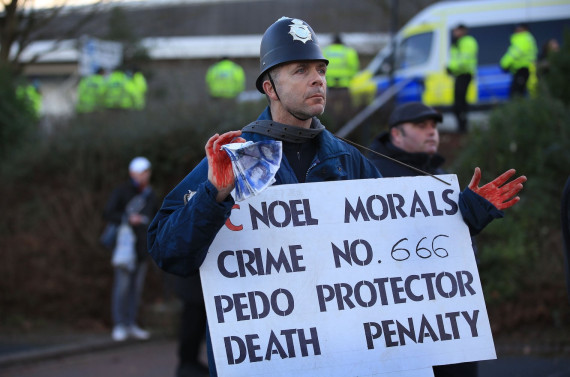
At this point a new line of messaging was emerging, namely that they knew and did nothing. ‘They’ was the councils, the police, other officials, and the left in general. The problem was perceived to be far, far greater than the perpetrators sitting in jail. They were just the visible tip of a supposedly vast cover up undertaken by people who feared inflaming community tensions.
The BNP started adding politicians to their visual messaging. One image I saw was of children in a box wrapped up like a Christmas present, with a little tag reading, “to grooming gangs”. The English Defence League staged a huge march in Rotherham in 2014. In 2017, a report from the Quilliam Foundation claimed that 84% of group-based CSE was committed by men with Asian heritage. This figure was quickly challenged by experts in the field, but it didn’t really matter. This really powerful idea was already out there and there was no pulling it back. Soon after, the Democratic Football Lads Alliance started unveiling massive banners about the apparent threat to women and girls from Islam.
And then there is Tommy Robinson. He used to lead the English Defence League, but by the mid-2010s he was pretty washed up. Then, in 2016, he joined the right-wing Canadian website Rebel Media as a journalist of sorts. He got himself arrested for filming outside sexual exploitation trials in Canterbury and Leeds, where, according to Guardian, he made “what a judge later described as ‘generically derogative’ remarks about the defendants’ ethnicity and religion while claiming that child sexual abuse had been covered up”.
These stunts brought Robinson back to stardom in far-right circles as a ‘truth teller’ and political prisoner valiantly standing up against the conspiracy. He did it brilliantly, manipulating a lot of people while making himself a good deal of money in the process. I’ve been told by so many people on the far-right that Robinson exposed the ‘grooming gangs’, and I’ve been asked how I can criticise a man who exposes grooming gangs? He didn’t actually expose anything – if anything he endangered the trials. But that reputation remains solid in certain circles, and shows again how CSE narratives can be effectively used to attack anyone who questions them.
It has continued to snowball, most recently with Elon Musk’s interventions earlier this year. As Andrew Gillingham presciently noted in a Telegraph column way back in 2011, “There could…hardly be a more emotive story than this. Sexual abuse! White girls! Pakistani men! Politically-correct establishment letting it all happen!”
BTS: What parts of the story do the far-right have to omit in order to keep the weapon sharp?
Louise: Brown girls, male victims, white perpetrators.
We know that paedophiles target those close to them – people who are accessible. Official reports acknowledge that there is likely massive underreporting from Muslim girls, but where is the outcry and promise of support for them?
Male victims also never seem to get mentioned, yet there’s every reason to think boys are victimised as well. Indeed, if we treated paedophilia rather than racialised paedophilia as the problem, Telford, Rochdale, Rotherham, and the Catholic church would all be mentioned in the same sentence and receive the same kind of attention.
Finally, the far-right never talks about its own problem with paedophilia and child abuse. Not all white perpetrators are on the far-right, of course. But there are enough documented examples that it should really be part of the conversation.
Robert Ewing, a self-described neo-Nazi, was found guilty in 2015 of murdering 15-year-old Paige Chivers. Elliot Jones, who was once incarcerated for attacking a mosque, and his brother tried to entrap and extort a paedophile online. They had dubbed themselves the “The Paedophile Squad”. Yet two years earlier, Jones himself had been convicted of trying to incite a child into sexual activity. Or Jack Denny, a former police sergeant and one-time candidate for Reform UK. He was dropped from the ballot when it was revealed that he had been convicted of possessing indecent images of children. The list goes on and on.
I think this is important to stress, as being ‘protectors of women and children’ is so core to their rhetoric. There are a lot of convicted child sex offenders in the ranks of the far-right. If they were truly so anti-paedophile, wouldn’t they be the first to expose and condemn their own? That’s the real cover up. They will not speak to it, at all. And if you speak to it, boy, do they come down on you.
BTS: What has been the response to this from both the state and civil society?
Louise: The response has been poor by just about everybody. In general, it’s been to not push back against the narrative.
Let’s state clearly that paedophilia exists in a fairly stable percentage – I think it's about 2% across every diverse group – so let’s look at this as a non-racialised issue of male violence and misogyny. This is something governments could do. They could say, “we care about all victims, so we're going to put more money into this. We're going to put more into helping victims, into helping people report, into educating the police, into educating local councils and local authorities.”
But what have they done instead? They've given into the far-right narrative at every turn. It makes it look like they’re guilty of what the far-right has always accused them of – covering it up. Now they’re throwing yet more money at it, rather than standing up and saying, “do you know how many enquiries there have been? Do you know how much work has been done on this? Yes, we want to do more, but let’s look at paedophilia as the problem rather than any racialised version of it, and go after all sorts in equal measure.”
The establishment is on the back foot and the far-right is on the front foot. That’s been the problem all the way through. It looks like no one cares. And what does the far-right do? What it always does – it comes in and hoovers up. Hoovers up those who are concerned and who want support.
BTS: I get how the far-right attracts people who feel really concerned about this issue. But how are they attracting those who want support as well?
Louise: Just by saying they care. If you feel like nobody cares and nobody's listening to you, and then someone comes along and says they do, you will pay attention to them. If you’re someone who still has to see your abusers on a daily basis, or you’ve felt judged by the authorities, and then suddenly a few people who seem very strong want to support you – that’s massively appealing, isn’t it? You may not be very political or right-wing yourself. But if they’re the only ones offering physical, financial and medical support, and a friendly ear, you will likely appreciate that. That’s how they open the door.
BTS: What about the left? What has their response been to CSE by multiple perpetrators?
Louise: The left in this country has never dealt with misogyny very well. Historically it grew up in opposition to the women’s movement, and that remains a problem now.
Far too many people on the left don’t see misogyny as a systemic or political issue. It’s easy – though wrong – to see how men treat women as a private matter that politics can’t possibly address.
You see this again and again. Groups will say they’re against racism, transphobia, homophobia, Islamophobia, ableism, and you will sit there and whisper: “say misogyny, say misogyny”. It gets left out, left to the feminists, left to women mostly. We all know where that leads. Women and ‘their’ issues get treated as an irritant, as divisive, #notallmen. The left’s inability to openly say it opposes misogyny is one of its failings. We are still far better on it, and on supporting CSE victims, than the right. But we need to make that much clearer.
BTS: Last month, the National Audit on Group-based Child Sexual Exploitation and Abuse was released by Louise Casey, a peer in the House of Lords. The prime minister has responded by saying he accepts the report’s recommendation to open a full national enquiry into “grooming gangs”. How do you assess this development? Does the report give us reasons for optimism, or do you think it steers the government in an unproductive direction?
The decision to commission a review that focused exclusively on group-based CSE was deeply problematic from the start. It suggests a hierarchy of abuse – that this is the most ‘important’, most serious, perhaps most common form of CSE.
Those starting limitations will create a severely blinkered result. Its analysis will ignore tragedies like the murder of 15-year-old Paige Chivers by a white EDL and BNP supporter. It will also ignore the millions of children abused in the most common way – by individual people they know. They won’t count, and the society and services that failed them will get away without so much as a sideways glance.
Instead, the parameters of the report will ensure that attention stays only on group-based CSE, and most likely only on group-based CSE committed by people who aren’t white. In this way, Casey’s recommendations actually make it more likely that future victims will be failed. The report is a showy, media-friendly, far right-appeasing sticking plaster on just one of many gaping wounds. It does not offer a pathway to a solution.
Addressing systemic misogyny and male violence, and properly funding struggling children’s services, might go some way to actually changing things and helping victims.
But we know that placing a disproportionate focus on perpetrator ethnicity only fuels dangerous stereotypes and stands in the way of justice. We know this from many experts, including the most important voices – those of survivors. They have told us they suffer more and struggle more to be believed when their own suffering doesn’t ‘fit’ a popular narrative of abuse that is being pushed.
Experts, including those with lived experience, academics, charities and organisations in the field, have already warned the home secretary that racialised, reductive depictions of CSE undermine and frustrate the response to it. Casey herself has made subsequent pleas for the issue not to be racialised, but it’s too late. This is exactly what the review has done.
BTS: Is CSE the far-right’s golden ticket?
Louise: I think they're increasingly settling on it, because it really is the golden bloody goose. We’re seeing them focusing on it more. It’s not just the nationalistic far-right anymore either – the evangelical far-right and what we might call the alt-right are also jumping on this train.
They’re doing it for all the reasons we’ve suggested. It’s eminently usable, applicable, adaptable – it just ticks all those boxes. Who's going to stand up and say, “I don't approve of you supporting victims?” Who's going to stand up and say, “I don't approve of your attacking paedophiles?” Anybody who does that will instantly get called a nonce apologist and a rape apologist. It’s bulletproof.
BTS: It does seem phenomenally hard to push back on. It seems like only victims and survivors could really make that message land. Some have tried, but that’s ended up pretty nasty, hasn’t it?
Louise: It's gotten very, very nasty. Asking those people to speak up is also ethically very dubious, so you have to hope that they will approach you. It makes you feel like crap even asking, but that’s still why I have my little lobby group Survivors Against Fascism. I try to get those voices out because absolutely no one else is going to be listened to. It’s the only way.
We can only fight fire with fire, and we can only take it to the battlefield they’ve set up. It's no good tinkering around the edges, obfuscating, arguing something like, “migrants contribute a lot to the economy”. It’s true but no one will hear it unless you also tackle this issue head on. You have to keep repeating, even though it should be obvious, “We abhor child sexual abuse; we support ALL victims!” The Left is already doing this, but it needs to be louder to be heard over far right lies.
We have plenty of victims on side with us, and it’s our job to absolutely protect them. They get attacked very quickly on social media when they start speaking out, and from there it can escalate. People say social media isn’t real life, but it bloody well is when they’ve got your address. We do our best, but society in general should be much better at protecting victims from the counterattacks. There’s a lot to be done.
BTS: Anything to add?
Louise: The effect of all this on both victims of paedophilia and the Muslim community has been disastrous. We need to help both, while at the same time showing that we care about stopping paedophilia – all of it.
Being abused can lead to lifelong issues, physical and mental. We need proper funding for programmes to support victims. And we need proper funding to fight misogyny and empower girls. We can’t help keep them safe without it.
And we need to show that the far-right are predators, not protectors. We need to evidence and talk about all the vile things they have said and done. Expose them, show the world what they’re really about. We also need to shine a light on how much money key figures in the far-right are making off of this. Show that they don’t actually care.
Above all we need to not abandon the field of victim care to the far-right. We should be ones holding victims' hands and throwing our arms around them, protecting them. We have done great work in this area and we are the ones that genuinely care, and who don’t seek to make money from it! But we need to make this clearer. We can’t be shy about showing that we – the opposition to the far-right – are, and always have been, the people standing up to protect the vulnerable in society. We can’t afford to let that be their thing. We have to make it clear that it is ours.