If someone forwarded you this email you can subscribe. View in web browser.

Hi ,

The situation between Israel and Iran is evolving at a rapid pace (even as we write this, the status of the ceasefire appears to be changing). Today's main story was written yesterday by our defence expert, Paul Rogers. Although the conflict is fast-moving, Paul's argument remains relevant this morning: global leaders have drawn lines in the sand, and there is no going back now. How will the US and the UK be affected by their involvement – both direct and tacit – in this conflict?

Read more below.

- openDemocracy

 
EDITOR'S PICKS
 
1
🔴 Israel vs Iran: fallout of a war [2010]
An Israeli assault on Iran’s nuclear and missile infrastructure and personnel would be far more extensive than many realise. The prospect that it will happen in the next few months is increasing.
Read more...
2
✍️ Iran’s nuclear deal reconsidered [2015]
Business delegations are flying in daily, making the most of this opportunity to establish themselves in Iran when Republican opposition to the deal is compromising US prospects at this critical early stage.
Read more...
3
🎧 PODCAST | A momentous day for reproductive rights
MPs voted to decriminalise abortion in England and Wales, what does this mean and what's next?
Read more...
 

FEATURED STORY

What next for Iran-Israel conflict after US strikes on nuclear facilities?

Paul Rogers

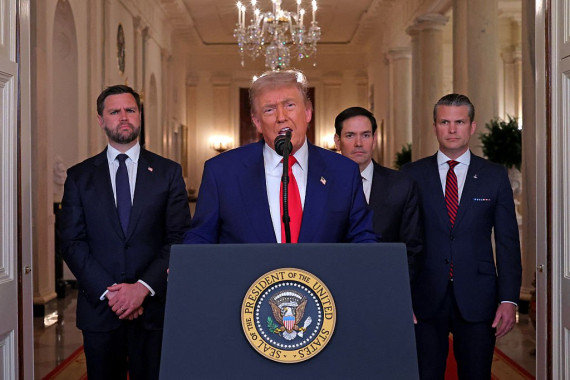
After yesterday’s US attack on Iran, US president Donald Trump was quick to report that the three nuclear sites at Esfahan, Natanz and Fordow had been “completely and totally obliterated”. Similar messages, using less sensational language, were issued by other parts of his administration.

Israel’s decision this morning to carry out a further strike on Fordow – Iran’s most important uranium enrichment facility – exposes that Trump’s claims of destroying the underground plant were likely untrue.

Even if the US and Israel do succeed in wiping out the facility, it is unlikely to put an end to Iran’s nuclear aims. Satellite imagery from Fordow, which has been released by a US defence contractor, appears to show many large cargo trucks leaving the facility in the days before the attacks, quite possibly to transfer enriched uranium to sites elsewhere in Iran.

In any case, the success (or not) of the strikes will make little difference to what happens next. The dominant impact will remain the political significance of Trump’s decision to attack; the US president cannot back down from this as the deed is done. He is instead embracing regime termination in Tehran, posting on Truth Social: “MAKE IRAN GREAT AGAIN”.

 
Is MAGA a religion? Why has protest been criminalised in England and Wales? Who is profiting from anti-immigration sentiment? And how can we engage with young men who’ve fallen down the alt-right pipeline? 
 
These are just a few of the questions that we’ve put to leading thinkers, frontline activists, and global experts on our new podcast, In Solidarity, over the past six months.
 
In Solidarity is a podcast for people who understand that politics doesn’t just happen in the halls of power. Every show, we tackle a new theme to uncover how authoritarianism spreads, who is benefiting from fear, and how solidarity is evolving into resistance movements around the world.
 
To ensure you never miss an episode of In Solidarity, subscribe to get an email notification whenever a new one is released. 
Subscribe to episode notifications
 

The key point here is that much of Trump’s behaviour is predicated on the act of winning. While he may feel that his decision to attack Iran looks good to him for now, it means that he has gone fully in with the war aims of Binyamin Netanyahu’s Israeli government. Any backtracking will be little short of disastrous for him.

Those war aims are highly relevant and were discussed in a column I wrote for openDemocracy three days ago. In summary, they are:

  • Removing the Palestinian population of Gaza and replacing them with Jewish settlers,
  • Annexing the occupied West Bank and encouraging the outward migration of Palestinians to Jordan while rapidly expanding Jewish settlements,
  • Removing any threats to Israel arising in neighbouring states, including Lebanon, Syria and Iraq, with persistent use of airpower; and
  • Completing the destruction of Iran’s nuclear ambitions and aiming for regime termination.

Trump cannot escape these, even more so if Iran responds to the strikes either by killing US troops in Jordan, Syria or elsewhere in the region, or closing the Strait of Hormuz, one of the world’s most critical oil chokepoints. Either action would demand a violent US response, further ensuring an escalation to the conflict with no end in sight.

Iran’s Parliament has already voted to close the Hormuz channel, through which around 20% of global oil supplies pass daily, according to its state media. The final decision now rests with the country’s Supreme National Security Council and its supreme leader, Ayatollah Ali Khamenei.

To make matters worse, Netanyahu is now so confident of his hold over Trump that he will use stronger force to ensure Israel’s security in surrounding states – meeting any notion of a threat from groups in Lebanon, Syria, Iraq, Yemen or elsewhere with air strikes – and allow the Israeli Defence Force (IDF) free rein in Iran. This is, after all, Netanyahu’s war.

Above all, Netanyahu will continue with his aim of clearing Gaza, where hundreds are being killed and far more wounded every week, as starvation forces people to seek food while risking being shot by IDF soldiers. He will also continue to seek ever greater control over the occupied West Bank, where life is becoming steadily worse as Israel’s lockdown of towns and villages expands.

For Trump, there is no going back from this, even though it may eventually lead to a change in the public mood domestically and even opposition from within his own party. If that becomes a problem for the US president, it will be far worse for those states where there is even greater opposition to the war, which have unwisely allied themselves with him and Netanyahu.

Of all of these, Keir Starmer’s Britain is the one to watch.
Will you help defend democracy?
 
A world in turmoil needs fearless, independent investigative journalism that can overcome censorship and hold power to account. 
That’s the kind of media you deserve - and you can support it when you donate to openDemocracy today. When you give today, you can:
  • Keep openDemocracy free to read for everyone
  • Provide our team with the support they need to work safely in a dangerous world
  • Deliver the reporting that matters to you – and that reaches as many people as possible
Please support independent non-profit journalism by donating today.
Please donate now
 

Starmer’s Labour government already has a very close relationship with Israel, as has been uncovered through dozens of reports from Declassified UK over the past 18 months. What’s more, much of that relationship links directly to the US.

As the war goes on, British government ministers will condemn Israel’s actions in Gaza while avoiding criticism of Trump. Ministers could certainly afford to be bolder as, in practice, Britain has minimal sway over Trump, let alone Netanyahu; yet even most backbench Labour MPs are unwilling to risk going against Starmer to go public with their concerns.

A rare exception is Clive Lewis, the backbench Labour MP for Norwich South, who wrote on X in the aftermath of the US strikes: “We are not making the world safer. We are making it infinitely more dangerous. And for Britain to so uncritically align itself with the actions of Donald Trump and Benjamin Netanyahu – two hard-right authoritarians with little respect for democracy or the international norms that sustain it – is not just morally indefensible.

“It’s a dangerous travesty that risks dragging us into wars we did not start, and whose consequences we will all have to bear.”

Lewis’s views are already more in tune with the national public mood than Starmer’s, and expect that to be even more the case as the war continues.

More than 20 years ago, another Labour prime minister was similarly out of kilter with the public mood. Tony Blair’s decision to send British troops to join the US war in Iraq tarnished his reputation. This time, and especially as Israel’s actions in Gaza become an even greater war crime, Starmer could lose not just his reputation, but his position as prime minister.


COMMENTS

Sign in 💬

Our award-winning journalists can now respond directly to your comments underneath the articles on our site!

Just sign in or register underneath any of our articles to start leaving your thoughts and questions today.

Sign in and join the conversation

MORE FROM OPENDEMOCRACY

Weekly Newsletter
The Dark Arts
Beyond Trafficking and Slavery 
 Facebook  X / Twitter  Linkedin  Instagram  Youtube


openDemocracy, 18 Ashwin Street London, E8 3DL United Kingdom

Unsubscribe