If someone forwarded you this email you can subscribe. View in web browser.

Hi ,

This morning, human rights organisation Liberty revealed that the Labour government has quietly dropped its legal battle to maintain strict anti-protest laws introduced by the Conservatives. openDemocracy’s senior investigative reporter, Sian Norris, sat down with Liberty lawyer Katy Watts last week to discuss the draconian laws on our podcast, In Solidarity, following her extensive investigation into the crackdown on protest in England and Wales.

Our main story today was written on 13 June 2025, hours after Israel launched its first strikes on Iran. The conflict has since escalated, with Iran firing missiles back into Tel Aviv and US president Donald Trump today dramatically cutting short his visit to the G7 summit to return to Washington to deal with the crisis. The fast-moving situation may have developed, but the crux of Paul Rogers’ argument – that we’ve been here before – remains unchanged.

Read more about their findings below.

- openDemocracy

 
EDITOR'S PICKS
 
1
🎧 PODCAST | Locked up: Protestors in prison

Protestors now face lengthy prison sentences for 'conspiring to cause disruption', we asked a human rights lawyer what this means for us all.

Read more...
2
🔎 How the UK’s ‘free speech’ government banned protest

Conservative ministers loudly championed free speech – right up until they outlawed it. Now, we’re all at risk Read more...

3
🔴 Law enforcement alone will never stop modern slavery

Reducing modern slavery isn't that hard, but getting governments to implement solutions is next to impossible Read more...


FEATURED STORY

20 years ago I warned that attacking Iran would not end well. That’s still true

Paul Rogers

As tensions rise between Iran and the United States and Israel, the US has this week announced that it is reducing staff numbers in its embassy in Iraq, while US defence secretary Pete Hegseth has authorised the voluntary departure of dependents of military personnel right across the Middle East.

Both moves came after the UN nuclear watchdog, the International Atomic Energy Agency, found Iran is not complying with its commitments to international nuclear safeguards. The agency’s resolution said that Tehran has failed to explain how uranium traces detected at undeclared sites came to be there and has not complied with inspections by its staff.

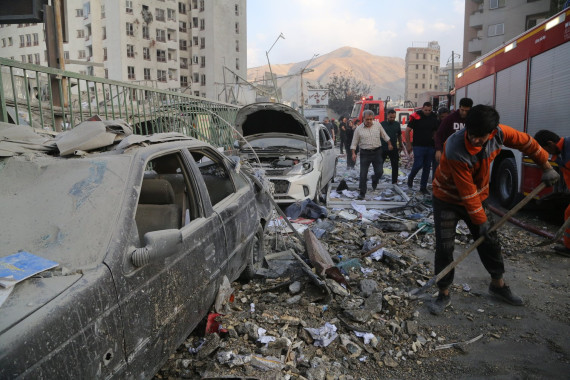
Binyamin Netanyahu’s government in Israel remains insistent that Iran is the main threat to the entire region. This morning (13 June), it launched strikes on Iran’s nuclear programme, having repeatedly warned it would do so unless Tehran backed down and observed its international obligations under the Non-Proliferation Treaty.

Israel’s attacks so far appear to have primarily targeted Iran’s uranium enrichment facilities and military commanders, although Iranian media is reporting some civilians have also been killed. US president Donald Trump, who previously said that any such actions by Israel would lead to “massive conflict”, has responded to the strikes by warning that “the next already planned attacks [will be] even more brutal” unless Iran makes a deal.

 
Will you help defend democracy?
 
A world in turmoil needs fearless, independent investigative journalism that can overcome censorship and hold power to account.

That’s the kind of media you deserve – and you can support it when you donate to openDemocracy today. When you give today, you can:

  • Keep openDemocracy free to read for everyone
  • Provide our team with the support they need to work safely in a dangerous world
  • Deliver the reporting that matters to you – and that reaches as many people as possible
Please support independent non-profit journalism by donating today.
 
Please donate now
 

We have been here before, many times. The winter of 2005-6 is one example, when then-US president George Bush was warning of the need for military action, not least as Iran was aiding rebels in the bitter war the US was fighting in Iraq.

An analysis that I published at the time for the Oxford Research Group, Iran: Consequences of a War, highlighted the multiple risks of any military attack by the US aimed at setting back Iran’s nuclear ambitions.

While I agreed that Iran’s nuclear and missile programmes could be seriously damaged in the short term, I concluded that a key Iranian response:

“…would be a determination to reconstruct a nuclear programme and develop it rapidly into a nuclear weapons capability, with this accompanied by withdrawal from the Non-Proliferation Treaty. This would require further attacks. A military operation against Iran would not, therefore, be a short-term matter but would set in motion a complex and long-lasting confrontation. It follows that military action should be firmly ruled out and alternative strategies developed.”

In the end, the US decided against an attack on Iran. But now, with the Israeli assault underway, has the situation changed substantially in the past couple of decades? Or will Iran’s response to Israel’s latest attacks be the same as I predicted in 2006, leading to a long, drawn-out confrontation?

It’s worth considering that the Oxford Research Group report was written in the context of a potential attack by the US, not Israel. While Israel’s conduct in Gaza is making it an international pariah, in terms of a conflict with Iran, it is in a stronger position than the US was in 2006.

Back then, Iranian-backed militias were becoming more significant in the Iraq War and Hezbollah was stronger than it is today in southern Lebanon. Both were more likely to intervene in the case of a US attack than they are today. And in the present day, Iran’s air defences have been weakened by recent Israeli air strikes, and Iran’s domestic economy is struggling against extensive US-led sanctions and its government is unlikely to be able to spend as much on counter-attacks against Iran as it would like.

It’s true that the Houthis in Yemen are causing some problems for Israel as they support the Palestinians in Gaza and the West Bank by launching missiles against Israeli territory. But Netanyahu knows full well that if Houthis took any seriously damaging response to Israeli actions in Iran, the US and the UK would react by stepping up their anti-Houthi air strikes in support of Israel.

There is one major uncertainty for Israel, though: whether Iran really has been able to construct the most important parts of its nuclear programme sufficiently deep underground to protect them from an Israeli air attack. So far, a spokesperson for Iran’s Atomic Energy Organisation has said that the majority of the damage from Israeli air strikes targeting its underground Natanz uranium enrichment facility has been at surface level.

Whether this continues to be the case may be determined by whether the US decides to supply the Israeli Defence Forces with its most powerful “bunker-busting” bombs or even join Israel in the conflict.

Israel’s primary aim will be to set back the Iranian nuclear ambitions for as long as possible, preferably up to five or even ten years. That goes far beyond damaging the core physical elements of the programme to destroying the knowledge base of Iran’s nuclear ambitions.

As such, Israel will be planning to kill the people who make up the programme, from senior scientists and engineers right through to young technicians and even the people who train them. That plan is already underway, and will also involve attacking any government facility directly or even indirectly involved with the nuclear programme, including the university and college staff who would train the new generations of nuclear industry workers needed to replace those killed.

Beyond that, Iran may attempt to close the Straits of Hormuz between the Persian Gulf and the Gulf of Oman and also damage oil and gas production facilities in the region, aiming to cause substantial increases in energy prices. One factor that is often overlooked is that 20 years ago, the US was substantially dependent on imported energy supplies. That has changed in the past two decades, as it has increased its reliance on oil and gas by much more use of fracking. Even as the world faces uncertain times, this will make it easier for the US to remain firm in its support for Israel.

The Israeli prime minister has made it abundantly clear that these first attacks are just an initial step in what will be a long operation. As my ORG report from 2006 put it: “A military operation against Iran would not, therefore, be a short-term matter but would set in motion a complex and long-lasting confrontation.” That remains the case as much now as it did then.
 

MORE FROM OPENDEMOCRACY

Weekly Newsletter
The Dark Arts
Beyond Trafficking and Slavery 
 Facebook  X / Twitter  Linkedin  Instagram  Youtube


openDemocracy, 18 Ashwin Street London, E8 3DL United Kingdom

Unsubscribe